Sunday, June 22, 2014

Scanfest is Coming!


The June 2014 Scanfest will take place here at AnceStories this coming Sunday, June 29th, from 11 AM to 2 PM, Pacific Daylight Time.
 
What is Scanfest? It's a time when geneabloggers, family historians, and family archivists meet online here at this blog to chat while they scan their precious family document and photos. Why? Because, quite honestly, scanning is time-consuming and boring!

Scanfest is a great time to "meet" other genealogists, ask questions about scanning and preservation, and get the kick in the pants we all need on starting those massive scanning projects that just seem too overwhelming to begin.

To get started, you need to know the basics about scanning:

1. Don't use commercial glass cleaners (i.e. Windex) or paper towels to clean your scanner's glass plate. Use a soft, clean cloth, preferably microfiber. If you must use a liquid, use water sprayed directly onto the cloth  and make sure to let the plate dry thoroughly before placing photos or documents on it.

2. Wear cotton gloves (available at many art and/or photography supply shops) when handling photos and old documents.

3. Don't slide the photos around on the glass plate. Place them exactly where you want them. Photos should NEVER be scanned by a scanner that feeds the document through the machine, but ALWAYS on a flat-bed scanner.

4. Set your scanner to scan at no smaller than 300 dpi (dots per inch). Many experts recommend 600 dpi for photographs.

5. Photographs should ALWAYS be scanned and saved as .tif files. Use "Save As" to reformat the .tif file to a .jpg file for restoration and touchups, emailing, or uploading to an online photo album. ALWAYS retain the original scan as a .tif file.

6. Documents can be scanned as .pdf files or .tif files.

7. When you are done scanning your photos, don't put them back in those nasty "magnetic" photo albums. Place them in archival safe albums or boxes found at websites such as Archival Products or Archival Suppliers. Do NOT store any newsprint (articles, obituaries, etc.) with the photos. The acid from the newspaper will eventually destroy the photograph.

Now about the chatting part of Scanfest:

We will be using Blyve, a live blogging platform that you access right here at AnceStories. On Sunday at 11 AM, PDT, come right here to AnceStories and you'll see the Blyve live blog/forum in the top post. It's not really a "chat room," per se, it's more like a live forum and anyone visiting this site can read and see what is happening in the forum.

You will not need to download any software.

We look forward to having you participate with us!


Pin It

Tuesday, June 17, 2014

Tuesday's Tip: Looking at Divorce Records

Image from Microsoft Clip Art

Recently, Ancestry released a database titled "Michigan Divorce Records, 1897-1952".(Images are only available for records from 1897 through 1938; the rest is a transcribed index.) To say I was in genealogy heaven is an understatement! I have several direct ancestors and some collateral relatives who divorced during this time period in Michigan. Several of those direct ancestors married and divorced multiple times, which makes unearthing all their marriage and divorce records fascinating!

I'm no expert on divorce records, but I have had the opportunity to obtain and analyze a variety of them for a number of my ancestors. I'd like to share a few tips that I've discovered. If you have any of your own, please feel free to post them in the comments below.

1) Learn about the divorce laws in existence at the time and place your ancestors lived. Red Book: American State, County & Town Resources, The Source: A Guidebook Of American Genealogy, and
The Handybook for Genealogists: United States of America are all classic U.S. resources available at most public and genealogical libraries. The Red Book is also available on Ancestry's Wiki, for free.

2) Understand that there really were more divorces in the past than we realize or would like to admit. This ties into Tips 5 and 8. While statistically, the percentages were much lower than today, much of that was due not just to societal norms and religious frownings upon divorce, but to the fact that the laws really discouraged--and in some cases completely prohibited--divorce. People were not more saintly in the past than they are in the present. Remember that in the big picture of history, women were considered little more than the property of their fathers or husbands. It could be very difficult, socially, legally, and financially for a woman to show just cause for divorce, such as adultery, drunkenness, non-support, and physical abuse. It was much easier for a man to divorce his wife than the reverse. However, women DID divorce their husbands successfully and the records prevail to prove this.

3) There are many divorce records and indexes online. Joe Beine, the webmaster of DeathIndexes.com has a great list of divorce records (mixed with marriage and birth records) here. Cyndi's List has multiple categories under "Marriages & Divorces" to help you find records online and offline, as well as articles and guides for those who are new to divorce research. Don't forget to check out online newspapers for legal notices, gossip columns, and local news items mentioning a pending or completed divorce.

4) There are even more divorce records and indexes OFFline. Categorize this under "Not everything is on the Internet, nor will it all eventually get there." For very early divorces, generally before the mid-1800s, check the state's records, especially indexes of the state congressional journals for dissolutions of marriage, divorces, private acts, or the couple's surname. Otherwise, check with the state's Department of Vital Statistics and the county's civil court records. An essential resource is Christine Rose's Courthouse Research for Family Historians: Your Guide to Genealogical Treasures. Chapter 9, "Civil and Criminal Court," is especially helpful. Offline newspapers (microfilmed or archived hard copies) are also a good resource.

5) Compare marriage dates to divorce dates and check out EVERY marriage and divorce for EVERY partner. This gets complicated when you have an individual who married and divorced multiple times, because it's likely that most of their partners also did so. You could have a good dozen marriages and divorces that spin off from your original divorced ancestral couple. It always amazes me how soon after a divorce was granted that a person turned around and remarried someone else. Obviously, they were just waiting for that divorce decree to come through so they could marry their next victim partner.

6) Realize that everyone who got "married" may not have because they couldn't/didn't get a divorce from their last partner. I'm currently looking at an ancestor who purportedly was married four times. The first marriage, to my ancestor, ended with his death at a young age. My female ancestor then married a second time, but divorced that husband. She married a third time, but I am unable to find a divorce record for that couple. She then supposedly married her fourth husband in 1922. Interestingly enough, I can't find a divorce record for her fourth "husband" and his last known spouse, his second wife. My female ancestor and her fourth "husband" are found living with one of her sons in the 1930 census, and another one of her sons in the 1940 census. In both cases, the fourth "husband" is listed as "widowed" and a "boarder," while my female ancestor is also listed as "widowed" and is enumerated with her first husband's surname, and not her "husband's." At this point, I truly believe my female ancestor and her fourth "husband" never were legally married, although her death certificate and tombstone give his surname as her last name. P.S. In many census records, divorced people were listed as "widowed," or "married" but living separately from their spouses.

7) Check out "annulments." A brother of one of my direct ancestors was said to have had an annulment before he married his wife, with whom he had a long and happy marriage. Interestingly enough, that "annulment" shows up in an online divorce database, without images. Until I can get my hands on a copy of the actual record, I'm not certain it really was an annulment. Regardless, check divorce databases and indexes, as annulments may be listed with them.

8) Run EVERYONE's name in that time period and place through the divorce database or a printed index. I guarantee you will come across some surprises. Use the handy "find" or "search" features of your genealogy database to generate a list of these individuals.

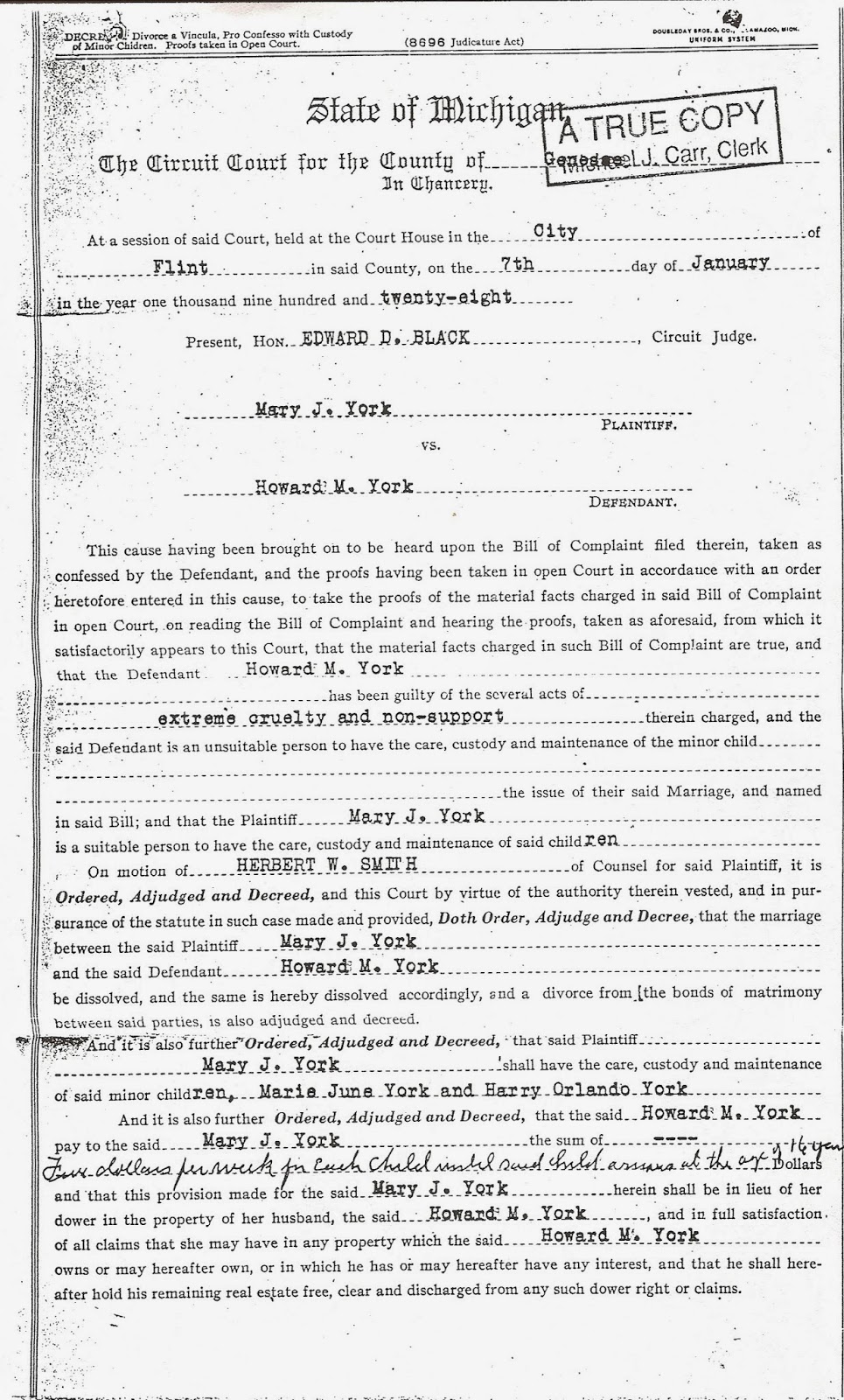
9) There is more than one kind of divorce record. As with any genealogical event, the more records you find for it, the better idea you'll have of the big picture. For example, I have the following photocopy of the divorce decree for my great-grandparents, Howard Merkel and Mary Jane (BARBER) YORK that I obtained from the Genesee County, Michigan Clerk:

Click on any of the following images to enlarge:

Genesee County, Michigan Circuit Court File no. 15759, Liber 6 of Chancery Decrees, p. 604, Mary J. York vs. Howard M. York, "Decree for Divorce," 7 January 1928; County Clerk's Office, Flint Township.

I also have the following state copy, as found on Ancestry's  "Michigan Divorce Records, 1897-1952":

"Michigan, Divorce Records, 1897-1952," online database with images for 1897 - 1938 only, Ancestry.com (http://www.ancestry.com : accessed 12 June 2014), Howard M. and Mary J. York; citing Michigan Divorce Records, Department of Health, Bureau of Records and Statistics, Lansing, Michigan.

Finally, here is a copy of a divorce return for Mary Jane's mother, Mary Jane (FREDENBURG) SMITH, also found on Ancestry's  "Michigan Divorce Records, 1897-1952" (record 2714):

"Michigan, Divorce Records, 1897-1952," online database with images for 1897 - 1938 only, Ancestry.com (http://www.ancestry.com : accessed 12 June 2014), Entry for John and Mary Darby, Rec. no. 2714; citing Michigan Divorce Records, Department of Health, Bureau of Records and Statistics, Lansing, Michigan.

At one time, I attempted to order a divorce record for another ancestral couple, James L. and Mary E. "Mae" (McARTHUR) YORK, parents of Howard YORK in the first example, above. All I received was the following court clerk's file index or case index. Craig Manson helped me work this document out (I have since discovered their marriage date and location, and just this week found their return in Ancestry's "Michigan Divorce Records, 1897-1952"!):

Genesee County, Michigan Circuit Court Clerk File Index (unknown volume,) p. 302, referencing file no. 4299,  James L. York vs. Mary E. York, "Bill for Divorce, " 21 March through 9 July 1928; County Clerk's Office, Flint Township.

Finally, I obtained a 12-page document from the Superior Court of Grand Rapids, Michigan in Chancery for my maternal grandfather's divorce from his first wife. I won't post the images here, but it was a wealth of information including the official Bill of Complaint of the first wife, sworn testimony of the first wife as well as her mother's, and the detailed order with a Dower Clause and custody order for their child.

In all these documents, take time to check the details, especially the date and location of the marriage (which I have found to be slightly off or quite incorrect in a small percentage of the cases I've examined), the number of children they may have had (which should lead you to custody information), and mentions of property (leading to deeds, sales, and other court records).

10) People lie in divorce proceedings, or omit/withhold important information to their own advantage. I know this comes as a great shock to you that your ancestors could actually make false statements or accusations against their spouses, or that they might not state all their activities if it made them look bad. So if you get a transcript of the proceedings, read them with the knowledge that not everything that was stated actually was true, or that there might be some important details left out.

11) Get familiar with terminology. When I first read the term "extreme cruelty" years ago in Howard and Mary Jane York's divorce decree, I assumed Howard had been horrendously and physically abusive to Mary Jane. However, as I have analyzed records over the years, I have come to realize that "extreme cruelty" generally means physical or mental harm and in many of the cases I've analyzed, it was related to accusations of adultery where one spouse purportedly flaunted their unfaithfulness or it was generally known by the community. "Next friend" is another term I have seen, which means another person stood in for the plaintiff or defendant because that person either was a minor or incompetent. In both cases I've seen, the "next friend" was the father of the wife in the divorce, who happened to be under the age of 21. A wonderful resource for legal terminology is Judy Russell's The Legal Genealogist; it's a must-read genealogy blog!

Bonus Tip: Find out where the "divorce meccas" were for your ancestral locations. Just like some locations were Gretna Greens, where people ran off to get married, others were Divorce Meccas because of short waiting times and short or no residency requirements. Las Vegas is a prime example. For my own Spokane County, Davenport, the county seat in neighboring Lincoln County, Washington, is a Divorce Mecca. Not only is there a shorter waiting time, probably because of a less backed-up, smaller court system, but the divorces granted there are not published in the Spokane paper, which may help those hoping to avoid publicity. The local genealogical society in your ancestral location is sure to know where the nearest Divorce Mecca is.

Beyond the desire to uncover a delicious family scandal (admit it, you like finding these!), divorce records can give insight to some of the subsequent actions and events that occurred in the lives of our ancestors, as well as their children's lives: statistically, children of divorce are more likely to divorce, themselves. More importantly, it should give us empathy and compassion for what were surely traumatizing and perhaps humiliating circumstances at a time when to get a divorce often meant social and religious ostracism. Much luck to you in uncovering these records and getting to know your ancestors just a little bit better!

Disclosure: I am an affiliate for Ancestry.com and Amazon.com, and as such, receive compensation for products advertised on and linked from this blog.


Pin It

Sunday, June 15, 2014

Signature Sunday: Robert Lewis (or Louis?) ROBBINS

Genealogy has this way of surprising you by undoing what you know--or thought you knew.

My paternal grandfather, Robert Lewis ROBBINS, was named for his mother's side, the LEWIS family. We always knew this. My father told me so.[1] My grandaunt, my grandfather's youngest sister, told me so.[2] My sister gave her youngest son the middle name of Lewis, because he was born on Grandpa's birthday, the first birthday after he passed.[3]

My grandfather was a wonderful man. Most of you would agree you had a wonderful man for a grandfather, but mine was special. I never knew anyone who didn't immediately fall in love with my grandpa's gentle spirit, his sense of humor, his work ethic, his homespun wisdom, or his incredible faith. He loved people, and people loved him. Little children especially loved him. He could perform magic tricks, ride a unicycle, and tell funny stories, you see. Neighborhood kids would knock on door of my grandparents' house, and if my grandmother answered, they would ask, "Can Mr. Robbins come out and play?"[4]

He was a hero. As a volunteer firefighter, he saved lives and homes. We were never allowed to play with balloons as small children, because grandpa had a sad story of a life he didn't save: a young child who sucked on a balloon until it popped, the force of the burst causing the fragments of balloon down the windpipe, suffocating the child.[5]


As a flight mechanic in the U.S. Army Air Corps, he saved the lives of the crew on his flight by disobeying the pilot's order to only fuel one of the plane's fuel tanks, in order to reduce weight of the transport. The plane was part of the Alaska Division, Air Transport Command which flew military supplies and mail from Canada to Alaska and then again from Canada to Minnesota and North Dakota. On that particular flight, the pilot got lost. He ran out of the fuel for the one engine. If Grandpa hadn't used his common sense that day and fueled both tanks, I wouldn't be here, nor would over 30 of my family members.[6]

He was definitely a LEWIS. He was on the short side, just like his mother, who was only four feet, eleven inches tall. He might have had the ROBBINS ears, but he had the LEWIS nose, just like my dad and my siblings do. He was inspired by his own Grandpa LEWIS, a quiet but spunky carpenter who encouraged Grandpa when he started his own business as an auto body repairman after the war.[7]

Originally from Michigan, the fingers Grandpa had frozen flying near the North Pole during the war could not handle the cold Midwest winters. When the children left the (ROBBINS') nest, he and Grandma started spending winters in Texas, where his brother and sister-in-law lived and where his own parents often visited (my great-grandfather also couldn't handle Midwest winters, having served in North Russia during WWI).[8] My grandparents eventually retired in Rockport, Texas, but always visited their children and grandchildren and later, great-grandchildren, in long road trips to Florida, Michigan, and Washington.[9] We mourned his loss when he passed away on 29 December 2003.[10] As a veteran, he was entitled to a free burial at a National Veterans Cemetery, and so he was buried at Fort Sam Houston.[11]

After he passed, I created a memorial page for him on Find A Grave,[12] and submitted a request for a photo of his tombstone, which was soon fulfilled:


Later, I found his listing in the Nationwide Gravesite Locator[13] for Ft. Sam Houston National Cemetery, a Veterans Administration project:


What was this? His name was spelled wrong on the veterans website! The military had it wrong! Ugh!

After a few years of scratching my head and wondering what I could do to submit a request of change, I was given the following document[14] from my uncle:


More head scratching ensued. Now, I know this document above was not an original record of birth. At the time my grandfather was born, a certificate of birth was required to be filed by the attending physician or midwife, or in their absence, the father or other competent person, within 10 days of birth.[15] The birth was also recorded in Liber 10 on page 40 of the county birth libers (huge official record books).[16] This certificate was filled out by using the information in the liber. My guess is that the original certificate of birth was either lost by my family members, or was never actually issued to them when my grandfather's birth was recorded. You'll note that this copy was created on 3 July 1942, when my grandfather was getting ready to enlist in the Army Air Corps.[17] He would have had to have a record of his birth to show upon his enlistment.There are at least two errors in the above certificate: the first is that my great-grandfather's middle initial is given as "S." His middle name was Bryan [18], so likely the handwritten liber entry was misread. The second error is a corrected typo where my great-grandfather's last name was spelled "Ribbins." If there could be these errors, there could be more. Perhaps the clerk glanced at the liber entry and assumed the handwritten "Lewis" said "Louis," just as they mistakenly entered "Wm. S. Riobbins" for "Wm. B. Robbins."

This prompted my next question: did Grandpa acknowledge this spelling of his name? Did he really believe it was "Louis" rather than "Lewis"? Every other document I could find for him from his marriage record to his driver's license, every signature I found from his youth to old age, simply stated "Robert L. Robbins."[19]


Just a couple of weeks ago, my father brought by some documents for me to scan. They included his birth certificate and a Report of Change of Status and Address from the War Department[20], reporting the birth of my father so that my grandfather's family allowances could be upgraded. At the bottom of the document was the following:


So there was the answer to my question: Robert Louis ROBBINS did indeed acknowledge this spelling of his name. I still don't know if this spelling was intentional or accidental. Only a look at the county liber book to determine with my own eyes what was written there will satisfy me somewhat that it may have intended to be "Louis." It won't completely erase all doubt, as I don't know what the original certificate issued close to birth said (if there was one), nor do I know my great-grandparents' intentions.

Regardless, my grandfather was both a ROBBINS and a LEWIS. And genealogy will continue to send many surprises my way, which is part of the addiction of it all!


SOURCES

     1. Robbins family traditions regarding Robert L. Robbins (1920-2003), Miriam Robbins, compiler (privately held by M. Robbins [ADDRESS FOR PRIVATE USE,] Spokane, Washington.
     2. J. Sanders, Tulsa, Oklahoma [(CONTACT INFO FOR PRIVATE USE),] to Miriam J. Robbins, private Facebook message, 28 April 2013, no subject; privately held by Robbins [(CONTACT INFO) & STREET ADDRESS FOR PRIVATE USE,] Spokane, Washington.
     3.  Robbins family traditions about Robert L. Robbins (1920-2003).
     4.  Ibid.
     5.  Ibid.
     6.  Ibid.
     7.  Robert L. Robbins (Coopersville, Michigan) to "Dear...Miriam...." [Robbins Midkiff]. Letter, 28 August 1991. Privately held by M. Robbins, [ADDRESS FOR PRIVATE USE,] Spokane, Washington. 2014.
     8. Miriam Robbins, "1. A Polar Bear in North Russia," AnceStories: The Stories of My Ancestors, 16 July 2007 (http://ancestories1.blogspot.com/2007/07/polar-bear-in-north-russia.html : accessed 15 June 2014).
     9.  Personal knowledge of Miriam Robbins [ADDRESS FOR PRIVATE USE,] Spokane, Washington. Robbins, the granddaughter of Robert L. Robbins, was a host of her grandparents on numerous visits.
     10.  City of Corpus Christi, Texas, death certificate no. 097490 (2003), Robert Louis Robbins; Bureau of Vital Statistics, Corpus Christi-Nueces County Health Department, Corpus Christi.
     11.  Ibid.
     12.  ---, Find A Grave, database and images (http://www.findagrave.com/cgi-bin/fg.cgi?page=gr&GRid=8682931 : accessed 15 June 2014), photograph, gravestone for Robert L. Robbins (1920-2003), Ft. Sam Houston National Cemetery, San Antonio, Texas.
     13.  United States Department of Veterans Affairs, "Nationwide Gravesite Locator," database, Nationwide Gravesite Locator (http://gravelocator.cem.va.gov/ : accessed 15 June 2014), database entry for Robert Louis Robbins (1920-2003).
     14.  Muskegon County, Michigan, certificate as to birth, citing county birth liber 10, page 40 (1920), Robert Louis Robbins; Muskegon County Clerk's Office, Muskegon.
     15.  Carol McGinnis, Michigan Genealogy: Sources & Resources, Second Edition (Baltimore: Genealogical Publishing Co., Inc., 2005), 49.
     16.  Muskegon Co., Mich., certificate as to birth (1920), Robert Louis Robbins.
     17.  Access to Archival Databases, "World War II Army Enlistment Records," database, U.S. National Archives & Records Administration (http://aad.archives.gov : accessed 22 Apr 2005). Database entry for Robert L. Robbins, Army serial no. 16086708.
     18.  Michigan Department of Public Health, death certificate 129632, local file no 72-1749 (1972), William Bryan Robbins; Bureau of Vital Statistics, Lansing.
     19.  Robert L. Robbins signature, Michigan Driver License, bef. 2000; privately held by Miriam Robbins [ADDRESS FOR PRIVATE USE,] Spokane, Washington, 2014.
     20.  Robert Louis Robbins signature, Report of Change of Status and Address from the War Department to Robert Louis Robbins, Army serial no. 16086708, Minneapolis, Minnesota, 20 June 1944; digital copy held by Miriam Robbins [ADDRESS FOR PRIVATE USE,] Spokane, Washington, 2014.


Pin It

Saturday, June 14, 2014

Surname Saturday: RENEMA


Intro
RENEMA is a Frisian clan name. The Frisians are an ethnic minority in the north of the Netherlands and the west of Germany. Our family oral history indicates that the name came about because the family is descended from a French Huguenot by the name of René who took religious refuge in what would have been the Dutch Republic, sometime during the religious persecutions of the late 17th and early 18th centuries. In 1811, the people of the Netherlands, which had been annexed to France by Napoleon, were required to register a surname with the local government. Before this time, most used patronyms, although it was not unusual for others to already have a surname.

The family is more recently found in the vital records of the municipality of Wonseradeel, Friesland, the Netherlands. The municipality, Wonseradeel, was merged with the municipalities of Bolsward, Nijefurd, Sneek, and Wymbritseradeel to become Súdwest-Fryslân (Southwest Friesland) in 2011. Also, before the merge--and even now when reference is made to it--it was spelled Wûnseradiel in the Frisian language. However, Frisian was not recognized by the Dutch government as a second state language until the 1950s and as an official minority language until 1996. In this post, I am using the original municipality name with the Dutch spelling as it was used at the time my ancestors lived there.

Stories and History:

Ahnentafel #880 - Eable (dates unknown) - earliest known named male ancestor of this line

Ahnentafel #440 - Freerk Eables (dates unknown) - married Antje Siedses

Ahnentafel #220 - Sieds Freerks RENEMA (1762 - 1834) - registered the RENEMA surname under Napoleon's decree. Born in Makkum, Wonseradeel, he married Akke Klazes BANGMA (1767 - 1813) in 1787.

Ahnentafel #110 - Dirk Siedses RENEMA (1797 - 1859) - born in Zurich, Wonseradeel, he married Baukje Wipjkes TERPSTRA (1804 - 1873) in 1824.

Ahnentafel #55 - Akke "Aggie" Dirks RENEMA (1832 - 1882) - born in Zurich, she married Wijbren Joukes WIERSMA (1831 - 1909) in 1852. At the time of their marriage, she was already expecting the first of what may have been as many as 17 children! Not all of them have been accounted for at this point, but there were likely two sets of twins in the family. After Akke's death, Wijbren and a number of their children emigrated to Grand Rapids, Kent County, Michigan.

Ahentafel #27 - Doetje WIERSMA (1854 - 1916) - My immigrant ancestor. Born in Zurich, she married another Frisian immigrant, Geert Aukes TUINSTRA (1851 - 1928) in 1884 in Grand Rapids. They had 10 children, including a set of twins. She died in Grand Rapids.

Ahnentafel #13 - Agnes TUINSTRA (1885 - 1921) - read her AnceStory here; a tale of tragedy

Ahnentafel #6 - William VALK (1912 - 1989) - read his AnceStory here

Ahnentafel #3 - my mother (living)

Ahnentafel #1 - myself


More About the RENEMA Family:

1. Online database (I update this at least once a month): RENEMA ancestors and relatives (no info on living persons available)

2. Posts about RENEMA ancestors and relatives on this blog


My RENEMA Immigration Trail:

Wonseradeel, Friesland, the Netherlands > Kent Co., MI > AK > Stevens Co., WA > Spokane Co., WA


Related Saturday Surname Posts:

WIERSMA, TUINSTRA, HOEKSTRAVALK, ROBBINS


Pin It

Sunday, June 01, 2014

Signature Sunday: Ezra DICKINSON


This signature of my 4th-great-grandfather, Ezra DICKINSON, comes from the marriage license that he applied for on 7 November 1820 in Trumbull County, Ohio. His signature testified that he had made "a solemn oath" that he had attained the age of 21, that his intended, Cynthia PHILLIPS (my 4th-great-grandmother), had attained the age of 18, and they were no closely related than first cousins. Ezra and Cynthia were married five days later, possibly in the community of Fowler, although they both resided in Johnston Township. Their marriage record has the place name Fowler with the marriage return date, so it's not clear if that is the marriage location or just a notation that the return was documented there.

Although this was his first marriage, it certainly was not his last. He married four more times, outliving his first four brides, but making his fifth wife a widow when he died 17 September 1886 in Auburn, DeKalb County, Indiana. 

You can read his published biography here and learn more about his Civil War service here.

Pin It

Sunday, May 25, 2014

Signature Sunday: Jan Aans MUD (a.k.a. Jan Aants MUT)


My 4th-great-grandfather, Jan Aans MUD (c. 1786 - 1846), also spelled his name Jan Aants MUT, as you can see above in his signature. This was written at the bottom of the birth record of his daughter, Aaltje, my 3rd-great-grandmother, on 12 September 1848. Aaljte was born two days earlier, on 10 September 1848, in Sloten, Gaasterlân-Sleat, Friesland, the Netherlands.

Pin It

Saturday, May 24, 2014

Saturday Surname: DIJKEMA


Intro
The DIJKEMA family is one of my maternal step-grandfather's maternal lines. DIJKEMA is a Dutch family or clan name referring to living near or working on a dike.


Stories and History:

(I use the letter "C" to differentiate between my biological family tree and my step-family tree. Similarly, I use the letter "B" to mark my paternal grandmother's adoptive family tree.)

Ahnentafel #434C - Melle (dates unknown)

Ahnentafel #212C - Pieter Melles (dates unknown) - married Geertje Heertjes (dates unknown)

Ahnentafel #106C - Melle Pieters DIJKEMA (b. 1799) - born in the village of Spijk, municipality of Delfzijl, Province of Groningen, the Netherlands, he married Aaltje Klaassens JUKKEMA (b. 1794) in 1820 in the village of Bierum, Delfzijl, Groningen. They had four known children.

Ahnentafel #53C - Geertje Melles DIJKEMA (1821 - 1872) - lived her entire live in Bierum. Married Jan Ewes BOS (1823 - 1881) in 1849 and had three known sons.

Ahnentafel #26C - Melle "Millard" BOS (b. c. 1853 - d. c. 1888); m. 1877 in Bierum to Trientje ZIGTERMAN; immigrated 1879 to Michigan; have been unable to find death record for Melle; his widow married 1889 in Lamont, Ottawa Co., Michigan to Pieter BARSEMA

Ahnentafel #13C - Johanna BOS (a.k.a. Josephine BUSH) - (1885 - 1946); m. 1911 in Grand Rapids, Kent Co., Michigan to Jarig Egbert Binnes DeVRIES (a.k.a. George Edward Benjamin DeVRIES)

Ahnentafel # 6C - Adrian "Ed" DeVRIES (1916 - 2007) - my beloved maternal (step) grandfather, greatly missed; m. 1947 in Wyoming Twp., Kent Co., Michigan to Ruth Lillian (HOEKSTRA) VALK.

Ahnentafel #3 - my mother (living)

Ahnentafel #1 - myself


More About the DIJKEMA Family:

1. Online database (I update this at least once a month): DIJKEMA ancestors and relatives (no info on living persons available)

2. Posts about DIJKEMA ancestors and relatives on this blog


The DIJKEMA Immigration Trail:

Delfzijl, Groningen, the Netherlands > Missaukee Co., MI > Ottawa Co., MI > Kent Co., MI > AK > Stevens Co., WA > Spokane Co., WA


Pin It

Tuesday, May 20, 2014

Tuesday's Tips: Summertime Genealogy


For some people, winter is the best time to do genealogical research. They may be home more and traveling less. Stay-at-home moms (or dads) may have a little more time on their hands while their kids are at school. Others, like me, find summer a better season to work on family history. School staff may have a more flexible summer schedule. Perhaps an upcoming family reunion sparks a desire to wrap up loose ends on a particular family research project, say, for a published book to share or sell at the get together. Vacation destinations may include courthouses, cemeteries, and repositories in ancestral locations. Finally, many genealogical societies have large summertime conferences. No matter what your favorite or most convenient season is in which to do research, you can be prepared to get the most of our your summertime genealogy with the following tips.

A Free Guide
Mocavo offers a great Summer Genealogy Research Guide as a free downloadable .pdf document. Complete with tips for genealogy at home or on-the-go, it includes several handy forms and a checklist.

Holiday Specials
Next weekend is Memorial Day in the United States, when we honor the fallen military and traditionally clean and decorate family graves. Fold3 is offering free access to their entire WWII Military Collection from now through May 31st (if you're not a subscriber, you will be prompted to create a freebie user account). MyHeritage is offering free access to their US Military Collection from May 23rd - 26th. Not sure if your ancestors served? Check out this free handy infographic from Fold3!

Keep in mind that it's not just the U.S. genealogy subscription websites that offer freebies during summer holidays. If you live in a different country--or your ancestors did--keep an eye on genealogy sites in those locations. Add the 4YourFamilyStory Blog to your list of must-reads to be sure to find highlights of those specials.

Cemetery Tips
Speaking of Memorial Day, it's always a good idea to know what to bring, what to do, and (most importantly!) what NOT to do when you visit a cemetery. Savings Graves has some informative educational resources in their left-hand menu which include locating cemeteries and gravesites, cleaning and care of tombstones, and gravestone repair and restoration. Midge Frazel, of the Granite in My Blood blog, shares a useful, labeled photograph of her cemetery kit. She also shares her series, Learning Cemetery Research, with some forms and videos here.

Conferences
The mecca of geneabloggers everywhere, the Southern California Genealogical Society's Jamboree fires up in a few more weeks. In late August, genealogists will be "Gone to Texas" during the Federation of Genealogical Societies 2014 Conference. My own state will be hosting D. Joshua Taylor as keynote speaker for the Washington State Genealogical Society's State Conference in mid-August in Arlington. Keep track of conferences in your areas of interest by visiting ConferenceKeeper.

Webinars
Family, work, or financial restraints prevent you from traveling to conferences? Many offer webinars for free at the time of the conference, or for a modest fee after the session has ended. Learn about webinars and where to access them in my post, Tuesday's Tip: Webinars.

Chats
Using different technology, you can participate in a genealogy chatroom to do some summer learning as well. Jen Baldwin hosts GenChat through Twitter several times a month (use the hashtag #genchat). Pat Richley hosts Mondays with Myrt on Google Hangouts. And I host Scanfest on the last Sunday of most months (go here for the 2014 dates); it's an opportunity to scan your precious genealogy photos and documents as a preservation and backup measure, while chatting with other genealogists about preservation, technology, and genealogy. Actually, our topics range from the serious to the silly!

Podcasts
Whether you're driving your kids to endless soccer or baseball games, or taking a long road trip, you'll want to be able to listen to your favorite genealogy podcasts. I've listed some must-listens here. Best of all? They're free!

Family Reunions
Planning a reunion...or even just thinking about one? Family Reunion Organizer is software made by the folks of my favorite genealogy database software, RootsMagic. You can also use EventBrite for a free online organizer. GatheredAgain has tons of ideas for themes, games, and invitations. Finally, don't forget to use Pinterest to discover, gather, and organize your ideas!

Summer Reads
If your idea of summertime genealogy means sitting on the beach or the dock with an umbrella drink and an engrossing novel, I recommend checking out GoodReads' list of genealogy fiction!

Traffic
What would summer be without road construction? You can avoid the delays, headaches, and (maybe) cranky kids and spouses by using Google to find current construction projects that might be on the way from your home to your ancestors' tombstones in the old family cemetery. Check the state, county, and city websites to ensure your route will be construction-free, or to find detours and/or alternative routes. For Washington State, I searched for Washington Department of Transportation. There was a link on the DOT's home page for construction projects; I could also have used the site's search engine to search for road construction. For Spokane County, I Googled Spokane County road construction projects. And for my city, I searched for City of Spokane road construction projects. All three searches brought up helpful lists or maps.

* * *

There you have it! Ten tips to keep your summer genealogy projects interesting, educational, and affordable!


Pin It

Sunday, May 18, 2014

May 2014 Scanfest


Pin It

Signature Sunday: TUINSTRA, MUD, and WEILINGA Ancestors

I thought it would be fun to highlight some of my ancestors' signatures as I find them in documents. Yesterday, I happened across the marriage record of my 3rd-great-grandparents, Auke Caspers TUINSTRA and Aaltje Jans MUD, who were married in Franeker, Friesland, the Netherlands on 23 January 1848. On the bottom of the second page were eight signatures, and after double checking the document wording, realized that the first four of them were my direct ancestors:


A: C: Tuinstra - this is the groom, my 3rd-great-grandfather, Auke Caspers TUINSTRA

A J Mud - the bride, my 3rd-great-grandmother, Aaltje Jans MUD

K: A: Tuinstra - the groom's father, my 4th-great-grandfather, Kasper (or Casper) Aukes TUINSTRA

G Wielinga - the groom's mother, my 4th-great-grandmother, Geertje Beerents WIELINGA

A J Mud - the bride's oldest brother, Aan Jans MUD

E A Mud - another older brother of the bride, Edser Jans MUD

B: C: Tuinstra - the groom's brother, Berend Caspers TUINSTRA. The groom, Auke, was the oldest child, and Berend was the second son.

E C Tuinstra - the groom's next younger brother, Eelke Caspers TUINSTRA; third son

The bride's father, Jan Aans MUD was deceased and her mother, Aukjen Lammerts SCHAAFSMA (a.ka. Aukjen Lammerts JONGBLOED) probably was living in Leewarden, so their signatures do not appear in this marriage record. I'll have to continue translating the marriage record, which mentions Aukjen, to make sure of my guess.

Source: Netherlands. "Burgerlijke Standregister." Database and images. AlleFriezen. http://www.allefriezen.nl : 2014.

Pin It

Saturday, May 17, 2014

Saturday Surname: MUD


Intro
When I first came across this Frisian surname while researching my TUINSTRA family, I had to laugh. The phrase, "his name is mud," immediately came to mind! I have seen this name spelled as MUT once or twice, but generally, it is spelled MUD. It is most likely pronounced "moodt" in the Netherlands. I have been told that "mud" is a measure of weight equal to about 70 kilos or 154 pounds, although I'm not sure why it was chosen as a surname.

For those of you to whom Frisian is a new term, it is an ethnic and cultural minority of people with a distinct language more closely related to Old English. They live in the the northern part of the Netherlands and the northwestern part of Germany, where they are referred to as "Ostfriesen." The Frisians have populated the Frisian Islands, the modern provinces of Friesland and Groningen in the Netherlands and Lower Saxony and Schleswig-Holstein in Germany.


Stories and History:

Ahnentafel #424 - Jan (dates unknown) - his name is known merely because of his son's patronym

Ahnentafel #212 - Aan Jans MUD (c. 1761 - 1828) - he married Zwaantje Jans (c. 1860 - 1836) and had at least four children. Their third child, Edser Aans MUD (not my ancestors), was born in Garijp, Tietjerksteradeel, Friesland, the Netherlands, so they likely lived in the area. The MUD family is probably the most migratory of my Frisian families that I've so far come across. Aan died in the provincial capital of Leewarden, and Zwaantje died in the municipality of Opsterland.

Ahnentafel #106 - Jan Aans MUD (c. 1786 - 1846) - the eldest child of his parents. In 1812, he married Aukjen Lammerts SCHAAFSMA (1793 - 1871) in Langezwaag, Opsterland. They had six known children, whose birthplaces included Leeuwarden, Blija (in Ferwerderadeel), Tzummarum and Wiedum (in Barradeel), and Sloten (in Gaasterlân-Sleat). Jan died in the municipality of Menaldumeel, while his wife Aukjen died in Leeuwarden.

Ahnentafel #53 - Aaltje Jans MUD (1825 - 1857) - the fifth of six known children, she was born in Sloten, Gaasterlân-Sleat. She married Auke Caspers TUINSTRA (1818 - 1898), a gardener, in 1848 in the city of Franeker. She was his second wife, as his first had died, leaving one surviving son. Together, Auke and Aaltje had six sons. The fifth died at four months old. Aaltje died in the city of Sneek the day she gave birth to her sixth son. Her husband married for the third time and the family immigrated to the United States.

Ahnentafel #26 - Geert Aukes TUINSTRA (1851 - 1928) - immigrated to the United States in 1874 with his father, step-mother and many siblings - read his AnceStory here

Ahnentafel #13 - Agnes TUINSTRA (1885 - 1921) - read her AnceStory here; a tale of tragedy

Ahnentafel #6 - William VALK (1912 - 1989) - read his AnceStory here

Ahnentafel #3 - my mother

Ahnentafel #1 - myself


More About the MUD Family:

1. Online database (I update this at least once a month): MUD ancestors and relatives (no info on living persons available)

2. Posts about MUD ancestors and relatives on this blog

My MUD Immigration Trail:

Tietjerksteradeel, Friesland, the Netherlands > Oopsterland, Friesland, the Netherlands > Leeuwarden, Friesland, the Netherlands > Ferwerderadeel, Friesland, the Netherlands > Barradeel, Friesland, the Netherlands > Gaasterlân-Sleat, Friesland, the Netherlands > Barradeel, Friesland, the Netherlands > Franeker, Friesland, the Netherlands > Sneek, Friesland, the Netherlands > Kent Co., MI > AK > Stevens Co., WA > Spokane Co., WA


Pin It

Sunday, May 11, 2014

Scanfest is Coming!


The May 2014 Scanfest will take place here at AnceStories this coming Sunday, May 18th, from 11 AM to 2 PM, Pacific Daylight Time. It will be held one week early due to the Memorial Day holiday weekend.
 
What is Scanfest? It's a time when geneabloggers, family historians, and family archivists meet online here at this blog to chat while they scan their precious family document and photos. Why? Because, quite honestly, scanning is time-consuming and boring!

Scanfest is a great time to "meet" other genealogists, ask questions about scanning and preservation, and get the kick in the pants we all need on starting those massive scanning projects that just seem too overwhelming to begin.

To get started, you need to know the basics about scanning:

1. Don't use commercial glass cleaners (i.e. Windex) or paper towels to clean your scanner's glass plate. Use a soft, clean cloth, preferably microfiber. If you must use a liquid, use water sprayed directly onto the cloth  and make sure to let the plate dry thoroughly before placing photos or documents on it.

2. Wear cotton gloves (available at many art and/or photography supply shops) when handling photos and old documents.

3. Don't slide the photos around on the glass plate. Place them exactly where you want them. Photos should NEVER be scanned by a scanner that feeds the document through the machine, but ALWAYS on a flat-bed scanner.

4. Set your scanner to scan at no smaller than 300 dpi (dots per inch). Many experts recommend 600 dpi for photographs.

5. Photographs should ALWAYS be scanned and saved as .tif files. Use "Save As" to reformat the .tif file to a .jpg file for restoration and touchups, emailing, or uploading to an online photo album. ALWAYS retain the original scan as a .tif file.

6. Documents can be scanned as .pdf files or .tif files.

7. When you are done scanning your photos, don't put them back in those nasty "magnetic" photo albums. Place them in archival safe albums or boxes found at websites such as Archival Products or Archival Suppliers. Do NOT store any newsprint (articles, obituaries, etc.) with the photos. The acid from the newspaper will eventually destroy the photograph.

Now about the chatting part of Scanfest:

We will be using Blyve, a live blogging platform that you access right here at AnceStories. On Sunday at 11 AM, PDT, come right here to AnceStories and you'll see the Blyve live blog/forum in the top post. It's not really a "chat room," per se, it's more like a live forum and anyone visiting this site can read and see what is happening in the forum.

You will not need to download any software.

We look forward to having you participate with us!


Pin It

Saturday, May 10, 2014

Surname Saturday: SIEGERS


Intro
According to Friesche Naamlijst, SIEGERS is a misspelling of the patronym, SIGERS. Siger is a derivative of the Latin name, Victor.

What is interesting about this family is that the name comes from the mother's side, as the father of  Korneliske SIEGERS was not named. Another interesting fact is that Kornliske's mother, Aaltje, already had the patronym, Hendriks, but also used SIEGERS.

SIEGERS is one of my maternal step-father's lines. (I use the letter "C" to differentiate between my biological family tree and my step-family tree. Similarly, I use the letter "B" to mark my paternal grandmother's adoptive family tree.) I have not done much research on this line; consequently, I do not have very much information to share at this time, other than that this family is first found in Oldehove, Gronigen, the Netherlands in 1858.

Stories and History:

Ahnentafel #103C - Aaltje Hendriks SIEGERS (dates unknown) - presumably from the province of Groningen, the Netherlands. No father is listed for her daughter, Korneliske.

Ahnentafel #51C - Korneliske SIEGERS (b.1827) - born presumably in Groningen. Married Hendrik WIERINGA (b. 1815) on 19 May 1858 in Oldehove, Groningen. They had two known daughters. Korneliske's name was passed down to her granddaughter, Cornelia DeVRIES.

Ahnentafel #25 - Adriaantje WIERINGA (1861 - 1925) - her name is also spelled "Adriaantze" and "Adriana." Born in Oldehove, Groningen, the Netherland, she first married a shoemaker and barber, Binne Jarigs DeVRIES (1856 - 1896) in 1886 in the municipality of Kollumerland, Friesland, the Netherlands. At that time, her residence was in Noord Drachten, Smallingerland, Friesland. They had three children before Binne died. Adriaantje apparently ended up in an arranged marriage with John HOOGSTRA (b. 1858), who had emigrated to the United States in 1890. He was widowed as well. It is likely they knew each other before he left the Netherlands, or that Adriaantje had contacts with the Dutch immigrant community in Western Michigan, who may have helped arrange the marriage. At any rate, Adriaantje arrived at Ellis Island on the Spaarndam with her three young children on 29 March 1897. Ten days later, she married John in Grand Rapids, Kent Co., Michigan, with her ten-year-old son, George, as one of the witnesses. She and John had three more children. After his death, she married another widower, Teunis NIEMEYER (b. c. 1865) in 1915 in Grand Rapids. Adriaantje died in East Grand Rapids, Kent Co., Michigan.

Ahenentafel #12C - Jarig Binne Egbert DeVRIES (1887 - 1959) - born in the city of Drachten in Smallingerland, Friesland, the Netherlands he immigrated with his mother and two younger siblings to the United States, the only group of my ancestors to pass through Ellis Island. His name was anglicized to George Benjamin Edward DeVRIES. He married Johanna "Josephine" BOS / BUSH (1885 - 1946) in 1911 in Grand Rapids, Kent Co., Michigan. They had four sons and one daughter. My mother remembers George pretty well, as he lived with her family in Grand Rapids in his elder years, and died in their home.

Ahnentafel #6C - Adrian "Ed" DeVRIES (1916 - 2007) - my beloved grandfather, greatly missed

Ahnentafel #3 - my mother (living)

Ahnentafel #1 - myself


More About the SIEGERS Family:

1. Online database (I update this at least once a month): SIEGERS ancestors and relatives (no info on living persons available)

2. Posts about SIEGERS ancestors and relatives on this blog


 My SIEGERS Immigration Trail:

Oldehove, Groningen, the Netherlands > Kollumerland, Friesland, the Netherlands > Smallingerland, Friesland, the Netherlands > Kent Co., MI > AK > Stevens Co., WA > Spokane Co., WA


Pin It

Saturday, May 03, 2014

Surname Saturday: DeVERRE


(I got behind in my Saturday Surname posts, so I am posting two this week.)

Intro
The surname DeVERRE probably is originally of French origin. It is found in England, however, because it is one of the names of soldiers who fought with William the Conqueror at the Battle of Hastings. According to the Internet Surname Database, "...they served with conspicuous distinction so much so that the nameholders were granted large estates, mainly in East Anglia, some of whom they still hold after nine hundred years. The origination is from the villages of 'Ver' in the canton of Guttray, La Manche, Normandy, although there is also a Dutch town called 'Veere' on the island of Walcheren, and it is possible that later nameholders may have originated there."

Stories and History:
Ahnentafel #102 - Joseph DeVERRE (dates unknown) - he married Mary [--?--] (dates unknown) before 1803. It is believed he died in Louisiana, thereby adding to the hypothesis that this may be a family that originated in France before immigrating to the United States, rather than a line that came via England.

Ahnentafel #51 - Mary DeVERRE (1803 - 1871) - born in Clark County, Kentucky, she married John W. HAINLINE in 1826 in that county. They had eleven known children, the first six of whom appear to have been born in Montgomery County. The family then removed to Sciota Township, McDonough County, Illinois between 1834 and 1837. This is the county in which their remaining five children were born and where both John and Mary died.

Ahnentafel #25 - Susan W. HAINLINE (1828 - 1914) - born in Montgomery Co., Kentucky. She was the second wife of Gideon CHAPLIN (1821 - 1876), whom she married in 1850 in McDonough Co., Illinois. They had ten children. She continued to run the family farms with her sons' help after her husband died. The family emigrated to Union Co., Iowa and then Cheyenne Co., Kansas, where she died after a stroke and fall.

Ahnentafel #12 - Albert Francis CHAPLIN (1868 - 1946) - born in Afton, Union Co., Iowa. He married Emma Alice LYTON (1874 - 1959) about 1891 in Iowa. They had six children, and lived all over the Midwest and West (Nebraska, Iowa, South Dakota, Colorado, Idaho) before settling in Washington State, where Albert died.

Ahnentafel #6 - Forrest "Frank" L. CHAPLIN (1901 - 1977) - born in Yankton, Yankton Co., South Dakota. Came out West in a covered wagon as a boy with his family...yes, they still had them in the early 1900s! Married Leona Mary MARTIN (1906 - 1993) in 1925 in Vancouver, Clark Co., Washington. they had three children and lived in various counties in Central and Western Washington State. Frank died in Othello, Adams Co., Washington.

Ahnentafel #3 - My children's paternal grandmother (living)

Ahnentafel #1 - My children's father (living)


More About the DeVERRE Family:

1. Online database (I update this at least once a month): DeVERRE ancestors and relatives (no info on living persons available)

2. Posts about DeVERRE ancestors and relatives on this blog


My Children's DeVERRE Immigration Trail:
LA? > Clark Co., KY > McDonough Co., IL > Union Co., IA > Cheyenne Co., KS > Butler Co., NE > Fremont Co., IA > Clay Co., SD > Yankton Co., SD > Prowers Co., CO > Cheyenne Co., IA > Payette Co., ID > Yakima Co., WA > Thurston Co., WA > Clark Co., WA > Spokane Co., WA


Pin It

Surname Saturday: CHATTERTON


(I got behind in my Saturday Surname posts, so I am posting two this week.)

Intro
The name CHATTERTON is a habitational name from Chadderton, Lancashire in what is now Greater Manchester. It possibly is derived from a Celtic hill name Cadeir (chair) and the Old English word for settlement (tun). --from the Dictionary of American Family Names, Ancestry.com

This is my children's paternal grandmother's line. It's one I look forward to researching more, because the name is just unusual enough to make researching a little easier than with more common surnames.


Stories and History:
Ahnentafel #98 - Jacob CHATTERTON (d. 1813) - he married Polly [--?--] (dates unknown) and had five known children. He died in the Town of Virgil, Cortland Co., New York.

Ahnentafel #49 - Lana CHATTERON (c. 1792 - 1851) - born in New York, she married Joseph CHAPLIN (c. 1786 - 1854) about 1809 in Cortland County. They had ten known children, all whom appear to be born in that county. The couple remained there through the 1850 census, but by the time of Lana's death in November 1851, they were in Fulton Co., Illinois. Several of their children had removed to neighboring McDonough County in the late 1840s, which may have prompted Joseph and Lana's immigration to the area.

Ahnentafel #24 - Gideon CHAPLIN (1821 - 1876) - married twice, my children's line is from his second wife. Gideon died fairly young (age 55); his wife outlived him by 33 years

Ahnentafel #12 - Albert Francis CHAPLIN (1868 - 1946) - for years I wondered why he continually traveled back and forth for many years between the Midwest and the Pacific Northwest - after doing a timeline on his family, I figured out that he was going back to the Midwest to help his widowed mother and single brothers with their farm every time someone in the family fell ill (many had tuberculosis) or died

Ahnentafel #6 - Forrest "Frank" L. CHAPLIN (1901 - 1977) - came out West in a covered wagon as a boy with his family...yes, they still had them in the early 1900s!

Ahnentafel #3 - My children's paternal grandmother (living)

Ahnentafel #1 - My children's father (living)


More About the CHATTERTON Family:
1. Online database (I update this at least once a month): CHATTERTON ancestors and relatives (no info on living persons available)

2. Posts about CHATTERTON ancestors and relatives on this blog


My Children's CHATTERTON Immigration Trail:
Cortland Co., NY > Fulton Co., IL > McDonough Co., IL > Union Co., IA > Cheyenne Co., IA > Butler Co., NE > Fremont Co., IA > Clay Co., SD > Yankton Co., SD > Prowers Co., CO > Cheyenne Co., IA > Payette Co., ID > Yakima Co., WA


Pin It