Showing posts with label Lewis. Show all posts

Sunday, June 15, 2014

Signature Sunday: Robert Lewis (or Louis?) ROBBINS

Genealogy has this way of surprising you by undoing what you know--or thought you knew.

My paternal grandfather, Robert Lewis ROBBINS, was named for his mother's side, the LEWIS family. We always knew this. My father told me so.[1] My grandaunt, my grandfather's youngest sister, told me so.[2] My sister gave her youngest son the middle name of Lewis, because he was born on Grandpa's birthday, the first birthday after he passed.[3]

My grandfather was a wonderful man. Most of you would agree you had a wonderful man for a grandfather, but mine was special. I never knew anyone who didn't immediately fall in love with my grandpa's gentle spirit, his sense of humor, his work ethic, his homespun wisdom, or his incredible faith. He loved people, and people loved him. Little children especially loved him. He could perform magic tricks, ride a unicycle, and tell funny stories, you see. Neighborhood kids would knock on door of my grandparents' house, and if my grandmother answered, they would ask, "Can Mr. Robbins come out and play?"[4]

He was a hero. As a volunteer firefighter, he saved lives and homes. We were never allowed to play with balloons as small children, because grandpa had a sad story of a life he didn't save: a young child who sucked on a balloon until it popped, the force of the burst causing the fragments of balloon down the windpipe, suffocating the child.[5]


As a flight mechanic in the U.S. Army Air Corps, he saved the lives of the crew on his flight by disobeying the pilot's order to only fuel one of the plane's fuel tanks, in order to reduce weight of the transport. The plane was part of the Alaska Division, Air Transport Command which flew military supplies and mail from Canada to Alaska and then again from Canada to Minnesota and North Dakota. On that particular flight, the pilot got lost. He ran out of the fuel for the one engine. If Grandpa hadn't used his common sense that day and fueled both tanks, I wouldn't be here, nor would over 30 of my family members.[6]

He was definitely a LEWIS. He was on the short side, just like his mother, who was only four feet, eleven inches tall. He might have had the ROBBINS ears, but he had the LEWIS nose, just like my dad and my siblings do. He was inspired by his own Grandpa LEWIS, a quiet but spunky carpenter who encouraged Grandpa when he started his own business as an auto body repairman after the war.[7]

Originally from Michigan, the fingers Grandpa had frozen flying near the North Pole during the war could not handle the cold Midwest winters. When the children left the (ROBBINS') nest, he and Grandma started spending winters in Texas, where his brother and sister-in-law lived and where his own parents often visited (my great-grandfather also couldn't handle Midwest winters, having served in North Russia during WWI).[8] My grandparents eventually retired in Rockport, Texas, but always visited their children and grandchildren and later, great-grandchildren, in long road trips to Florida, Michigan, and Washington.[9] We mourned his loss when he passed away on 29 December 2003.[10] As a veteran, he was entitled to a free burial at a National Veterans Cemetery, and so he was buried at Fort Sam Houston.[11]

After he passed, I created a memorial page for him on Find A Grave,[12] and submitted a request for a photo of his tombstone, which was soon fulfilled:


Later, I found his listing in the Nationwide Gravesite Locator[13] for Ft. Sam Houston National Cemetery, a Veterans Administration project:


What was this? His name was spelled wrong on the veterans website! The military had it wrong! Ugh!

After a few years of scratching my head and wondering what I could do to submit a request of change, I was given the following document[14] from my uncle:


More head scratching ensued. Now, I know this document above was not an original record of birth. At the time my grandfather was born, a certificate of birth was required to be filed by the attending physician or midwife, or in their absence, the father or other competent person, within 10 days of birth.[15] The birth was also recorded in Liber 10 on page 40 of the county birth libers (huge official record books).[16] This certificate was filled out by using the information in the liber. My guess is that the original certificate of birth was either lost by my family members, or was never actually issued to them when my grandfather's birth was recorded. You'll note that this copy was created on 3 July 1942, when my grandfather was getting ready to enlist in the Army Air Corps.[17] He would have had to have a record of his birth to show upon his enlistment.There are at least two errors in the above certificate: the first is that my great-grandfather's middle initial is given as "S." His middle name was Bryan [18], so likely the handwritten liber entry was misread. The second error is a corrected typo where my great-grandfather's last name was spelled "Ribbins." If there could be these errors, there could be more. Perhaps the clerk glanced at the liber entry and assumed the handwritten "Lewis" said "Louis," just as they mistakenly entered "Wm. S. Riobbins" for "Wm. B. Robbins."

This prompted my next question: did Grandpa acknowledge this spelling of his name? Did he really believe it was "Louis" rather than "Lewis"? Every other document I could find for him from his marriage record to his driver's license, every signature I found from his youth to old age, simply stated "Robert L. Robbins."[19]


Just a couple of weeks ago, my father brought by some documents for me to scan. They included his birth certificate and a Report of Change of Status and Address from the War Department[20], reporting the birth of my father so that my grandfather's family allowances could be upgraded. At the bottom of the document was the following:


So there was the answer to my question: Robert Louis ROBBINS did indeed acknowledge this spelling of his name. I still don't know if this spelling was intentional or accidental. Only a look at the county liber book to determine with my own eyes what was written there will satisfy me somewhat that it may have intended to be "Louis." It won't completely erase all doubt, as I don't know what the original certificate issued close to birth said (if there was one), nor do I know my great-grandparents' intentions.

Regardless, my grandfather was both a ROBBINS and a LEWIS. And genealogy will continue to send many surprises my way, which is part of the addiction of it all!


SOURCES

     1. Robbins family traditions regarding Robert L. Robbins (1920-2003), Miriam Robbins, compiler (privately held by M. Robbins [ADDRESS FOR PRIVATE USE,] Spokane, Washington.
     2. J. Sanders, Tulsa, Oklahoma [(CONTACT INFO FOR PRIVATE USE),] to Miriam J. Robbins, private Facebook message, 28 April 2013, no subject; privately held by Robbins [(CONTACT INFO) & STREET ADDRESS FOR PRIVATE USE,] Spokane, Washington.
     3.  Robbins family traditions about Robert L. Robbins (1920-2003).
     4.  Ibid.
     5.  Ibid.
     6.  Ibid.
     7.  Robert L. Robbins (Coopersville, Michigan) to "Dear...Miriam...." [Robbins Midkiff]. Letter, 28 August 1991. Privately held by M. Robbins, [ADDRESS FOR PRIVATE USE,] Spokane, Washington. 2014.
     8. Miriam Robbins, "1. A Polar Bear in North Russia," AnceStories: The Stories of My Ancestors, 16 July 2007 (http://ancestories1.blogspot.com/2007/07/polar-bear-in-north-russia.html : accessed 15 June 2014).
     9.  Personal knowledge of Miriam Robbins [ADDRESS FOR PRIVATE USE,] Spokane, Washington. Robbins, the granddaughter of Robert L. Robbins, was a host of her grandparents on numerous visits.
     10.  City of Corpus Christi, Texas, death certificate no. 097490 (2003), Robert Louis Robbins; Bureau of Vital Statistics, Corpus Christi-Nueces County Health Department, Corpus Christi.
     11.  Ibid.
     12.  ---, Find A Grave, database and images (http://www.findagrave.com/cgi-bin/fg.cgi?page=gr&GRid=8682931 : accessed 15 June 2014), photograph, gravestone for Robert L. Robbins (1920-2003), Ft. Sam Houston National Cemetery, San Antonio, Texas.
     13.  United States Department of Veterans Affairs, "Nationwide Gravesite Locator," database, Nationwide Gravesite Locator (http://gravelocator.cem.va.gov/ : accessed 15 June 2014), database entry for Robert Louis Robbins (1920-2003).
     14.  Muskegon County, Michigan, certificate as to birth, citing county birth liber 10, page 40 (1920), Robert Louis Robbins; Muskegon County Clerk's Office, Muskegon.
     15.  Carol McGinnis, Michigan Genealogy: Sources & Resources, Second Edition (Baltimore: Genealogical Publishing Co., Inc., 2005), 49.
     16.  Muskegon Co., Mich., certificate as to birth (1920), Robert Louis Robbins.
     17.  Access to Archival Databases, "World War II Army Enlistment Records," database, U.S. National Archives & Records Administration (http://aad.archives.gov : accessed 22 Apr 2005). Database entry for Robert L. Robbins, Army serial no. 16086708.
     18.  Michigan Department of Public Health, death certificate 129632, local file no 72-1749 (1972), William Bryan Robbins; Bureau of Vital Statistics, Lansing.
     19.  Robert L. Robbins signature, Michigan Driver License, bef. 2000; privately held by Miriam Robbins [ADDRESS FOR PRIVATE USE,] Spokane, Washington, 2014.
     20.  Robert Louis Robbins signature, Report of Change of Status and Address from the War Department to Robert Louis Robbins, Army serial no. 16086708, Minneapolis, Minnesota, 20 June 1944; digital copy held by Miriam Robbins [ADDRESS FOR PRIVATE USE,] Spokane, Washington, 2014.


Pin It

Saturday, January 25, 2014

Sepia Saturday 212: Marie LEWIS in the Snow

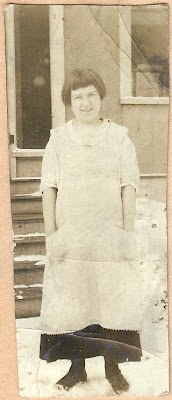
Marie Lewis. C. Winter 1916-7. Muskegon Heights, Michigan. Original photograph privately held by Catherine M. Robbins, [ADDRESS FOR PRIVATE USE], Coopersville, Michigan. 2014.
This is my submission for Sepia Saturday 212: Snow. This photograph features my paternal great-grandmother, Marie LEWIS, a couple of years before she married my great-grandfather, William Bryan ROBBINS. They would meet that fall, when Bryan would drive the hearse for her maternal grandfather's funeral. At four-foot, eleven-inches tall, Marie's petite figure and sparkling blue eyes would have been attractive to any young man. She waited for Bryan while he served in the American-North Russian Expeditionary Forces during World War I. They were married Christmas Day, 1919.


Pin It


Saturday, October 10, 2009

Surname Saturday: LEWIS


The LEWIS family is my paternal grandfather's mother's line, and it is a name that is perpetuated into the present. It was my paternal grandfather's middle name, and is also my youngest nephew's middle name (he was born on my grandfather's birthday).

LEWIS can be a surname from multiple places in Europe; however, mine appears to be British. Like many of my New England lines, I am descended twice from the LEWIS family and am related to myself once again, an event that takes place when two LEWIS ancestors, first cousins, marry.

Stories and History:

The LEWIS Family History on my website.

Ahnentafel #2304 and 2308 - John LEWIS the Immigrant (1631 - 1690) - John was probably born in Greenwich, England, and was first located in 1661 Westerly, Kings Co., Rhode Island records, one of the first settlers. Here his family lived for many generations. He and his wife (unknown) had one daughter and seven sons, two of whom I descend from.

Ahnentafel #1152 - Israel LEWIS (1669 - 1719) - little is known about this ancestor as well, other than he was the brother of Daniel and son of John the Immigrant

Ahnentafel #1154 - Daniel LEWIS (1668 - 1717) - son of John the Immigrant, and brother of Israel

Ahnentafel #576 - Nathaniel LEWIS (1706 - 1763) - son of Israel, grandson of John the Immigrant; married his first cousin, Mary LEWIS

Ahnentafel #577 - Mary LEWIS (1711 - 1791) - daughter of Daniel, granddaughter of John; married her first cousin, Nathaniel LEWIS; after her husband's death, she removed to Hopkinton, Washington Co., Rhode Island to be with her grown children

Ahnentafel #288 - Captain Israel LEWIS (1745 - 1806) - son of Nathaniel and Mary; served in the Revolutionary War; removed to Hopkinton, Washington Co., Rhode Island

Ahnentafel #144 - Nathaniel LEWIS (1778 - 1857) - removed to Morris, Otsego Co., New York

Ahnentafel #72 - George Washington LEWIS (1800 - 1879) - removed to West Amboy, Oswego Co., New York

Ahnentafel #36 - John Wallace LEWIS, Sr. (1839 - 1908) - I uncovered lots of unknown (to the present generations) facts about this man in my research: he was married before he married my ancestor and had two children; his first wife apparently died and he left his children with his parents when he came to Washtenaw Co., Michigan; his son from his first marriage eventually settled in Western Michigan when he did. John and his second wife, my ancestor Elenor "Nellie" L. VREELAND, had two more children than our family records show. They appear on the 1880 Federal Census and then disappear, probably dying young, and missing all the death and burial records at that time. The third unknown fact that I uncovered was that he was a Civil War veteran, but I can't find further details to confirm it, other than the 1890 Veterans Census.

Ahnentafel #18 - George Emmett LEWIS (1868 - 1964) - read his AnceStory here

Ahnentafel #9 - Marie LEWIS (1902 - 1986) - my great-grandmother; read her AnceStory here

Ahnentafel #4 - Robert Lewis ROBBINS (1920 - 2003) - my paternal grandfather; read his AnceStory here

Ahnentafel #2 - my father (living)

Ahnentafel #1 - myself

More about the LEWIS family:

1. Online database: LEWIS ancestors and relatives (I update this at least once a month; no info on living persons available)

2. Some LEWIS obituaries

3. Posts about LEWIS ancestors and relatives on this blog

4. Some scanned LEWIS documents

5. Some scanned LEWIS photos

6. My LEWIS Virtual Cemetery on Find A Grave


My LEWIS immigration trail:

Greenwich, England > Kings Co., RI > Washington Co., RI > Otsego Co., NY > Oswego Co., NY > Washtenaw Co., MI > Clinton Co., MI > Muskegon Co., MI > Manistee Co., MI > Muskegon Co., MI > Ottawa Co., MI > AK > Stevens Co., WA > Spokane Co., WA

Saturday, February 14, 2009

In Honor of St. Valentine's Day...


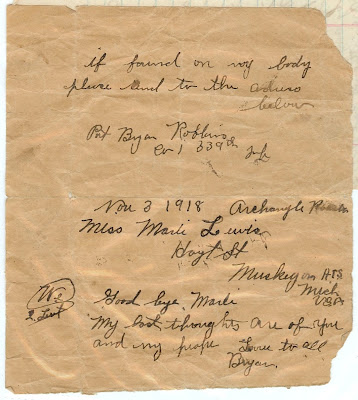
if found on my body please send to the address below

Pvt Bryan Robbins
Co I 339th Inf

Nov 3 1918 Archangle [sic] Russia

Miss Marie Lewis
Hoyt St
Muskegon Hts Mich USA

Good bye, Marie
My last thoughts are of you and my people
Love to all
Bryan

This is a partial repeat of a post, 3. Bryan and Marie - A World War One Romance, from my "Polar Bear in North Russia" series.

Thursday, January 15, 2009

Winter Photo Essay: Marie LEWIS


I've got lots of modern winter photos, but I went through my collection of scanned vintage ones, and figured out that these two were the oldest winter ones I have. The top one is of my paternal great-grandmother, Marie LEWIS, taken during the Winter of 1916 - 1917, when she was 14 years old. I believe she is in the backyard of her parents' home at 1132 Hoyt Street in Muskegon Heights, Muskegon Co., Michigan.

That appears to be the same setting for the next photo, which features Marie, her husband William Bryan ROBBINS, Sr., and her two sons William Bryan ROBBINS, Jr. and Robert Lewis ROBBINS (holding the cat). Bob was my grandfather. It's also possible that it was next door at 1140 Hoyt Street, since Marie and Bryan were living next door to her parents at that time (Winter 1924 - 1925). I especially love the beautiful coats everyone is wearing in this photo. With her cloche hat and fur-trimmed coat, Marie is certainly showing the flashy side of the Roaring Twenties!

Written for the 64th Edition of the Carnival of Genealogy.

Photographs
1. Lewis, Marie. Winter 1916-17. Scan of original held privately by Joyce Robbins Sanders, [ADDRESS FOR PRIVATE USE], Tulsa, Oklahoma, 2009.

2. The Robbins Family. Winter 1924-25. Scan of original held privately by Jeanne Holst Robbins, [ADDRESS FOR PRIVATE USE], Sault Ste. Marie, Michigan, 2009.

Saturday, January 10, 2009

Friday Findings: LEWIS, TUINSTRA, Lookups and (Maybe) a Bigamist

I had hoped to post this last night, but was too exhausted after a long day to finish up the details. This has been a completely weird week, so I don't feel like I got much accomplished. Things happened in fits and starts, so to speak. School was supposed to start on Monday, a return from Winter Break, but we had a snow day and started on Tuesday, instead. It was odd coming back to work after seven weeks, but good to see everyone again. Then school was closed Wednesday and Thursday because rain and warm temperatures had our 76 inches of snow melting all over the place and causing flooding. There was no place for students to walk to school, as sidewalks were still covered with mounds of frozen, melting snow and the streets were filled with slush and standing water. Friday morning we all returned yet again!

I started adding information from the LEWIS e-mails and MyHeritage family site that were shared with me from my newly-found cousin. It's taking a while, since I'm being very careful to cite my sources correctly. My Great-grandmother Robbins, Marie LEWIS, was one of 13 children, and although only ten made it to adulthood, marriage, and parenthood, when you start adding their descendants to a family tree, it grows quite quickly!

I also heard from a TUINSTRA cousin this week, with whom I've been in contact previously, but haven't had time to look closely at her e-mail other than to note that she has some documents she'd like to share with me.

There were three lookup requests this week; two for records from Muskegon County, Michigan and one for Newaygo County. I'm not sure when I'm going to be able to get to the Family History Center, because although the roads are clearing up, I'm starting my next Beginning Online Genealogy Class Thursday night, the day I normally set aside for research at the FHC. I also had a request for lookups in the record books for Park Hill Cemetery in Vancouver, Washington. These records are now available online, but many people don't realize it. I choose to keep my lookup service for Park Hill available so that I can direct requesters to the website when they contact me.

My husband has a third cousin--Holly--who is attempting to find out about the ancestry of her paternal grandmother, Fidelia (ORTIZ) MIDKIFF. This woman was married to Holly's grandfather, William Mason MIDKIFF. They had four children. When Willie became blind in one eye due to violent headaches, Fidelia left, taking the youngest child, Sam. Attempts to determine what became of her or their son has been futile. Willie died when the remaining children were teenagers and they were placed in foster care.

I knew from some research another distant cousin had done that Willie and Fidelia had been married in Trinidad, Las Animas Co., Colorado in 1937. Our records indicated that Fidelia had also been born in Trinidad. I started with the 1930 Federal Census and believe that I found her living with her parents and siblings. They were all born in New Mexico, not Colorado. By the ages of her parents and the information given on how old they were at their first marriage, it was easy to determine that this was not a first marriage for this Fidelia's father. Tracing back into 1920 and 1910, I also determined that the age given for this Fidelia on the 1930 census were incorrect, and that this Fidelia would have been 10 or nearly 11, not 12 as stated. I also made an interesting find: it appears that this Fidelia's father may have been a bigamist. Without going into tons of details too long for this post, anyone curious enough with access to the Federal Census collection at Ancestry can trace this Fidelia's father, Francisco ORTIZ and her mother Telesfora [--?--] ORTIZ, along with Fidelia's older half-sister's mother, Venerada [--?--] ORTIZ to possibly come up with the same conclusions.

I wrote Holly and said that the only way we could know with certainty that the Fidelia ORTIZ I found in the 1930 census was her grandmother was to order a copy of her grandparents' marriage record, a tricky task, since Colorado has such stringent privacy laws. Holly would have to prove she is descended from Fidelia and Willie, but since Holly's father died young and her step-father adopted her, she does not have access to her birth certificate with her MIDKIFF surname. She does have an aunt, the one known surviving child of Willie and Fidelia, so perhaps the aunt can fill out the application and provide the evidence needed to obtain the marriage record. From that record, we could hopefully ascertain that this is indeed Holly's grandmother Fidelia in 1930. From there, perhaps we can obtain a birth record from New Mexico and then see if the birth date matches any women with the same name in the Social Security Death Index to discover what happened to her. It's all very "iffy," of course, but it is fascinating and I hope that I'll be able to help Holly, and in turn her siblings and cousins. (Holly was amused by the bigamist possibility.)

This week I renewed my subscription to Footnote for the year and actually got 15 months out of the deal, instead of only 12. I also started another trial subscription to GenealogyBank when I saw on their blog that they have recently added the Grand Rapids (Michigan) Press, 1901 - 1922. I have found some little treasures that I will probably post later. I do know from using the obituary database at the Western Michigan Genealogical Society's website that my ancestors preferred placing notices in the Grand Rapids Herald while it was still in publication. However, GenealogyBank only has three years of the Herald available at this time.

I also found a blog template that I really liked, but wasn't having success downloading it. I finally used Internet Explorer instead of Firefox and was able to download it just fine. I also uploaded it to a private sample blog, but there are some backgrounds I want to change and I'll have to save and tweak all my widgets. It will take some uninterrupted time (!) to accomplish, but at least I'm headed in the right direction in my New Year's resolution to redesign my blog and make it look less cluttered.

Friday, January 02, 2009

Friday Findings: McCLELLAN Pension Record, E-mails, Atlas Project, BORCHERS

I ordered the Civil War Pension Record for my 4th-great-grandfather, Levi E. McCLELLAN (McLELLAN, McLALLIN, etc.). That along with subscriptions for Internet Genealogy (renewal) and Discovering Family History (new) were some of my Christmas gifts this year.

On Saturday, I e-mailed the VALK and LEWIS cousins that had left comments in my website's guestbook a couple of weeks ago. I also went through my Juno email inbox (nearly 900 messages), deleted all the junk and forwarded the good e-mails to my Gmail inbox. I used to use Juno for many years, and keep this freebie account open for those times when a distant relative or other researcher comes across a query I left on a message board with the old address. One of the messages was the following:

I have been searching for over 5 yrs. for a missing link, my Gr. Grandfather Lewis Harding. I knew his name, his wife’s name, when he was born, where he is buried and I knew that he came to Michigan when he was 2 yrs. old. I spent some time on looking at the Atlas Project, did a search and found him in the biography of George M. Campbell. Thank you so much for your Atlas Project. I not only found Lewis Harding’s parents, but also his sisters and brother. I have an old album that belonged to my grandparents, M.C. and Matilda Harding that has pictures of several of the people named in the Atlas Project. I knew they were relatives, but I didn’t know their connection and thanks to you now I do. I am thrilled to get this information that I have been seeking for so long.

Thank you again.

As you can imagine, this made my day! I haven't worked on the Atlas Project in a couple of years so it's nice to know that the information I put on it has helped someone. Here's another person I need to contact to see if she would be willing to add her photographs to the website for the benefit of others.

I heard back from my LEWIS cousin we are collaborating. I have the information she needs on the earlier, older generations and she has information I've been wanting on the more recent ones--info I couldn't access because of restrictions to current vital records. I also sent her quite a few ancestral and gravestone photos. I'm very excited to find how easy it is to find things and send them to others using my new filing system for documents, photos, and research notes.

Speaking of which, I spent a lot of time this week organizing digital files, answering a backlog of emails, and even got some scanning done. My dad loaned me the funeral book of my paternal grandmother's adoptive father, Alfred Henry HOLST. There are lots of gems inside: obituaries, signatures of nearly everyone in town (including other relatives), and pages where relatives are specifically listed. One of the list of relatives had some unfamiliar names on it. I remembered that I had discovered that Alfred's father, John, had a sister that had also immigrated from Germany; this was from John's FBI Case File, which I found at Footnote. His sister was listed as Mrs. Anna M. BORCHERS, so using Ancestry and FamilySearch Record Search, I was able to piece together her family and identify the individuals by the same surname listed in the funeral book: Anna's sons and Alfred's cousins. Doing research on this family uncovered that Anna and her husband Claus immigrated from Germany in 1874, so when John and his wife and infant son Alfred immigrated in 1882, it was obvious that they were joining his sister and brother-in-law. I love how putting pieces of the puzzle (facts) together gives a larger, deeper look into the family history!

Lastly, I happened to go to the Zeeland (Netherlands) Provincial Archives website and saw that they had added birth records, which they were lacking before. I've been able to add quite a few details and family members to my TON and VanKLINKEN lines.

Friday, December 26, 2008

Friday Findings: VALK, LEWIS, McCLELLAN, Markham Twp Ancestry

I haven't done a Friday Findings post in a while, and as I'm slowly returning to posting more of my regular "columns", I thought I'd start here. Friday Findings is a feature I started last summer to record my weekly research finds and cousin connections. I hope to do a better job of keeping up with this. This post covers the past two weeks.

LEWIS and VALK
Last week, I had two cousins leave comments on the guestbook at my family history website, also named AnceStories. I'm delighted to hear from them, and need to take the time to compose thoughtful, comprehensive e-mails as responses.

McCLELLAN
I have spent a lot of my online research time during the past two weeks trying to find as much as possible about one of my brick wall ancestors, Levi E. McCLELLAN (or McLELLAN). The Michigan vital records at FamilySearch Record Search helped me to determine that he was indeed married twice, and not just once. Confusion came about because both wives had similar names. His first wife, my ancestor Clarissa Mary (or Mary Clarissa) CLEVELAND, was born c. 1832 in New York state. She last appears on the 1870 Federal Census with him and the children, William, Cornelia (my 3rd-great-grandmother), and Edwin in New Haven Village, Macomb Co., Michigan. In 1880, Levi is living with wife Mary C. FORD, along with a 10-year-old son Ira, and two step-children in Detroit. Finding son Ira's marriage record, also at FamilySearch Record Search proved that he was Clarissa's son and not Mary's. Mary appears in the 1890 Veteran's Census as a widow of two veterans, Levi being one of them. So Levi died sometime between 1880 (when he appears in both the Federal Census in Detroit and the 1880 Detroit City Directory) and 1890. The 1850 Federal Census gives me a possible mother, brother, and niece for Levi. I've decided to spend my Christmas money on obtaining Levi's Civil War Veteran's pension record from the National Archives to see what genealogical gems I can glean from it.

Markham Twp., York Co., Ontario Ancestry
Janet Iles was kind enough to let me consult her regarding what Markham Township records are available so that I can try to knock down some other brick wall lines, my WILKINSON and either TERRY or LAMONEAUX lines. I'm hoping to find the marriage record of Richard WILKINSON and his wife Mary, who seems to have two surnames (TERRY and LAMONEAUX).

Sunday, August 03, 2008

Friday Findings: GenLine, CRAPSEY Burials, Cousins, and SNOOK Graves

Due to the Blogger debacle this week, I was not able to post my Friday Findings in a timely manner. Here's a rundown of my research results for the week of July 26 - August 1, 2008:

More on Many Marriages
While entering the marriage records of my husband's granduncle, Lee Joseph "Mick" MARTIN, I realized that the witnesses for his third marriage, to Martha Isabell (JONES) DVORAK, were his daughter from his first marriage and her husband. Hmm... It made me wonder if his first wife had died by then (I'm not sure how their marriage ended; by divorce or by her death?). I couldn't find any death information for her, but I did find Isabell, as she was called, on the SSDI.

Swedish Parish Records
Also following up on last week's findings, I went to my local Family History Center to use their free subscription to GenLine, the Swedish parish records database, to find and verify my great-great-grandmother's birth (Ida Charlotte (GUSTAVSON) HOLST). I had never used it before, so it took some time. Fortunately, it has a nice tutorial, available both in English and Swedish. It is necessary to know the name of the parish to do a search. The records appear in digital image format, not unlike looking at a roll of microfilm. They are not indexed by name in any way, so it takes some searching. All I had for Ida's birthplace was Hamnada, Sweden. I had no idea where this location was, and used both Wikipedia and the FamilySearch Library Catalog to find it, without any success. I had a feeling I was spelling it incorrectly. I then did a Google search and found a mention in someone's online family tree of a "Hamnada-Småland, Krnberg". I went back to Wikipedia to look at the political structure of Sweden. Småland is one of 25 provinces (landskapen) of Sweden and has no political structure as of 1634. It is a cultural, geographical and historical subdivision. Kronoberg is a county (län), a political subdivision, that lies in what is a part of Småland. I still could not find Hamnada or a a similiar name in any of the lists of municipalities (similar to American townships), villages, or cities of Sweden.

I went back to GenLine, and looking up Kronoberg County records, I noticed that Hamneda was one of the parishes. Bingo! They had birth and christening records up through 1861 (I don't recall the beginning year), so I went to take a look. In 1861 alone, there were NINE Ida Charlottas (no Charlottes) born in Hamneda parish! Only one had a surname close to GUSTAVSON, and that was a Ida Charlotta GUSTAFSON born, it appears on 29 December 1861 and baptized 31 December 1861. I say "appears", because I am not certain of what the dates stand for. There are three numbers and a month before each record. The first number is the record number, as they are all in sequence from 1 until the last record. Then comes the month abbreviation, which is very similar to our English month abbreviations. Then two numbers follow. The first number is always lower than the second number, and none of the numbers go beyond 31, so my assumption is that the first one is the birth date and the second one is the christening date. The words "Births and Baptisms" appear at the the top of each of these pages (in Swedish, of course), adding credence to my theory. I used FamilySearch's online Swedish Genealogical Word List to figure out the words.

My Ida Charlotte GUSTAVSON was born 28 October 1861, but I need to find my source of information for that. Her 1900 U. S. Federal Census enumeration does have October 1861 as a birth date. I ran out of time to double check 1860 records, and there are none available at GenLine for 1862. I will need to search other nearby parish records, too, I think. I also did not have time to figure out how to save or print the image with the birth date of the Ida Charlotta GUSTAFSON I found. This was an interesting first foray into Swedish records, and I felt I learned quite a bit.

CRAPSEY Burials
I've been trying to find a death date for my 4th-great-grandmother, Lura Ann (JACKSON) PECK CRAPSEY. I know she was deceased by 1900, when my step-ancestor, the Rev. John CRAPSEY, Jr. was listed as a widower in the Federal Census for that year. She was alive as late as 1891, when her husband filed an application for a pension based on his deceased son's military service. They were living St. Paul, Ramsey Co., Minnesota. Attempts to have a volunteer at RAOGK look up her death records did not work out. I then came across John's obituary stating he was buried in Forest Lawn Cemetery. There is a Forest Lawn Memorial Parks and Mortuaries in Ramsey County, and I contacted them to see if I could find burial information (and thus a death date) for the Crapseys. I received an immediate response that there was no record of either one in their records. I need to follow up with wording from John's obituary to make sure that the Forest Lawn Cemetery he was buried in is the same as what Park and Mortuaries company now manages, when their records begin, and if they have record of John and Lura's children being buried there (it's possible, if their children are buried there, that John and Lura are buried without markers).

Cousins
A distant LEWIS cousin of mine, Bob Stefanich, contacted me to tell me about another cousin of ours (related more closely to me than Bob is) and that the LEWIS family reunion is occurring today in Fruitport, Muskegon Co., Michigan (wish I could be there)! I've contacted Jim with the hope that I can get more information on the grandchildren and great-grandchildren of my 2nd-great-grandparents, George Emmett LEWIS and Mary WILKINSON.

Also, a McARTHUR cousin contacted me. She lives in Michigan and is able to visit the ancestral cemeteries. She promised to take some tombstone photos of some of our mutual ancestors...so exciting!

SNOOK Graves
Speaking of ancestral graves, I heard from a Find A Grave photo volunteer--Catherine Bryon--who photographed the graves of my husband's 3rd-great-grandfather, Reuben Wohlford SNOOK, and his second wife, Elizabeth NEARHOOD, at the Forsyth Cemetery in Rosebud Co., Montana. Click on the links to view the photographs. Thanks, Catherine!

Friday, August 01, 2008

Picnic Time!

Bill West at West in New England has asked the genea-bloggers to participate in a Genea-Bloggers Picnic. Here are some questions he asked:

*What food does your family serve at picnics?
Our annual must-attend picnic is my parents' Fourth of July picnic at their beautiful log home on the mountainside north of Colville, Washington. Traditionally, we grill hamburgers and hot dogs and have all the condiments: ketchup, mustard, mayo, pickles and/or relish, onion, lettuce, and tomatoes. There's usually potato salad, potato chips, and there MUST be baked beans. That's because Dad, like myself, is a traditionalist. He swears that at every Robbins Reunion that he attended as a kid there was nothing served but beans and dessert. Apparently there were dozens of bean dishes. He tells me this every year, and every year I remember that he inherited the Robbins' gene for storytelling, which although it always starts out with the truth, tends to grow and take on a life of its own! Mm-hmm.

When my niece's family comes, they almost always brings a cold three-bean salad that I love.

There are often veggie and fruit trays, soft drinks, and several desserts. Janet (Mom's friend) always brings a peanut-butter pie. When work kept her away this Fourth, her husband Pete did the honors.

*Are there traditional foods or family recipes?
Dad does have a special recipe for the beans. He starts out with canned baked beans, but adds all kinds of yummy stuff: mustard, molasses, etc. Can't be beat! I usually make a Jello Wave Your Flag cake.

*Is there one particular relative's specialty you wish you could taste again or one perfect picnic day you wish you could go back and relive?
One of my favorite times was a Spring Break when I was a high school junior, I think. The weather was beautiful, we had a picnic with a bonfire and roasted hot dogs and marshmallows for s'mores. Then we came in and watched "The Music Man" on TV.

Here's some more ideas I came up with, and added to my AnceStories2 blog:

*You could expand to write about family reunions, past and present, and what kinds of foods were/are brought to them. As a child, I only remember attending one reunion, the Lewis family reunion in 1979 in Michigan. I have no idea what we ate, but I do remember that one of the great-granduncles had an ice cream cart!

At the Midkiff Family Reunions that I coordinated in 1990 and in 1999 in the Spokane Valley, we split up the list of names and had one group bring main dishes, one bring salads and side dishes, and the third, desserts. Everyone had to bring their own meat to grill. The reunion committee supplied buns, condiments, beverages, and paper/plastic goods. It worked out well.

*You could add what dish everyone loved to eat, and which one people were sneaking off to scrap into the garbage so they wouldn't hurt the cook's feelings!
Everyone loves my Wave Your Flag cake. Janet has an interesting story about her peanut butter pie. Seems her Aunt Ruth is a horrible cook, yet Janet's husband Pete is always polite and will eat whatever Ruth sets before him. One time, Ruth mentioned she had made a peanut butter pie. Janet quickly declined, but Pete of course took a serving. He started nudging Janet, "You've got to try this!" Janet couldn't believe it! Aunt Ruth had finally made something edible, and not only that, delicious! And Janet blesses us by bringing one to the Fourth of July picnic/BBQ every year!

*Is there a picnic basket, old ice chest, a BBQ grill or camp stove, a special dish (physical, not recipe) or picnic cloth that's been handed down in the family and used for decades at picnics, potlucks, or reunions?
We have a picnic basket that used to belong to Norm's great-grandparents. I use it as a decorative piece in my dining room, but very occasionally we'll use it. Norm's dad loves garage sales, and he's found us a few old metal green Thermoses. He'll fill one with coffee for us before we leave their place for our long ride home.

*Is there a favorite campground, park, home, or meeting place where picnics or reunions regularly occurred?
There's a great little campground north of Colville at Mill Creek. We camped there for a few days in our camper when my parents first bought their home and we were waiting for the family to move out. Then we decided to take a trip back to Michigan, but that's another story! This campground has a swinging bridge that my dad and brother used to play on when my brother (now 34) was five years old. Adriaen would trip across the bridge, and my dad would pretend to be the troll from Billy Goats Gruff. My brother was gut-giggling so hard, he nearly fell off the bridge! Near the falls there's a great rock with drill holes in it from when the mill used to be there, gosh, 150 years ago? That rock is a good place to sit while fishing.

*What about unwelcome guests like ants, mosquitoes, and yellow jackets? Raccoons, anyone?
My son, Matthew, is a yellow jacket and mosquito magnet. I tell him it's because he's so sweet! I can't tell you how many picnics and play days we had at lakes and streams where he'd get bit/stung. Fortunately, he's not allergic.

*What favorite picnic or reunion photos do you have, especially ancestral?
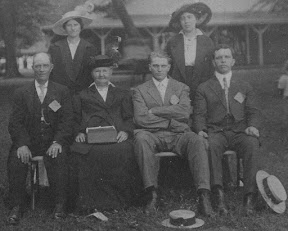
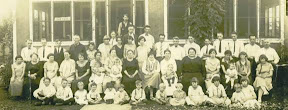
I've got one of my mother's ancestors, the Valks at a picnic, and another of a Lewis family reunion taken around 1924.

Source: The Valk Family. Photograph. Taken c. 1915 - 1918, probably in Grand Rapids, Kent Co., Michigan. Original photograph believed to be in the possession of John Hanson, Little Silver, New Jersey. 2000.


Source: The Lewis Family Reunion. Photograph. Taken c. 1924, probably in Muskegon Heights, Muskegon Co., Michigan. Original in the possession of Jeanne Holst Robbins, Sault Ste. Marie, Michigan. 2008. Reprint held by Miriam Robbins Midkiff, Spokane, Washington. 2008.

*Beverages served, games and activities played, stories told...all contain memories that future generations will someday treasure, if they're left for posterity!
I especially like Bocci, which I learned to play in my students' PE classes, but I need to buy a set for the next picnic!

Saturday, July 12, 2008

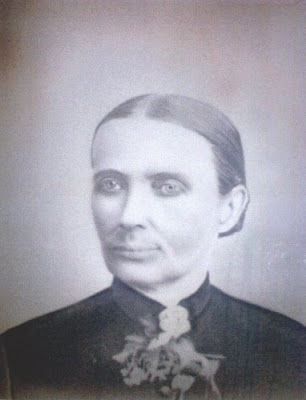
Elenor "Nellie" L. (VREELAND) LEWIS (1835 - 1912)


Source: Lewis, Elenor "Nellie" Vreeland. Photograph. Date unknown. Original photograph in the possession of Jeanne Holst Robbins, Fulton, Texas. 2008.

This photograph, within its oval oak frame and thick convex glass, adorned the walls of my paternal grandparents' living room in Coopersville, Ottawa Co., Michigan for many years, along with its mate, the photo of Nellie's husband, John Wallace LEWIS. Nellie was of the eighth generation of VREELANDs who had made North America their home. Her 5th-great-grandparents, Michiel Janszen VREELAND (1610 - c. 1663) and Sofitje HARTMANS (1611 - 1697) were immigrant ancestors from the Netherlands to the New Netherlands (present-day New York State and New Jersey). Perhaps you have a family line in which many of the men (or women) are given a certain first name, often to honor the patriarch of the family or an immigrant ancestor. In my SWEERS family line (unrelated to the people in this particular post), that name is Daniel; and in my VREELAND family line, it is Hartman. Nellie's 4th-great-grandfather, her 2nd-great-grandfather, her grandfather, a brother, and a son were all named Hartman, in honor of Sofitje HARTMANS VREELAND. (Hartman would also have been Sofitje's father's name; the patronym Hartmans literally means "Hartman's daughter.") The VREELAND family had lived all those generations in New Jersey until sometime between 1840 and 1843, when Nellie's parents, John P. VREELAND and Mary KANOUSE settled in York Twp., Washtenaw Co., Michigan.

Besides brother Hartman, who was about a year younger than Nellie, there were older siblings John H., Elizabeth, and Sarah, and younger siblings George W., Mary Esther, and Martha A. VREELAND. On 20 April 1867, Nellie married John Wallace LEWIS, a New York native who had come to Washtenaw County perhaps to start a new life, having been widowed, leaving his two young children in the care of his parents back in Oswego Co., New York.

John and Nellie had seven children, although our family history only lists five: George Emmett (my great-grandfather); John Wallace, Jr.; Esther Mary "Ette"; Hartman (named for Nellie's brother); and Ida May LEWIS. It was when the 1880 U.S. Federal Census Index was released on CD by FamilySearch that I discovered two more children that remain elusive in our family history: Ethel and Willie. Ethel was born c. 1875 and Willie c. 1879, both in Michigan. Willie's age was listed as one year old, while Ida, known to have been born 11 February 1879, was shown as two years old--curious! I cannot find these two children in any birth, death, or burial records, and they don't appear again on federal census records (I have yet to search the 1884 and 1894 state censuses). In the 1900 U.S. Federal Census, Nellie states that had given birth to five children, five of whom were living. So who were Ethel and Willie? If they were adopted children (perhaps a niece, nephew, or cousins), I've still been unable to find their births listed under John and Nellie's siblings' names.

The Lewis family lived in the Clinton and Washtenaw County area for quite a few years, and it appears to have been a back-and-forth migration. George (1868), Esther (1874) and Hartman (1876) were born in Clinton County, while John, Jr. (1870) was born in Washtenaw County, where his parents had married (1867). The family was in Washtenaw County in 1870 (federal census), but in Clinton County in 1874 (state census). Sometime between 1876 and 1879, the family relocated west to Muskegon County, where they farmed in Whitehall Township until the late 1880s, then moved to Blue Lake Township. There they stayed until at least 1900.

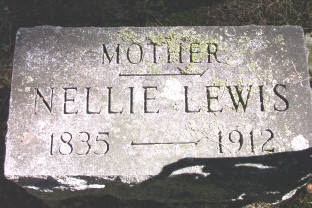
John died 9 February 1908 in Whitehall Village, followed four months later by son John, Jr. Nellie probably went to live with married daughter Ida in Pontiac, Oakland Co., Michigan. She does not have a death record in Muskegon County, but is buried there in Oakhurst Cemetery, Whitehall Twp. with her husband and numerous descendants. Her gravestone reads "1835 - 1912." My goal is to get her death record and obituary.


Source: Tombstone of Elenor L. "Nellie" (Vreeland) Lewis, Oakhurst Cemetery, Whitehall Twp., Michigan. Photograph taken at the request of Miriam Robbins Midkiff by Toni Falcon, volunteer for Random Acts of Genealogical Kindness. 2005.

Sunday, June 01, 2008

In the Good Old Summertime


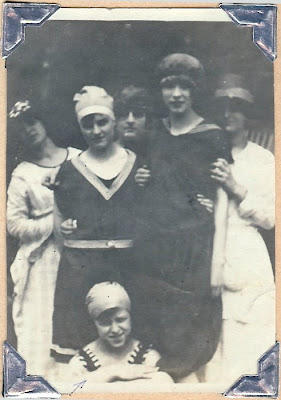
Source: Marie Lewis and Girlfriends. Photograph. 1917. Original photograph in the possession of Joyce Robbins Sanders, San Antonio, Texas. 2008.

It was Summer, 1917 in Muskegon County, Michigan. It could have been anywhere: Muskegon Lake, Bear Lake, Mona Lake, Wolf Lake, or Lake Michigan. Marie Lewis, my paternal great-grandmother, sits at the bottom of the photo, surrounded by her girlfriends. Some of the young ladies in this photo are dressed in swimsuits, others in summer dresses. Although the photograph was labeled as to the date in my grandaunt's scrapbook, we don't know who the ladies are. None appear young enough to be Marie's younger sisters, Bonnie (age 10) or Bertha (age 6). One of them was probably Stella Bolthouse, Marie's friend and later a witness to her marriage to my great-grandfather, William Bryan Robbins.

Marie, who would have been 15 at the time of this photograph, had not yet met Bryan by the summer of 1917. Her maternal grandfather, John Wilkinson, would pass away that September and during the funeral, Marie would meet Bryan while he was driving the hearse. They would correspond during Bryan's service during WWI, and marry Christmas Day 1919.

But for now, Marie is still a single young woman, cooling off from a hot, humid Michigan day at a favorite lakeside with good friends.

Written for the 49th Carnival of Genealogy.

Thursday, May 08, 2008

A Civil War Soldier: Pvt. John Wallace LEWIS (1839 - 1908)

Source: Lewis, John W. Photograph. Date unknown. Original photograph in the possession of Jeanne Holst Robbins, Fulton, Texas. 2008.

How Related: My 3rd-great-grandfather

Born: 8 July 1839 in New York, probably in Amboy Township, Oswego County

Parents: George Washington LEWIS, Sr. (1800 - 1879) and Sarah M. "Sally" BASSETT (1801 - 1873)

Siblings: George Washington, Jr. (b. c. 1825), Henry (b. c. 1831), Phidelia (b. c. 1833), Alonzo N. (b. c. 1835 - bef. 1880), Lawrence Harrison (1840 - 1920) and Emmet (b. c. 1844).

Married: first to Esther [--?--] (c. 1840 - bef. 1867) before 1858, probably in Amboy Twp. Secondly to my ancestor, Elenor L. "Nellie" VREELAND (1835 - 1912) on 20 April 1867 in Washtenaw Co., Michigan

Children: With his wife Esther, he had two children: Clarence (b. c. 1858) and Clara (b. c. 1860). With Nellie, he had seven children: George Emmett (1868 - 1964) - my ancestor; John Wallace, Jr. (1870 - 1908), Esther Mary "Ette" (1874 - 1930), Ethel (b. c. 1875), Hartman (1876 - 1938), Ida May (1879 - 1970), and Willie LEWIS (b. c. 1879).

---

Enlisted: date and place unknown; served with the 101st Regiment, New York Volunteers, Co. A

Side served: Union

Discharged: date and place unknown

---

Biography or Information of Interest: The more I look into this family, the more surprises I find. The first was that John had been married before he married my ancestor, Nellie VREELAND. He is found with his wife Esther and their two children on the 1860 Federal Census, living in Amboy Twp., Oswego Co., New York. By 1870, he has moved to York Twp., Washtenaw Co., Michigan, is married to Nellie, with one son, George, (my ancestor), and another one (John, Jr.) being born that year. Son Clarence is living with John's parents back in New York, and there is no sign of Cora or Esther. I can only presume they have died.

The second surprise was discovering that there were two more children of John and Nellie that no one seemed to know about. They don't appear in the written Lewis Family History. They do show up on the 1880 Federal Census: Ethel, born about 1875, and Willie, born about 1879 (was he Ida's twin?). They don't appear in Muskegon County birth or death records; cemetery records for Oakhurst, where most of the Lewis family members were buried, weren't kept until the early 1900s, and early records rely mostly on tombstone transcriptions.

Another surprise showed up in his obituary. He is always listed as John Wallace Lewis, Sr. in the family history, with a son, John Wallace, Jr., and a grandson John "Wallace" (through son Hartman). However, his obituary lists John, Sr. as John Wesley Lewis. Official records always show John W. Lewis, typical for that time, so no help there. What was his middle name?

Did he serve, or didn't he? In the 1890 Veterans Census, John W. Lewis is listed as serving with the 101st New York Infantry. However, the enumerator noted that he (or some other family member) refused to answer questions about his enlistment and discharge dates. I haven't been able to find him listed in any roster of the 101st New York Infantry online; thus, I can't order a pension record for him to determine if he actually served.

Died: 13 February 1908 in Whitehall Village, Whitehall Twp., Muskegon Co., Michigan


Source: Tombstone of John W. Lewis, Oakhurst Cemetery, Whitehall Twp., Michigan. Photograph taken at the request of Miriam Robbins Midkiff by Toni Falcon, volunteer for Random Acts of Genealogical Kindness. 2005.

Buried: Lot 415-8, Oakhurst Cemetery, Whitehall Twp., Muskegon Co., Michigan

Thursday, March 06, 2008

The Family of William Bryan and Marie (LEWIS) ROBBINS, Sr.


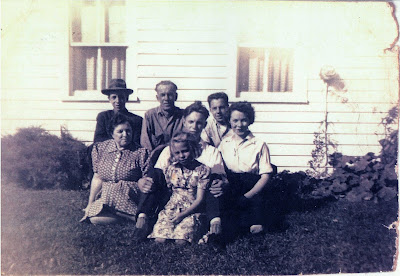
Source: Robbins, William Bryan Sr. and Marie (Lewis), Family of. Photograph. October 1942. Original photograph in the possession of Joyce Robbins Sanders, Tulsa, Oklahoma. 2008.

I wanted to feature this photo for several reasons. It is the only group photo I know about of the family of my paternal great-grandparent, William "Bryan" ROBBINS, Sr. and Marie LEWIS. In the back row, from left to right, you can see 15-year-old Lloyd "Jack", father Bryan, and 20-year-old William "Bill" Bryan, Jr. The middle row consists of mother Marie, my grandfather Robert "Bob" Lewis (age 22), and 17-year-old Shirley Marie. In front is the "baby" of the family, Joyce, who as you can see was quite a bit younger than her siblings. Joyce's age is not listed for privacy reasons, she being the only one of this family group still living. As I mentioned earlier this week, my granduncle Bill recently passed away, and I've yet to find an obituary online for him (more to come later).

This photograph was taken October 1942 on the Robbins' farm called Five Acres, just outside of Coopersville, Ottawa Co., Michigan. I believe that the photographer was my paternal grandmother, wife of Bob. Furthermore, I am certain this photo was taken because Bob and Bill had just enlisted in the Army Air Corps during World War Two (Jack joined the Navy two years later). My grandfather had already received a draft notice, but had gotten it deferred because he was married and my aunt was "on the way." My aunt would have been two months old at this time of this photo. Bob and Bill went down to Kalamazoo to enlist together on 13 October 1942, the day after my grandparents' second anniversary. I have often heard that it was common--from the Civil War days forward--for families to take group photos shortly before their son(s) went off to war so that the son(s) could have a copy to remember their families by, and those at home could have one of their whole, intact, family unit, "just in case." There is a similar photo of father Bryan's family, somewhere in the possession of other relatives, with his parents and siblings shortly before his older brother Lloyd went off to fight in the trenches of Europe during World War One. Bryan had not yet been drafted; Lloyd is wearing his Army uniform.

Now to tell a little about my granduncle Bill, since I'm currently unable to find an online obituary: He was born William Bryan Robbins, Jr. on 22 May 1922 in Muskegon Heights, Muskegon Co., Michigan, the second of five children. As mentioned, he joined up with my grandfather and they served together in the Army Air Force. I believe--but am not certain--he served in the same unit as my grandfather, the 1452nd AAF, Alaska Division, Air Transport Command. I do know they were stationed together in Edmonton, Alberta, Canada, where Bill met and married Josephine E. Semple, a Canadian citizen. Bill went on to serve in what later became the U.S. Air Force during the Korean and Vietnam Wars. I once heard my grandfather speak with great pride that his brother had attained the highest non-commissioned officer rank in the Air Force. If I heard and understood him correctly, I believe this would be the rank of Chief Master Sergeant.

Uncle Bill and Aunt Jo had a son and a daughter, and at least two grandchildren. Bill was instrumental along with his wife and parents in starting the Reinhart W. Roman American Legion Post 537 and Women Auxiliary in Chester Township, Ottawa Co., Michigan in 1946. He and Jo retired to San Antonio, Bexar Co., Texas. My grandparents and Shirley and Joyce and their husbands also lived or wintered nearby, while Jack and his wife preferred Florida. Ten years and ten days before his own death, Uncle Bill and Aunt Jo were in a terrible collision. It was the day before Jo's 76th birthday, as well as the day before Valentine's Day, and they were going out to eat. As they were making a left-hand turn, an oncoming vehicle hit the passenger side of their automobile, killing Jo and severely injuring Bill. He never fully recovered from his injuries and required some level of care for the rest of his life. Since I'm still waiting to obtain an obituary, I'm not sure if Bill passed away (23 February 2008) in San Antonio or in a community where one of his children was living. I do know that Aunt Jo was buried in Fort Sam Houston National Cemetery in San Antonio, and Bill's name was inscribed on the back of her headstone. One of my aunts told me the plan was for Bill to be interred in the same plot as Jo. My grandfather is buried in a nearby section.

As you can see, this is a poorly sketched-out overview of my granduncle's life, and very likely contains errors. I hope to obtain correct and more detailed information to improve this small tribute.

Wednesday, March 05, 2008

Wordless Wednesday: The Family of William Bryan and Marie (LEWIS) ROBBINS, Sr.


Source: Robbins, William Bryan Sr. and Marie (Lewis), Family of. Photograph. October 1942. Original photograph in the possession of Joyce Robbins Sanders, Tulsa, Oklahoma. 2008.

Tuesday, October 30, 2007

Obituary of Mahala (SAYERS) WILKINSON - 1937

VENERABLE LADY IS SUMMONED BY DEATH AT LUCHINI HOME

Mrs. Mahala Sears [sic] Wilkinson, 89 years old, died at the home of her son-in-law and daughter, Mr. and Mrs. Floyd Luchini, 115 Walnut street, at 2 o'clock Wednesday [2 Jun 1937] morning, following a critical illness which began with a heart attack last Saturday.

The aged lady had been in precarious health since July 8, 1936, when she was found to be suffering from a serious heart malady. She got along quite comfortably, however, until last week when the sudden heat wave brought on the condition which resulted in her death.

The body was taken to Whitehall [Muskegon Co.], Michigan, Mrs. Wilkinson's old home, Wednesday morning, and the funeral and burial will take place there beside her husband, and among loved friends and scenes.

Mrs. Wilkinson was born July 8, 1847, at Prince Edward [County], Ont., and came to the States many years ago. She is survived by Mrs. Floyd Luchini, Alma; Mrs. George Lewis, Mrs. A. L. Ainger and John Wilkinson, all of Whitehall, and Fred Wilkinson, of Kelso, Wash. Mrs. Luchini has the sympathy of many Alma friends in her loss.

--from The Alma Record and Alma Journal, Alma, Gratiot Co., Michigan, Thursday, 3 Jun 1937, unknown page.
------------------------
Mahala was my paternal 3rd-great-grandmother, a Canadian immigrant, herself the child of Ulster Scot immigrants from Letterkenny, County Donegal, Ireland. My paternal grandfather fondly remembered her from his early childhood. She used to run her finger down the slope of his nose and say, "Love is like this," then run it back up, saying, "but marriage is like this!" I had some digital scans of photos of her with my grandfather and his younger brother taken around 1923 in Whitehall, and she appeared rather frail even then. Unfortunately, I did not know enough about re-writable CDs at that time, and those digital scans have been lost. The originals remain with my paternal grandmother in Texas.

This obituary gives me more detailed birth information (date and location) and a complete death date, than what I originally had. A photo of her tombstone in Oakhurst Cemetery, Whitehall, Muskegon Co., Michigan can be found at Find A Grave here.

Sunday, July 29, 2007

Muskegon County, Michigan Family Histories Wanted

DearMYRTLE highlighted an article in today's Muskegon Chronicle which encourages those of us with Muskegon County, Michigan roots to share our family stories for the publication of a county history being created by the Muskegon County Genealogical Society.

With ten ancestral--and dozens more collateral--surnames of my family tree taking residence in Muskegon County from at least 1879 to the present, I could submit a ton of information! However, only one family history of no more than 400 words and one photo are allowed free entry into the book. There's no information on the costs involved if you would like to submit more than one family history. Let's see, I could do the following groupings and submit five family histories (if they allow this): HOLST/GUSTAVSON/CONCIDINE; ROBBINS/KIMBALL; LEWIS/VREELAND; HOEKSTRA; and WILKINSON/SAYERS. Wonder how much that'll cost me?

I'm off to e-mail the genealogy society...!

Wednesday, July 25, 2007

5. Basic Training at Camp Custer

View military documents at Footnote.com.

From Muskegon Heights, Muskegon County, Michigan, my great-grandfather, William Bryan ROBBINS, was sent southeast to Camp Custer in Battle Creek, Calhoun County. Camp Custer actually lies right at Calhoun County's west border with Kalamazoo County. General George Armstrong Custer is one of Michigan's native sons, and although he is most famous for his unsuccessful battle at Little Big Horn in Montana, he had built up quite a reputation for himself during the Civil War. Camp Custer was built in 1917 to accommodate the training of what would eventually be 90,000 Midwestern troops heading to Europe during World War I. At the end of the war, it was used as a demobilization base for over 100,000 men. Many soldiers, Bryan included, passed through the camp twice: once on their way to war, and again on the way home. This was the home of--among others--the 85th Division, originally called "The Custer Division," but eventually taking the nickname "The Polar Bear Division," because of its service in the American North Russian Expeditionary Force.

During the early 1920s, the predecessor to the Veterans Administration, the Veterans Bureau, established the Battle Creek Veterans Hospital, whose grounds contained 200 acres that were farmed by staff and patients. In 1940, Camp Custer was designated as Fort Custer, becoming a permanent military base. Over 300,000 World War II soldiers were trained there, including my paternal grandfather, Robert Lewis ROBBINS, and his brother, Bill, Jr., sons of Bryan. The fort also housed 5,000 German prisoners of war. In 1981, the Fort Custer National Cemetery was created, with opening ceremonies on Memorial Day 1982. The official address for Fort Custer is Augusta, Michigan, a small community just to the west of the base and located in Kalamazoo County.

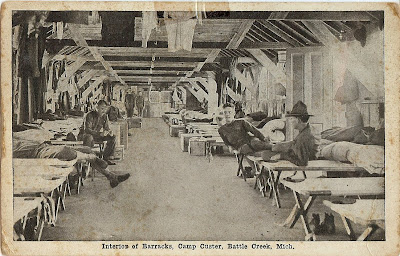
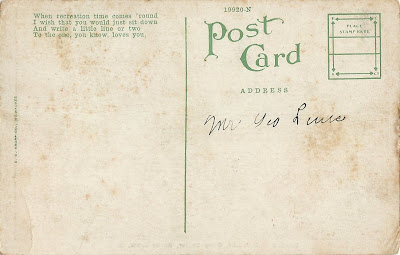
Bryan would have been at Camp Custer in late June and though late July of 1918, at which time the 339th Infantry was shipped overseas. In his papers was this postcard of one of the barracks' interior, on the back of which was addressed, "Mr. Geo. Lewis," Bryan's future father-in-law. It wasn't addressed fully, so perhaps it was never mailed, or mailed inside another letter:


There is also a little poem printed on the reverse of the postcard:
When recreation time comes 'round
I wish that you would just sit down
And write a little line or two
To the one, you know, loves you.

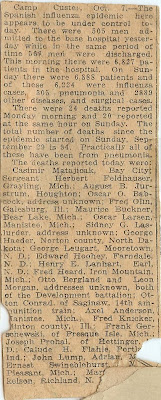
Also among Bryan's papers was this clipping of a newspaper article with an update on the Spanish Flu epidemic that hit Camp Custer, apparently that fall of 1918 (the date of the unnamed newspaper is October 7th). Bryan's unit was not at Camp Custer when the epidemic hit; they were on their way to Russia, and I will be blogging more about that, later:


You can click on the image above to read the article in full in my Picasa Web Album. It is rather long. In the Picasa view, click on the magnifying glass icon in the upper right hand corner to zoom in for an easier read.

For more interesting online reading regarding Camp/Fort Custer, I recommend the following websites:
Other posts in this series:
1. A Polar Bear in North Russia
2. The Family of Angelo and Lula Robbins
3. Bryan and Marie - A WWI Romance
4. Bryan Gets Drafted
6. Getting "Over There"
7. Bryan and King George V
8. To Russia, With Influenza
9. A Letter from Mother - 25 Sep 1918
10. A Letter from Father - 7 Oct 1918

Wednesday, July 18, 2007

3. Bryan and Marie - A World War One Romance

See the "Index to Naturalizations of World War I Soldiers, 1918" here

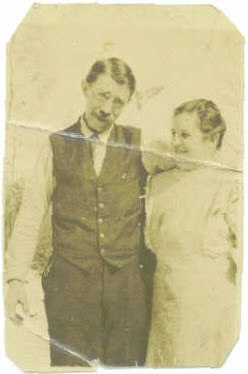
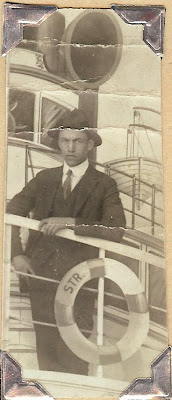
In establishing some more of the characters that will be appearing in the documents and letters of William Bryan ROBBINS, Sr.--my great-grandfather--during his service in the American North Russian Expeditionary Forces at the end of World War I, I have posted some photographs of him and his sweetheart, Marie LEWIS, which I recently received from my aunt, as well as a photo of her parents. According to my grandfather, his parents Bryan and Marie met while Bryan was chauffeuring during the funeral of Marie's maternal grandfather, John WILKINSON, Sr. John's burial occurred 14 September 1917 at Oakhurst Cemetery in Whitehall Township, Muskegon County, Michigan.


George Emmett Lewis and Mary J. Wilkinson, c. 1917

His daughter, Mary J. WILKINSON, her husband George Emmett LEWIS, and their 10 children were living in nearby Muskegon Heights at that time. This was around the same time period that Angelo and Lula ROBBINS and their four sons moved to Muskegon Heights from Ensley Township, Newaygo County, Michigan.


William Bryan Robbins, Sr., 1916, posing with ship prop & background


William Bryan Robbins, Sr., c. 1917


Marie Lewis, c. Winter 1916 - 1917


Marie Lewis, c. 1917

Bryan was 21 in 1917, and Marie was only 15. But apparently their romance was in full bloom by the time he was inducted on 23 June 1918. This is further verified by the following note Bryan carried on his person in North Russia, presumably at all times:


if found on my body please send to the address below

Pvt Bryan Robbins
Co I 339th Inf

Nov 3 1918 Archangle [sic] Russia

Miss Marie Lewis
Hoyt St
Muskegon Hts Mich USA

Good bye, Marie
My last thoughts are of you and my people
Love to all
Bryan

This just leaves a lump in my throat! Thankfully, Bryan made it safely home, or else I--and all their many other descendants--would not be here today!

Other posts in this series:
1. A Polar Bear in North Russia
2.
The Family of Angelo and Lula Robbins
4. Bryan Gets Drafted
5. Basic Training at Camp Custer
6. Getting "Over There"
7. Bryan and King George V
8. To Russia, With Influenza
9. A Letter from Mother - 25 Sep 1918
10. A Letter from Father - 7 Oct 1918

Monday, July 16, 2007

1. A Polar Bear in North Russia

Today I received a surprise in the mail: three CDs' worth of scanned pages and photographs from the scrapbooks of my paternal grandfather's sister. It is a treasure trove, and I am absolutely giddy over it! There is a large collection of letters, documents and photos from my Great-grandfather Robbins' service in the American North Russian Expeditionary Force during and shortly after World War I. I will be sharing these treasures with my readers in the near future, and to give you background, I encourage you to read his AnceStory (biography) here.

I am also posting an article below which I submitted to the Eastern Washington Genealogical Society's 2005 literary contest "My Favorite Military Ancestor," for which I won a second-place prize of $50 towards purchases at my favorite genealogical publishing company. This should give you a better idea of why American forces were in North Russia (and Siberia)...a fact that the U.S.S.R. used against us in their history books during the Cold War. After all, we had invaded them once; why wouldn't we do it again?
----------------------------------------------

William Bryan Robbins, Sr.
(1896 – 1972)
A Polar Bear in North Russia

by Miriam Robbins Midkiff


It was a humid night in Western Michigan, and the stars and fireflies twinkled over the yard of my great-grandparents’ home where I stood on a small statue of a polar bear. My 10-year-old cousin scolded, “Don’t stand on that! It’s Grandpa’s!” The “grandpa” mentioned was his grandfather and my great-grandfather, William Bryan Robbins, who had recently passed away. It was 1972, I was five years old, and although it was a time of sorrow for many family members, it was a time of magic for me. Just a few days earlier, I had flown 3,000 miles with my parents from our small Alaskan village, population 300, coming into a breathtaking view of Chicago at night, a scene I would never forget. At our journey’s end, my grandfather met us at the airport in Grand Rapids. We drove 35 miles west to tiny Conklin and pulled into the driveway of my great-grandparents’ home. Grandpa said, “Now there’s Great-grandma. She’s feeling sad today, so give her a great big hug.” I flew out of the car, and running across the yard to where my petite ancestor sat, I surprised her with the biggest embrace my small arms could manage!

Although our time in Michigan created memories that I still look back on with fondness, I unfortunately have none of the man whose funeral was the purpose behind our trip. I had seen him on two previous visits, but was too young to remember the lean, gray-haired man with an affinity for his pipe and the Robbins’ trademark storytelling. Nor did I have any clue of the significance of the statue in his front yard. Born 6 June 1896 in Hesperia, Michigan, William Bryan Robbins was named for the silver-tongued presidential candidate, William Jennings Bryan. Also known as “Bill” or “Bryan”, he was the third of seven children of Angelo Merrick Robbins and his wife, Mary May “Lula” Kimball. Because Angelo was a schoolteacher, the Robbinses lived all over Newaygo County, wherever a teaching position became available. It wasn’t until 1906 that the family settled in Ensley Township for ten years. Although Bill never attended a higher institute of learning, he continued to educate himself by helping his father study for his annual teaching certifications.

As Bill became a young man, the political climate in Europe geared up for World War I. There were also changes at home. After Bill’s oldest brother died in 1914, the family moved west to Muskegon Heights, a growing community situated three miles inland from Lake Michigan. Here Angelo ended his teaching career and became employed at a nursery, while Bill found work as a chauffeur in the new age of automobiles. One fall day in 1917, Bill was hired to drive a hearse for a funeral. Among the mourners was a blue-eyed, four-foot-eleven, 15-year-old, Marie Lewis. It must have been love at first sight, because they began a courtship that lasted two years. Bill’s older brother, Lloyd, was already serving in France with the 32nd Division in a machine gun corps. So, joining the patriotic spirit that was sweeping the nation, Bill enlisted on 23 June 1918 to begin an unforgettable year in a forgotten expedition in American history.

Like most wars, the events in Northern Russia in the early twentieth century had multiple complicated causes. At the beginning of World War I, Russia was one of the Allies, but was undergoing internal turmoil between the Czarist monarchy, the Provisional Republicans (a democratic party known as White Russians), and the Bolsheviks. When the communists overthrew the Provisional government that succeeded the monarchy, they signed an armistice with Prussia, switching sides mid-war. The Allies were horrified, realizing the enemy could now relocate troops to the Western Front, gaining a three-to-two advantage. The U.S. could also lose a fortune in munitions and foodstuffs it had stored at Murmansk, North Russia, originally intended to help the Allied cause. Things changed when the Bolsheviks realized that they had the disadvantage in their armistice with Prussia, and appealed to the Allies for assistance. Britain saw the opportunity not only to re-establish the Eastern Front, but also to colonize the area. Immense pressure was put upon President Wilson to supply American troops for the expedition, since most British troops were occupied in Western Europe. Ostensibly, Americans were sent to Russia to defend their munitions from Axis takeover. The truth is, the weapons had long been “requisitioned” by Bolsheviks by the time they set foot on Russian soil; and the next 17 months would be a senseless waste of American lives for a purposeless and futile campaign that rivaled the wars of Southeast Asia half a century later.

Bill Robbins’ basic training took place at Camp Custer, Battle Creek, Michigan. He was assigned to Company I of the newly formed 339th Infantry of the 85th Division, later nicknamed the “Polar Bear Division,” because of its service in the American North Russian Expeditionary Force (ANREF). But Russia was the last thing on these Michiganders' minds that summer of ’18. They believed they would join their brothers in the trenches of Western Europe. Leaving in late July, they made their way by train and ship to the south of England, where they had the bad luck to be stationed at the wrong place at the wrong time. General Pershing felt he could not spare any of his troops from France, so he chose the 339th to be assimilated into British schemes. The Americans were re-outfitted with British uniforms, rations, and supplies, which were of lowest quality. Antarctic explorer Ernest Shackleton had designed the outer garments of the uniforms. While constructed to keep out the cold, the soldiers’ safety and agility in battle had not been kept in mind. The overcoats were stiff and unwieldy, the boots’ slippery soles as useful as high heels on frozen terrain. The horrid rations consisted of ancient canned corned beef and seven-year-old frozen rabbit. Medicine was limited to iodine, quinine, and laxatives. The injury to insult was the replacement of reliable, U.S.-made rifles with the Russian Moisin-Nagant 7.62mm rifle, whose poor design and inaccuracy caused soldiers to describe it as being able to “shoot around corners.” Additionally, there was no scabbard for the bayonet, so it had to be permanently fixed to the rifle, making it only useful to roast meat over campfires!

The 339th was sent to Newcastle-on-Tyne, where they embarked for an eleven-day voyage. This transport also included the 310th Engineers, the 1st Battalion, the 337th Ambulance Company and the 337th Field Hospital. The medical training of the latter consisted mainly of learning how to roll bandages. Medical supplies had purposefully been left behind in England to make room for crates of whiskey for British officers. Only a handful of first aid equipment was brought along by some American medics. On their route through the North Sea, influenza took hold, due to one of the ships not being disinfected after its last trip on which it had carried many deadly cases of the illness. Several men died enroute and were buried at sea. When the ships arrived at Archangel on September 7th, a large number of soldiers were ill and had to be quarantined in makeshift hospitals. Four weeks later, the flu ran its course with nearly 100 young men dead and buried in a new cemetery in Archangel. Bill also became ill, but refused to seek medical treatment. He knew that in the contagious atmosphere of the infirmaries his chances of survival were slim. He recovered and was sent to the Railroad Front.

Archangel was then a city of 40,000 inhabitants, located where the Dvina River flows into the White Sea. The surrounding 250,000 square miles are nothing but swampland, with only stunted pine forests breaking up the monotonous landscape. A railroad stretched southward to Moscow for some 900 miles. Several companies, including Company I, were stationed at the Railroad Front, an area of about 125 square miles encompassing both sides of a 17-mile stretch of railroad. Encampments were made along the railroad, and these outposts were defended, along with French troops, from the Bolsheviks (“Bolo”). Besides the French, there were also British and Royal Scots, Italian, Canadian, and Serb troops spread across the province. All were placed under British command; lower-ranking British officers were given authority over other high-ranking officers. The Americans got on well with the other troops, except for the Brits. Unfortunately, the British took advantage of the Americans, even confiscating food, supplies, and gifts sent to them. Many soldiers had to pay to receive goods sent by their own families! Additionally, some in the service organizations stationed in Archangel also joined in to profit in this unethical manner. Bill recalled that he purchased a sweater from the YMCA, which had been made and donated by citizens back home. The Americans were paid in worthless British script; Bill ended up giving away his to a peasant when he left Russia.

The American troops received no help from their superior officers in these matters. ANREF commander, Colonel George Stewart, abdicated his authority to the British command and would not interfere to assist his men. To make matters worse, the major in charge of the 339th was a drunken incompetent. He would send his companies after the enemy without proper intelligence or maps. If they failed in their missions, he would blame them. He so infuriated the enlisted men that he was in danger of losing his life. Bill recalled later some of the men shooting at the chimney of the major’s building to scare him into going back from the front. The saving grace in this situation was the lower-ranking American officers, who did all they could to ease the load of those under them, taking part in their privations. These men often risked receiving reprimands from their superior officers as they defended the enlisted men in courts martial, or refused to obey orders that unnecessarily risked their men’s lives.

Above and beyond all obstacles was the climate, worse than the enemy himself. With the winter of 1918-1919 being one of the coldest on record, the thermometer plunged to 60 below zero. Bill once told how the men would sit on frozen, snow-covered logs near the campfires while they warmed themselves. When the spring thaw hit, they discovered that some of the “logs” were actually corpses! With inadequate clothing and lack of food, the troops looked to the peasants’ ways to survive. They discarded the cumbersome boots for fur moccasins, trapped rabbits, shot wild birds and used grenades to blow fish from the frozen rivers to eat. Always they must stay on the lookout for terrorist attacks. Like the wars in Korea and Viet Nam, our troops could never be sure who was enemy and who was friend.

Meanwhile, the families of the ANREF were appealing to their Congressmen. The Armistice, signed on November 11, 1918, had ended World War I, but their sons were still fighting what seemed an endless war. Finally, an Act of Congress brought the Polar Bears home. Beginning June 3, 1919, the first of the troops shipped out of Archangel for Brest, France. On June 21st, they boarded the S.S. Von Steuben for their final voyage home, arriving in Detroit on July 3rd. Orders to form ranks and march down the street were disregarded, as families mobbed the platforms to embrace loved ones. On July 7th, the Force demobilized at Camp Custer and headed home. Bill received his discharge pay of $284.45. He was fortunate that he was never wounded, and although he did not receive any medals, he was issued a Bronze Victory button. One hundred twenty-one American dead were left behind in Russian soil for another ten years, until a search party returned with the remains of eighty-six.

As for Bill, he married sweet little Marie whose letters sustained him during the bitter hardship of the north. They were wed Christmas Day 1919 and became the parents of five children. All three sons served in World War II: two in the Army Air Corps, the other in the Navy. Bill’s years after the war are another story; but when he passed away on 6 August 1972 in Grand Rapids, he was survived by his wife of nearly 53 years, five children, ten grandchildren and eight great-grandchildren. As I stood at his grave in Coopersville Cemetery, Ottawa County, Michigan for the first time in October 2000, I marveled at the obstacles this man had overcome thousands of miles away, and I felt proud to be his descendant. Truly, William Bryan Robbins, Sr. is one of my favorite military ancestors!

Sources:

Newaygo County, Michigan Vital Records

Oceana County, Michigan Clerk’s Office

Muskegon County, Michigan Vital Records

1900, 1910, and 1920 U. S. Federal Census Records

Robbins Family Records

Robbins Oral History, as told by Robert Lewis Robbins and Bryan Henry Robbins

Discharge and Enlistment Records of William Bryan Robbins

Quartered in Hell: The Story of American North Russian Expeditionary Force, 1918 –1919 by Dennis Gordon, published by The Doughboy Historical Society and G.O.S., Inc., Missoula, Montana, 1982

“Detroit’s Own” Polar Bears: The American North Russian Expeditionary Forces, 1918 –1919 by Stanley J. Bozich and Jon R. Bozich, published by Polar Bear Publishing Co., Frankenmuth, Michigan, 1985

Other Posts in this Series:
2. The Family of Angelo and Lula Robbins
3. Bryan and Marie - A WWI Romance
4. Bryan Gets Drafted
5. Basic Training at Camp Custer
6. Getting "Over There"
7. Bryan and King George V
8. To Russia, With Influenza
9. A Letter from Mother - 25 Sep 1918
10. A Letter from Father - 7 Oct 1918