Showing posts with label Washington. Show all posts

Thursday, May 10, 2012

The Clark County (WA) Genealogical Society's Spring Seminar

Last Saturday I had the pleasure of speaking at the Clark County Genealogical Society's Spring Seminar in Vancouver, Washington, just north of Portland, Oregon across the Columbia River. The theme was Frugal Genealogy and I gave four presentations: Frugal Genealogy, or How Not to Spend a Fortune on Your Family Tree; Finding Volunteer & Low-Cost Researchers Online; Finding Vital Records and Obituaries Online; and Finding Your Ancestors in Historical Newspapers. Here are some photos of their library and meeting room at 717 Grand Boulevard, as well as snapshots from the seminar:

Building Front
Meeting Room
Front desk in research library
Research library, view from front
Local history and records
Some of the stacks


More of the stacks
Microfilm collection and reader

Some of the attendees
Calling the group to order

I had an enjoyable time visiting with several members of the society and speaking to their group. I wish I had had the time to do some research at CCGS on my kids' paternal lines, as they settled in the area about a century ago. Perhaps next time...

Some of the links in my Frugal Genealogy syllabus were incorrect, even though I had checked them a week before. There were also some questions about other sites not on my syllabus for which I did some look ups during the lecture. A few members of the audience lent their expertise and recommended some sites as well. I promised the CCGS that I would post these corrected and new links to my blog. Here they are:

FamilySearch Center locations: http://www.familysearch.org/locations

Current newspaper websites: http://www.onlinenewspapers.com

World Ancestry Project (indexing for Ancestry.com): http://landing.ancestry.com/wap/learnmore.aspx

The difference between Ancestry.com's U.S. Deluxe Subscription and their Library Edition: http://tinyurl.com/6plclb6

Free Access to Pay Databases: http://www.familytreemagazine.com/upload/images/PDF/freedatabases.pdf (some info may be outdated on this chart)

Cyndi's List of Free Software: http://www.cyndislist.com/software.htm/free

For copyright questions, check out the Legal Genealogist's blog: http://legalgenealogist.com/blog/

For questions about DNA and genealogy, check out Emily Aulicino's blog: http://genealem-geneticgenealogy.blogspot.com/

PrintKey Freeware, to capture a screenshot of what's on your monitor: http://www.joshmastaaa.net/2010/11/printkey-v30-freeware.html (thanks to Laurie Burgess!)

Thursday, August 19, 2010

The Great Fire of 1910 Centennial Events and Articles

This month marks the centennial of the Great Fire of 1910 which swept over the Inland Northwest leaving devastation in its wake. To get an idea of the magnitude of this fire, imagine 10,000 new Forest Service workers and 4,000 troops (sent by President Taft) fighting a fire across three states. "Despite their efforts, the fire burned three million acres in two days, killed nearly 100 people, and burned several towns to the ground. It is believed to be the largest fire in recorded U.S. history." [from the Spokane Public Library website]

I wrote about my husband's ancestors' experience last October in my post, The Martin Family and the Great Fire of 1910. My local paper, the Spokesman-Review, has recently been publishing a series of fascinating articles about the fire. If you go to this link, you will see that currently there are 19 articles, three photo galleries, a video, an audio file, and a blog post published at their website that are tagged with the 1910 Fire label.

Additionally, area museums are showcasing exhibits about how the fire affected local communities (see list here) and the Forest Service also has some ceremonies and exhibits as well. Spokane Is Reading is bringing prize-winning author Timothy Egan (known especially for his book on the Depression, The Worst Hard Time: The Untold Story of Those Who Survived the Great American Dust Bowl) to Spokane on October 7th to speak for free on his newest book, The Big Burn: Teddy Roosevelt and the Fire that Saved America.

Last, and certainly not least, fellow Inland Northwest geneablogger and friend Amy Crooks has been writing about her family's summer adventures on her blog, Untangled Family Roots. The following articles touch on places they visited that commemorate the Big Burn:

Tuesday, May 18, 2010

30 Years Ago: The Eruption of Mount St. Helens

From the Washington State Digital Archives

Today, May 18th, is a red-letter day in Washington State. Thirty years ago today, at 8:32 AM, Mount St. Helens erupted. "The eruption touched off the greatest landslide ever, ripping off a large part of that enormous dome, blowing out 3.7 billion cubic yards of mountaintop and spewing ash that girdled the globe a number of times. The blast zone was 230 square miles; 57 people, including the crotchety Harry Truman, lost their lives." [Washington Secretary of State blog]

At the time, I was a 13-year-old eighth grader, living with my parents and younger siblings about 10 miles north of Colville in Northeastern Washington. It was a Sunday and I'm sure we went to church that morning. I don't remember exactly when or how we heard the news that the mountain had erupted, but at the time, it wasn't a surprise. Scientists had been monitoring the mountain for some time, as it was showing signs of volcanic activity. But it wasn't until we came home after church and turned on the TV that we realized the effect the eruption was having on Eastern Washington, especially those communities lying directly in the path of the ash cloud, like Ritzville and Spokane.

Spokane, Washington is the largest urban area between Seattle and the Twin Cities, Minnesota. Eighty miles to the south of my home, it was where all local television news was broadcast for my small rural community. And what a broadcast the local stations had for us! The reporters told how everything became deathly quiet, the sky turned dark by three o'clock in the afternoon with street lights coming on, and then the ash fell. Like snow it came down, up to six inches' worth, but much more serious. People with respiratory problems were affected, and so were vehicles. The fine particles of ash clogged air filters in automobiles. Air filters and face masks were soon sold out everywhere. Snow plows had to clear the streets, and the Spokane Police Department had special filtration systems in place on the front of their vehicles making them look like strange space machines. In fact, the city took on the look of a moonscape, gray and dusty. Schools, colleges, and even businesses closed for a week, and as in times past and future, the community came together to help each other out. (Check out photos from the local paper here.)

But up in the Colville area, the effect was much less severe. I took some photos of my parents' Jeep which showed just a light dusting of ash, as well as a panoramic shot of the mountain across the valley from their home. Normally easily visible even on a cloudy day, it appeared to be obscured by a cloud--not of rain, but of ash from a mountain some 400 miles away!

Jeep, with light dusting of ash.
© Copyright 1980, Miriam Robbins Midkiff


View from my parents' home toward Mount Dominion, normal day.
© Copyright 1980, Miriam Robbins Midkiff

Same view, with ash.
© Copyright 1980, Miriam Robbins Midkiff

---

Meanwhile, on the "other side of the mountains," as we like to say here in Washington, my husband-to-be was soundly sleeping. A 23-year-old college student in Vancouver (Washington, not British Columbia), he had been staying awake for hours on end, hoping to be able to witness the highly-anticipated event that the media and scientific world had been predicting. A beautiful dome in the snowy Cascade range which stretches from Lytton Mountain in British Columbia to Lassen Peak in Northern California, it was in the company of such notable peaks as Mount Baker, Mount Rainier, Mount Adams, Mount Hood, the Three Sisters, Mount McLoughlin, and Mount Shasta.

From the Washington State Digital Archives

Exhausted after waiting, he fell asleep and slept through the blast and concussion, even though it was only 50 miles away! Only a small amount of ash fell on Southwest Washington, as the blast and then the jet stream carried it away to the northeast.

Many residents of Washington can today show you their jars of Mount St. Helens ash, the fine particles like baby powder, from which ash trays and other mementos were made. Even today, if you look carefully, you can see the ash here and there throughout Central and Eastern Washington. Certainly, if you do any digging, you'll come across the layer. The ash, although devastating on many levels, did enrich the soil in Eastern Washington.

I tried to find the photo of my one trip several years ago when we came rather close to the now barren mountain after visiting my in-laws. It appears the photo has been damaged in my computer crash a year ago, so I won't be able to post it here. But I'll never forget driving up and pulling over to take a good look at the remains of the scorched mountain. At that time, it had been smoking again. Even at 10 or 15 miles away, it looked ominous, eerie, ghostly. Chills went up my spine and I urged my husband to turn around quickly and return to Vancouver. It took no strong imagination to understand how the ancient natives felt about these volcanoes. Sleeping giants, monsters, evil spirits...the legends live on.

---

Here are more memories shared by others in the Inland Northwest.

Tuesday, December 22, 2009

Eight More Washington State Newspapers Added to the Library of Congress' Chronicling America Webste

From the Washington State Library blog:

On Friday, December 18, more than 42,000 historic newspaper pages from 8 Washington newspapers were contributed by the Washington State Library to the Chronicling America web site, hosted by the Library of Congress...More pages from other newspapers around Washington State will be periodically uploaded throughout 2010 as part of WSL’s National Digital Newspaper Program (NDNP) grant.  Pages will also be loaded locally and included in the WSL’s existing Historic Newspapers in Washington collection.

Representation from Washington State Newspapers:

I lived for five years in Colville, when I first moved to Washington State, and the newspaper now is called the Statesman-Examiner, after an obvious merge. I'm excited to see this collection, as I have an ancestor's brother that lived in this county in the early part of the 20th century, as well as a niece whose birth father's ancestors were pioneers in the area. If you have Washington State ancestors, you'll definitely want to check out these FREE resources!

Personal fundraising widget for 2009 Red Kettle campaign

Click on the Image Above to Adopt a Needy Child or Senior in Your Community


Friday, December 18, 2009

News from the Washington State Library: Vashion Island Heritage Digital Collection

From the Washington State Library's blog:

NEW DIGITAL COLLECTION – VASHON ISLAND HERITAGE

The Washington Rural Heritage initiative is pleased to announce the publication of our latest collection, Vashon Island Heritage, www.washingtonruralheritage.org/vashon. A project of the Vashon Library (King County Library System) and the Vashon-Maury Island Heritage Association, the collection documents life on the island from the late 1800s through the 1960s.


Read more about the project, and quickly link to some of our favorite items, on the WSL blog: www.sos.wa.gov/quicklinks/vashon.

Seven new digital collections are currently slated for publication in 2010, and a new Washington Rural Heritage grant cycle will be announced this spring. To learn more about participation in the initiative, contact Evan Robb, Project Manager, evan.robb@sos.wa.gov (360) 704-5228, or visit www.sos.wa.gov/quicklinks/WRH.


Personal fundraising widget for 2009 Red Kettle campaign

Click on the Image Above to Adopt a Needy Child or Senior in Your Community

Wednesday, November 25, 2009

Newest Newspapers Added to Washington State Library's Digital Project

From the Washington State Library blog:

The Washington State Library has added an early Snohomish newspaper to its online offerings. The Northern Star, from 1876-1879, is the library’s latest addition to the Historical Newspapers Online Project, which makes available the state’s earliest territorial newspapers to anyone with an Internet connection. Indexed by staff and a group of enthusiastic volunteers, news topics include:

The Northern Star joins Olympia’s first papers, The Columbian, The Washington Pioneer and The Pioneer and Democrat, that cover 1852-1857. Also included in the collection are historical newspapers from the cities of La Conner, Lynden, Port Townsend, Seattle, Spokane, Steilacoom, Vancouver, Walla Walla and Yakima. Additional newspapers will be brought online as they are scanned and indexed.

The newspaper Web site was purposely designed for students, genealogists, and historians to easily access historical information. It provides viewers with the ability to search by keywords, dates, subjects, and personal names. To view the newspapers, please visit www.sos.wa.gov/history/newspapers.aspx.

Friday, November 20, 2009

Digital Updates to the Washington State Library

From the Washington State Library Blog:

Digital Updates

Historical Newspapers in Washington – 1 new title.

The years 1861-1864 have been added to the Puget Sound Herald in Historical Newspapers in Washington online project, which now covers six years of Steilacoom pioneer news, from 1858 to 1864.

Classics in Washington History

We have added a new category – 20th Century Events – to our Classics in Washington History. This category currently contains the Works Progress Administration Papers and, new to the collection, papers by the War Relocation Authority on the Japanese Internment :

The Community Analysis Report concerns how authorities should “deal” with the Japanese and Japanese American people they have incarcerated through an understanding of their customs and cultural background. Causes of social unrest, segregation, education, Buddhism and labor relations are topics covered within these papers.

The Community Analysis Notes “reveal the life experience and viewpoints” of the incarcerated Nisei. Why did many young men say “no” to two questions on the Army registration form? How did the Japanese deal with engagement and marriage in the camps? How did it differ from pre-internment days? How did they adjust to life in the camps?

The Project Analysis Series analyzes various events that occurred during the relocation project. What happened at Tule Lake in November 1943? Why did it happen? What was the reaction to opening Selective Service to Nisei? What are the motives behind Nisei requesting repatriation?

Other additions to Classics in Washington History are :

Reminiscences of Washington Territory by Charles Prosch

The editor of the Puget Sound Herald, Charles Prosch, recounts his memories and opinions feely on such subjects as newspapers, the army, churches, and doctors in the early days of Washington Territory.

Seattle General Strike

Account of the Seattle general strike from the point of view of the unions, written by the History Committee of the General Strike Committee.

F. A. Chenoweth letter to Gov. McMullin

This Letter to Gov. McMullin from F. A. Chenoweth, a justice on the Territorial Supreme Court, concerns his role in and opinions on the controversy over the proclamation of martial law by the previous governor, Isaac I. Stevens. He outlines his disagreements with Stevens and explains his actions during the events and his disapproval of the arrest of Judge Landers.

Oregon: the claim of the United States to Oregon

This small book contains the diplomatic correspondence between the U.S. and England regarding the claim of America to the Oregon Territory. These arguments and counter-arguments were part of the negotiations leading to the Treaty of 1846 and the establishment of the border between the U.S. and what is now Canada.

The Whitman Massacre of November 29, 1847 provides a painful window into a time of conflicting cultures, priorities and prejudices. The State Library has added two works to the Digital Collections that further illuminate this painful event.

Authentic account of the murder of Dr. Whitman and other missionaries by Fr. J.B.A. Brouillet

For decades after the tragedy at the Whitman Mission, writers, preachers and others sought to place blame for the event itself and for the underlying causes. Resentments against the Hudson’s Bay Company and religious prejudices often colored narratives, and led to charges of cowardice or malice.

One viewpoint comes from Fr. Brouillet, the Catholic priest who first discovered the massacre and helped to bury the dead. His brief book, published in 1869, attempts to refute Rev. Henry Spalding’s accusations that the Catholics fomented resentments against the Whitmans among the Indians. He does this by gathering statements and letters from people present in the territory at the time and involved in the events, and by trying to analyze the underlying causes. See an Authentic account of the murder of Dr. Whitman and other missionaries in Classics in Washington History.

Journey across the plains in 1836 by Narcissa Whitman

This work contains three separate sets of letters from Narcissa Whitman to her friends and relatives, both back east and in the Oregon Territory. The collections include several letters from Marcus Whitman as well. The letters were published as part of the proceedings of the Oregon Pioneer Association, and the speeches and committee reports of the Association are also included, as is a separate essay on “The Schooner ‘Star’”.

The letters reveal a woman who is determined to live up to her religious ideals. She accepts the loss of home and her extended family. She accepts her husband’s frequent absences and the physical hardships of frontier living. Yet, she continually begs her family to write more often, and is without any letters from home for two years due to long distances. She is never quite at home with the Indians and has difficulty learning the language. There are hints in her narratives about the tensions among the missionaries and the discouragement when few others arrive to join the mission effort. The letters, though relentlessly optimistic, create a portrait of an intensely social and conventional woman laboring in isolation and surrounded by a culture that remains foreign to her.

Tuesday, August 11, 2009

Update on King County, Washington Marriage Records Online

Although dated August 1st, the following came through my Google Reader today from the Washington State Digital Archives:

The long awaited King County Marriage records from 1855 to 1940 are now available online at the Washington State Digital Archives. As of August 1, records up to 1940 have been scanned and indexed and are searchable on the website. Although the project will not be complete until the end of the year, Marriage Certificates from 1855-2000 and Marriage Returns from 1891-1939 will be available and searchable as they are indexed, beginning with the earliest years. The collection contains over 1 million records.

Marriage Certificates, filed with the County Auditor following the marriage ceremony, provide marriage license number, date, and county; place and date of marriage; names and county of residence of bride and groom; names of witnesses; and name, residence, and official station of the person performing the marriage.

Marriage Returns, returned to the County Auditor from the person performing the marriage ceremony, contain more information than Marriage Certificates. Marriage Returns generally provide the names and birthplaces of the bride and groom and their parents; residence, age, race, number of previous marriages, and occupation of both parties; place and date of marriage; name and official station of the person performing the marriage; and names of witnesses.

For more information about King County marriage records program, contact Washington State Digital Archives at (509) 235-7509 or digitalarchives@secstate.wa.gov.

Tuesday, July 14, 2009

Tuesday's Tip: Washington State Genealogical Resource Guides

Do you have Washington State ancestors or distant relatives that you are researching? Well, you're in luck, because the Washington State Genealogical Society is producing the free! online! Washington State Genealogical Resource Guides to help researchers find the resources they need in nearly every county in Washington. This ongoing project was started by Kathleen Allen O'Connor of Gonzaga University (Spokane) and has been taken over by my fellow EWGS blog team member Charles Hansen, and currently has guides for 34 out of 39 counties.

When completed, each guide (in .pdf format for easy downloading and/or printing) will list the following information, many with hours of operation, physical address, mailing address, phone number, fax number, e-mail address, and website address:

1. Historical overview of that county

2. Names of counties/states that border it

3. County seat

4. Chambers of commerce

5. County government information

6. Genealogical societies

7. Health department

8. Historical societies

9. Libraries - academic, public, and special

10. Museums and Historical Sites

11. Selective bibliography: a long list of printed resources and published works that are available within that county that are useful for research, such as atlases, city directories, census records, land, military, and probate records, etc.

Now don't you think this is a treasure trove of genealogical goodies? Be sure to check them out...and please be patient if the guide for your county of interest is incomplete.

Monday, June 29, 2009

Washington State Genealogical Society's 2009 State Conference

The Washington State Genealogical Society's 2009 state conference will be upon us before you know it. September 11 through 13 is the weekend, the Davenport Hotel in Spokane, Washington is the location, and the Eastern Washington Genealogical Society is proud to play host for this event. My co-bloggers over at the EWGS blog, Donna Potter Phillips and Charles Hansen, have been busy researching and writing about all the events, speakers, activities, transportation, facilities, etc. surrounding the conference, and I'll be adding information about the great vendors that will be in attendance, as well.

Here's a wrap up of some recent posts that will be of interest to you:

Washington State Genealogical Society 2009 State Conference to Be Held in Spokane

Benefits of Attending Genealogical Societies

WSGS 2009 Conference Update

Online Registration Now Available for 2009 WSGS State Conference

WSGS: Other Activities

Getting to Spokane for the WSGS Conference

September...and the Conference...Be A-Comin'


To keep up-to-date on all the conference posts, be sure to bookmark the 2009 State Conference label on the blog. You can also add the EWGS blog to your daily reads at Bloglines, Google Reader, or any of your favorite feed readers here. If you prefer to read your blogs via e-mail, you can sign up to receive them through FeedBlitz.

P.S. There will be a number of Geneabloggers (genealogy bloggers) in attendance at the conference, and we are looking to meet for a GB event. Please contact me if you are interested.

Sunday, May 31, 2009

Indexing Project for Washington State City Directories

I received the following information from Terri Huntley, Historical Records Project Coordinator for the Washington State Digital Archives:

The Historical Records Project is designed for people to work from home using their computer/internet to transcribe or proofread selected documents (census, military, directories, birth, death, naturalization, and other materials). It isn't necessary to commit to specific hours since you work from your home donating your time at your convenience. The indexing efforts are posted online at the Washington State Digital Archives site: www.digitalarchives.wa.gov

Currently, many of the volunteers are transcribing many of the early Polk Directories that have been scanned at the Washington State Library. (We're working on early Seattle directories right now).

If you’re interested in volunteering, I need to know your spreadsheet preference: Works or Excel and your mailing address. Once we decide on a project to start on, I email a template and mail out paper copies along with postage paid return envelope. Once you have completed the project, you email the file back and return the paper copies in the envelope.

If you’re interested in volunteering, email Terri Huntley at: thuntley@secstate.wa.gov

Sunday, November 09, 2008

Resources for Local Native American Research

November is American Indian Heritage Month, so I thought I would share a list of resources for local Native American research. This list was compiled by Larry Fine for the Colville [Washington] Stake Family History Conference held April 26, 2008. I had been invited to speak on military records for the conference, and after my presentation, manned a table on military resources in the main room. Next to me was a table on Native American research, at which was sitting a familiar-looking gentleman. Larry Fine was my high school teacher for Algebra I and Computer Programming (we learned Basic on those old Macintoshes)! Larry told me he had begun to trace his roots about 10 years ago, discovering he had Metis ancestry (a mix of local Native American and French heritage...Northeast Washington was explored by early French furtraders) going back at least 150 years in the Colville Valley. He had developed the following list through his extensive research, and has a large personal collection of printed materials on local Native history. I thought about the irony of it all: the man who had taught me how to use a computer--a tool I use to do research and teach others genealogy--had himself become interested in his roots.

Microfilmed Native American Records on Permanent Loan at the Colville Family History Center
Bureau of Indian Affairs and Colville Tribe Indian Records (numbers are Family History Library microfilm numbers):
  • 1020972: BIA - Indian History Cards, Late 1800 - Early 1900
  • 1020973: Births, Marriages, Deaths
  • 1020974: Births and Deaths, 1909 - 1942
  • 1020975: Births and Deaths, 1914 - 1943
  • 1020976: Births, Deaths, Marriages: 1914 - 1943
  • 1020976: BIA - Annuity Roll Records, 1892 - 1948
  • 05742208: BIA - Indian Census Rolls, 1885 - 1891: Coeur d'Alene, Kalispel, Lake, Spokane, Nez Perce, Okanogan, Moses, Yellow Bulls
  • 05742209: BIA - Indian Census Rolls, 1892 - 1897: Okanogan, Nez Perce, Colville, Lake, Spokane, Moses, Nespelem, San Poil, Coeur d'Alene
  • 05742210: BIA - Indian Census Rolls, 1898 - 1903: Spokane, Moses, Okanogan, Nez Perce, Coeur d'Alene, Lake, Colville
  • 05742211: BIA - Indian Census Rolls, 1904 - 1908: Spokane, Colville, Coeur d'Alene, Nez Perce, Moses, Okanogan, Lake, Sanpoil, Nespelem
  • 05742212: BIA - Indian Census Rolls, 1909 - 1913: Spokane, Sanpoil, Moses, Nez Perce, Nespelem, Okanogan, Lake, Colville, Calispel, Wenatchi, Chewelah, Kootnai
  • 05742215: BIA - Indian Census Rolls, 1938 - 1938: Supplemental rolls of Colville and Spokane JOPA (also available at Foley Center Library, Gonzaga University)
  • 16711660: Washington - St. Paul - Jesuit Mission - with baptism registers, various entries from 1839 - 1870
  • 16711661: Washington - St. Regis - Jesuit Mission - with various baptism, death, and marriage records, 1848 - 1917
  • 16711662: Washington - St. Regis - Jesuit Mission - burial records, 1953 - 1887; baptism and marriage records, 1852 - 1866; St. Francis Regis Quarterly Indian School reports, 1893; Colville Reservation census,1902 - 1918, 1923, and 1937; Spokane Indian census, 1919 and 1927
  • 16711663: Washington - St. Regis: papers and correspondence
  • 16711664: Washington - St. Mary's: mission parish census, 1948 - 1949

Libraries

Sources to Consider


Items to Check

  • Annuity records of various tribes
  • Birth, baptism, marriage, death and burial records or registers
  • Books: history, biographies
  • Census: Federal and tribal
  • Family history files
  • Land patents
  • Military discharges
  • Obituaries
  • Oral history reports
  • Probate records with the Bureau of Indian Affairs or Office of Special Trustee
  • Tribal allotments
  • Tribal enrollment records
  • Tribal school enrollments
  • Wills

Thursday, July 17, 2008

The CHAPLIN - MARTIN Marriage Certificate


Source: Chaplin - Martin Certificate of Marriage. Washington. Clark County. Marriage Certificates 1889 - 1977. Digital image. Washington State Digitial Archives. http://www.digitalarchives.wa.gov/ : 2008.

Yes, I realize that Wordless Wednesday is supposed to be about displaying a photograph, not a document. Inspired by George Geder's posts of posting ancestral photos on Wednesday and then a biographical sketch on Thursdays, I started doing WW back in February, based on a pattern of showing ancestral photos from my father-in-law's, father's, mother-in-law's, and mother's family trees, in that order. The problem was, I don't have access to many photos from my mother-in-law's family, and I don't believe she does, either. Unless I can come in contact with some of her relatives and obtain scans of ancestral photos (if there are any), I'm relegated to displaying photos of tombstones and images of documents. So be it!

I did want to feature this document, however, for a variety of reasons. My husband's family (both parents' sides) has lived in this state since the early 1900s, and Washington State has a wonderful open-record policy, perhaps one of the best in the nation. In addition, the Washington State Digital Archives and FamilySearch Labs are featuring both indexes and images of county, state, and federal records for Washington residents. I'm waiting impatiently for FamilySearch to release the images that have been indexed on their pilot site, and decided to help them along by doing some indexing on that specific collection. That in itself has been a lot of fun...to see records from Stevens County (where my parents live), Spokane County (my residence), and Klickatat County (which we pass through on the way to visit my in-laws). I recognize all these little towns which certainly helps in determining messy handwritten locations on death certificates!

Besides featuring a document with personal sentiment from the fabulous digital archives site, I thought this record was unique because it contains the signatures of four my husband's direct ancestors. John Franklin and Angelia Rebecca (LUKE) MARTIN were Leona Mary MARTIN's parents. Forest "Frank" L. CHAPLIN and Leona were my mother-in-law's parents. I've always seen Forest's name spelled with two Rs, but here he signs it with one. Hmm... I had the privilege of meeting the widowed Leona once--at our wedding--and then attended her funeral in 1993. I've mentioned Leona and her twin brother Lee before in one of my earlier Wordless Wednesdays.

Wednesday, February 20, 2008

The HOEKSTRA Girls

Featured in the February 23rd Edition of Terry Thornton's "Harvest from the Blog Garden" at Hill Country of Monroe County, Mississippi.

I learned about George Geder's Genealogy~Photography~Restoration blog through Craig Manson of GeneaBlogie, I think. George has been doing Wordless Wednesday posts for a while, both of his ancestral photos and of his fantastic own pix (he's a photographer by trade). Imitation being the sincerest form of flattery, I thought I'd emulate his actions here.


These two little cuties are my maternal grandmother, Ruth Lillian HOEKSTRA, and her younger sister, Hope Mildred HOEKSTRA, taken as the captions indicate, in Tacoma, Pierce County, Washington in 1921, when Grandma was 35 months old, and Hope was 13 months. This would have been in December of that year, as Grandma was born on 16 January 1919.

Ruth and Hope were the oldest of three girls born to my great-grandparents, John Martin HOEKSTRA and Lillian Fern STRONG. Originally from Grand Rapids, Michigan, John, Lillian and Ruth came out West for a few years because John's parents, Martin HOEKSTRA and Jennie TON, and his brother and sister-in-law, Peter Louis Ton HOEKSTRA and Reatha Pearl DONOVAN, had also relocated there for better job opportunities. Lillian's parents, Charles Frisbe STRONG and Mary Lucy WRIGHT, were living several hundred miles south near Hubbard, Marion County, Oregon, with her brother Frank Charles STRONG. While the family was out west, Hope was born in Tacoma. The Hoekstra family returned to Michigan and remained there for the rest of their days. Mary Louise HOEKSTRA, John and Lillian's youngest daughter, was born in 1923 in Grand Rapids.

Ironically, after Hope grew up and married, she moved to Tacoma with her husband, had four children, and died and was buried there in 1968...the same city in which she was born.

Wordless Wednesday: The HOEKSTRA Girls


Source: Hoekstra, Ruth Lillian and Hope Mildred. Photograph. 1921. Original photograph in the possession of Miriam Robbins Midkiff, Spokane, Washington. 2008.

Sunday, February 10, 2008

Louis Frank Boyd, Washington State Representative, 1914

I don't often write about Spokane or Washington State historical figures or history on this blog, because I am the first in my family to live in this city. I've had a few ancestors and relatives live in this state (mostly on the west side), but only after living in New York State, Pennsylvania, and/or Michigan first (where most of my genealogical research takes place).

However, I have been in correspondence with Carol Wilkerson, who has written an interesting biography on her husband's first cousin, four times removed, Louis Frank Boyd. Frank was a Spokane city clerk for many years and went on to represent the city in the state legislature in Olympia. You can read Frank's biography, as well as see a newspaper clipping and a letter he wrote, on Carol's blog here. Carol also has other biographical articles on her blog, and I encourage you to read them.

Tuesday, January 15, 2008

Every Eleven Miles

On New Year's Day, Terry Thornton of Hill Country of Monroe County, Mississippi wrote a post entitled "Walksheds in the Hill Country." It's a fascinating look at the past when, in the old days before we became a country of automobile owners, general stores and/or grist mills were situated about three miles apart, so that everyone could live within a comfortable walking distance to and from a place where they could do their business and trade. At once I was reminded of a conversation I had had with my father-in-law some time back where he was telling me how railroad stations, and particularly manned water towers, were located eleven miles apart. I couldn't remember the details, so I asked to talk to him after my husband called to wish his parents a Happy New Year. What I received what a great little history lesson about days gone by and an enjoyable conversation as well.

My father-in-law, Troy MIDKIFF, was the son of John Franklin MIDKIFF, Jr., who was a Northern Pacific Railroad station master in Mabton, Yakima Co., Washington. Troy's maternal grandfather, George Rice WESTABY, III, worked for years for the Great Northern Railroad in both Montana and in Washington State. My father-in-law himself worked for the NP railroad as a telegraph boy. His father would receive the telegraph messages as part of his duties as a station master, and Troy would deliver them. During World War II, the death notices for soldier's families would always have a black mark on the envelopes, and my father-in-law delivered his share of them. He knew enough to ask for payment before he handed over the envelope, knowing the shock would drive out all other thoughts from the recipient's mind. As you can imagine, often being the bearer of bad news, he was not always the most welcome visitor to people's homes, since for many of them, the only telegrams they ever received were unhappy ones.
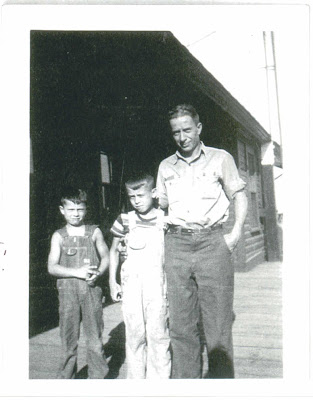

From left to right, Norman (the elder) and Troy Midkiff,
with their father, John F. Midkiff, Jr.
at the Northern Pacific Railroad station in
Mabton, Washington, c. 1942.

Troy told me that steam engines needed good clean water for their steam; otherwise, the minerals and impurities in the water would corrode the interior of the engine. Despite what you might see in old western movies, they couldn't just stop and draw water out of a river or creek unless the steam engine was fitted with a specialized filtering system, which was very unusual. A steam engine could go about eleven miles on level land before it would run out of water to produce steam. So railroad stations or manned water towers would be situated about every eleven miles along a railroad route, and even closer on steep grades.

Troy told me how there were stations at Toppenish and Mabton (where he and his parents and siblings lived just 100 yards off of the Yakima Indian Reservation), located 22 miles apart, with a manned water tower at Satus halfway in between. There was another station at Prosser, 11 miles east of Mabton, and then a station at Whitstran, another 11 miles east and somewhat north of Prosser. You can look at online maps of Washington State for Highway 22 and the Old Inland Empire Highway, which follow the Yakima River, to find these locations.

Along the Columbia River, on both the Washington and Oregon sides, as one traveled east from Vancouver or Portland, the situation was the same: railroad stations or manned water towers every eleven miles. However, as one approached the Columbia River Gorge, where the railroad tracks had to climb along the steep sides of the river, the stations were situated closer together, since the steam engines used more steam to power their climbs up the steep grades. For example, somewhere west of Biggs Junction, Oregon on the Columbia River, there was a station, possibly near Celilo, where the railroad traveled southeast along the steep rocky hills along the DeChutes River. From that station to Wasco, the line was less than eleven miles long. Looking at current online maps, it appears that the railroad no longer comes this way, but was probably along what is now either Highway 206 or Interstate 97.

I found this bit of history simply fascinating, and it made me stop and think about how travel was for my ancestors who rode trains cross country, either to migrate to a new location or to travel to visit relatives. Those trips sure must have been long when you had to make a stop every eleven miles! It has also made me more interested in researching the background of my husband's and my own ancestors who worked for various railroads around the country. Searching for "northern pacific railroad" maps on Google gave me some fascinating results as well. Thank you, Terry, for the great reminder!

Friday, October 12, 2007

Three Generations of Wedding Dresses

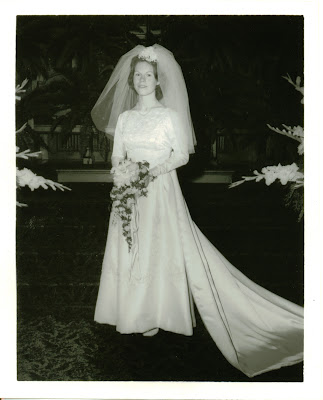
When I became engaged in January 1987, I began to look around for a wedding dress. My mother, I knew, had rented her own wedding dress back in 1965. I never thought much about that; I simply figured there weren't any family wedding dresses passed down for her to wear. I assumed my maternal grandmother wore a nice Sunday dress at her wedding in 1943 like my paternal grandmother had at her own wedding in 1940; it wasn't unusual for brides to wear a simple nice dress or skirt suit at one's wedding in those days. Most of my extended family lived in Western Michigan, and I was living and getting married in Eastern Washington, some 2000 miles away, so I didn't have much opportunity to have a conversation with relatives about this, anyway. My future husband and I were working with a limited budget and although (and especially since) we were planning a very nice church wedding and reception, I didn't want to burden my parents with a dress that cost hundreds, if not thousands, of dollars...the practical side of me knew I would only wear it once, anyway. Although my bridesmaids' and flower girls' dresses were handmade by friends as their wedding gifts to us, making a wedding dress wasn't an option at that time; so I began to look for a nice second-hand dress to purchase. Because I'm not very tall and was about a size 3 in those days, I wasn't having a lot of success finding one that fit me. Finally, a solution was reached when a girlfriend of mine loaned me her dress. It was somewhat too big for me, but I took it to my aunt and my paternal grandmother, who was on an extended visit to this area, and they determined that the style of the dress would allow for easy and subtle altering in such a way that it could be undone and returned to my friend. I borrowed a Madonna-style veil from Norm's sister-in-law, and purchased shoes, accessories, and jewelry. At the time, my fiance and I attended a small, independent church that did not own its own building. We were married in a historic Lutheran church building that had been converted to a wedding chapel. In the photo below, I'm waiting in the back room, seated in front of a vanity, waiting as the guests arrive to walk down the aisle, accompanied by my father:


Miriam Joy Robbins, 30 May 1987
Gretna Green Wedding Chapel
Spokane, Washington


My own parents were married in the chapel of the Grand Rapids (Michigan) School of Bible and Music (now Cornerstone University), where they were students. As a little girl, I loved looking at my parents' wedding album, and always wished my mother had been able to keep her wedding dress, so that I could wear it, too:


Faith Lillian Valk, 25 Jun 1965
Grand Rapids School of the Bible and Music
Grand Rapids, Michigan


Just last year, my mother received a little wedding book that had belonged to my maternal grandmother, Ruth Lillian HOEKSTRA. It was from her first marriage, to my biological grandfather, William VALK. My grandmother had traveled to Junction City, Kansas, to meet my grandfather who was probably stationed at nearby Fort Riley. They were married at the Methodist Church at the corner of Jefferson and Eighth Streets in Junction City. Tucked inside the wedding book was the following photo:


Ruth Lillian Hoekstra, 11 Sep 1943
Possibly the backyard of Mr. & Mrs. Fred B. Johnson,
or of Cristel Kiver
Junction City, Geary County, Kansas


When I remarked to my mother that I had not known that Grandma had had a wedding dress when she married my Grandfather Valk, she replied, "Oh, yes, but I didn't want to wear it at my wedding...it was too old-fashioned." !!!!! Apparently, my grandmother kept this dress for years. My mother's sister never married, and so because no one seemed interested in it (or--as in my case--didn't know about it), she either sold it or gave it away, I believe at some point after I was married. Yes, this story has turned into one of those "genealogy groaners"! If only I had known, I would have gladly worn this dress at my wedding, and saved it for my sister and someday for my daughter to wear! My daughter may not be quite 17, but seeing her lately in her formal dress for her homecoming dance, it's not hard to imagine that sometime in the next 10 years (hopefully later, rather than sooner!), she'll be wearing her own wedding dress and walking down the aisle. I hope that it will become an heirloom one that she can pass on to future generations!

This post was also originally started with the intention of submitting it to the 33rd Carnival of Genealogy, whose topic was "Weddings!" Due to illness, I ran out of time to fully research and write it before the deadline.

Sunday, October 07, 2007

New Prompt (Week Twenty-Five) Available at AnceStories2

I just posted a new prompt at AnceStories2: Stories of Me for My Descendants called "Your First Job."

I had several "first" jobs growing up. The first time I made any money apart from my parents was selling earthworms (25 cents a dozen) to fishing customers of the Log Cabin Resort next door (well, it wasn't a resort in those days...just a gift shop and a place where you could hire a fishing or hunting tour guide). It was owned (and still is) by the Fabry family just outside of Klawock, Alaska. (Skip Fabry was my fifth- and seventh-grade teacher.) On our little farm, we raised rabbits for meat and skins in a metal tool shed like the kind you could buy from Sears or Wards. Under the rabbit cages, we had deep stalls filled with earth to catch the rabbit droppings. Dad had ordered earthworms from somewhere and added them to the stalls to break down the compost. All of our food waste and garden waste was added and mixed into this compost pile. This rich composted soil was then mixed into our garden soil to fertilize it, along with the worms, which would naturally aerate the garden soil by digging little tunnels through it. I would get a spade and start digging and find a dozen worms, which I would place in an empty coffee can with more soil, cover it, and take it up the hill to the Fabrys.

My next two jobs were during high school. The first one was at my high school in Colville, Washington, where my dad worked as a custodian. He had heard from the cooks that there was a helper's position open. Every day, I would leave fourth period ten minutes early, go to the cafeteria, wash my hands and help serve lunch. The first few years, I worked right in the serving area. One of my duties was heating up and serving "chuckwagons," which were a meat and cheese sandwich on a sesame seed bun, heated briefly in a microwave so that the cheese would melt. They were in high demand...even more than hamburgers and pizza. I believe it was in my junior or senior year that I was put in charge of the salad bar, where would collect payment from the students. This job entitled me to a free lunch, and having a 50-minute lunch period, I had plenty of time to meet up with my friends and socialize before going on to fifth period. I worked in the cafeteria all four years of high school, and my experience there was a good asset for my resume for my next job. I enjoyed the cooks I worked with (I still remember the names of two of them: Earlene and Shirley), and in my senior year they all chipped together to buy me a nice gift for graduation. I also enjoyed the opportunity of checking out the cute guys that came through the lunch line. ;-) Sadly, I was such a nerd, none of them paid any attention to me! Besides which, I had no clue then that "cool" girls would rather be caught dead than work in the cafeteria! But I didn't think of those things; I thought of it as a good job experience and a way to earn a good, hot lunch.

The first job I had where I had to fill out an application and pay taxes was working at The Salvation Army Camp Gifford at Deer Lake in Eastern Washington, near the city of Loon Lake, off Highway 395. You may remember that my parents worked for The Salvation Army in Alaska; when we moved to Eastern Washington, we would occasionally attend services at the Corps (church) in Spokane, which is how I learned about the job opportunity at Camp Gifford. I worked there for all or part of the summers of 1982 - 1986. In the summer of 1982, I worked half the 10-week summer as a staff-in-training (SIT) and half as a kitchen helper, although really, it was the same job. I was listed as an SIT because it was a probationary period, but all that summer and the next, I had the same duties. Two other girls and I helped the cook prepare three meals and a snack and serve them. The last three summers there, I was a counselor. I have such wonderful memories of my summers there, and in writing about this, I realized I'll have to write in more detail about those times, for my kids' sakes. There were a lot of first experiences those summers: my first boyfriend, my first kiss, learning how to swim, and learning how to water-ski were some of those great times. I also learned that having a job required paying expenses; besides paying taxes, I had to contribute towards the cost of gas for the 70-mile round-trip journey required for my dad to pick me up each Saturday morning, and then repeat Sunday evening to begin the next session. My money was used to purchase school clothes, yearbooks, and any extras that I wanted to have over the next year.

I feel fortunate because most all of the jobs I've had were pleasant, learning experiences where I made new friends and enjoyed what I did to make a living. I'll never be rich from the wages I've earned, but my life has been enriched because of the jobs I've had.

Sunday, September 16, 2007

"Granddad is Back from the West"

In a letter dated 25 and 27 September 1918 to her son, William Bryan ROBBINS, stationed overseas in North Russia near the end of World War One, his mother, Mary May KIMBALL (a.k.a. Lula WEAVER) wrote "granddad is back from the west, but have not seen him."

In all likelihood, this was Lula's father-in-law, Charles H. ROBBINS, a Civil War veteran who had lost his wife, Viola Gertrude PECK, that March. It was very likely that Charles had been visiting his brothers, Benson and Lee (sometimes spelled Lea), out West.

One of the first genealogical misconceptions I had--and later straighted out--was that Charles' brother, Joseph Uzza Benson ROBBINS, who also was a Civil War veteran, lived in Washington, D.C. and was buried in Arlington National Cemetery. The basis behind this was that I had come across the family history which stated "Benson was also a Civil War veteran who lived in Washington and was buried in Arlington." For the life of me, I can't remember just how I realized my mistake...possibly when a descendant of Benson's step-daughter contacted me. Yes, he had lived in Washington and was buried in Arlington. But, to clarify, he had lived in Washington State and was buried in a cemetery in the city of Arlington, Washington! As a Washington resident, I'm so used to people mistaking my residence for D.C....it gets quite annoying. Yet I made the same error!

Benson wasn't the only one who lived out West. Brother Benjamin Leader ROBBINS--"Lee" or "Lea"--also lived out here. In fact, he lived not far from my own present home, up in Stevens County, where he died in 1929.

I'm still researching Lee's descendants, hoping to find some living ones. When we moved to the area, we noticed a "Robbins Resort" at one of the major lakes in the area, and joked that we were related. That's not so far-fetched, as that lake is located in the same county as Lee's final residence! Benson had step-children, so I haven't pursued those generations too far. It's kind of interesting thinking that my 3rd-great-grandfather Charles probably came through Spokane on a train headed to visit his brothers, although I don't have their definite residences in 1918. Benson was living in Edgecombe Township, Snohomish County in 1910, and was in the Veterans Home in Retsil, Kitsap County in 1920. Lee was in Arlington, Snohomish County in 1910, and near Stengar Mountain in Stevens County in 1920. Either way, the main train routes for the state come through Spokane.

Among the scanned treasures that I received from my aunt was a photograph of Charles and Viola, either an original or a very good print made from the original. What I had before was 2nd- and 3rd-hand photocopies, which can be seen on Charles' AnceStories page on my website here. Compare the quality to the photo below: