Showing posts with label Forms and Handouts. Show all posts

Tuesday, January 06, 2015

Tuesday's Tip: Research Plan - An Explanation and a Template


Ever feel that solving a genealogy problem is like navigating a challenging game of chess? Here's how a research plan can help!

A number of people who are participating in the Genealogy Do-Over have asked about how to create research plans or find forms or templates to use. Whether or not you're participating, you may wish to know more about research plans, why and when to use them, and how to create them.

When I took the ProGen professional genealogy course, one of our early lessons was learning how to create research plans, based on Chapter 14: "Problem Analyses and Research Plans" of Professional Genealogy: A Manual for Researchers, Writers, Editors, Lecturers, and Librarians. We used one of our own research problems to develop one. Here is an example of one I wrote to determine if my 2nd-great-grandmother is the same person as an orphaned girl I found in records in the Netherlands.

_______________________________________

"Plan refers to the process of thinking through our purposes and procedures before research begins."
--Helen F. Leary 
_______________________________________


First of all, what is a research plan, and what is its place in genealogy? According to Helen F. Leary, author of the aforementioned chapter, "Plan refers to the process of thinking through our purposes and procedures before research begins."

So what is our purpose? It can be to find the names of the parents of a brick wall ancestor. It can be to uncover the maiden surname of a married female ancestor. It can be to answer any of a thousand questions: "Why did my ancestor move West? Where is he buried? How many children did she have? Did he serve in the Civil War? Is my family legend true?"

What are our procedures? These are the process and systematic steps we take in our attempt to solve our problem.

There are four to six basic parts of a research plan:

1. Objective - This is our purpose (see above). It can be written as a statement or a question.

2. Known Facts - Obviously, this is what you already know about your research problem which you are attempting to solve. The information about the person should be placed in chronological order, citing the sources where each fact was found. This is where a timeline of the person's life can be really helpful.

3. Potential Conflicting Data - Very often, we hit a brick wall because of a Major Problem. One of my examples is that I have an ancestor listed on the 1890 Union Veterans Census. One problem--the conflicting data--is that the unit number he supposedly served from (101st New York Volunteers) did not muster from anywhere near his place of residence. I believe there's a simple explanation: the numbers got reversed. The 110th New York Volunteers did muster from his county. However, there is another problem: except for the veterans census, I cannot find any other evidence that this ancestor served in the Civil War. I have to explain this in the Potentially Conflicting Data part of my research plan.

By the way, not every plan will have this part. You may not have conflicting data at all. You may be simply stuck with not enough data!

4. Working Hypothesis - You may have an idea about what the answer could be to your problem. This is where that idea is stated. You should list your reasons as to why you believe this statement could be true.

When you first start your research plan, you may not have a hypothesis. As you start to research, one may form, and you can add this in at that time.

5. Identified Sources - These are the sources I've already looked at, which have given me my known facts, and--if I have conflicting data--be where I've found information that confuses the situation. These identified sources will be the same as the cited sources for my Known Facts, with possible additions, but are simply given in a source list entry or biographical form.

6. Research Strategy - Here is where we list the steps of what we're going to do, and where we're going to do it. Are we going to look at particular databases on Ancestry.com? Do we have a list of microfilm numbers at the Family History Center for records we believe will solve our problem? Is there a book in our local genealogical society's library that may have an answer?

---

Here is a link to your own free research plan template which you can download to your computer. You can open it with any word processing program (like Microsoft Word), edit it to fit your research objectives, and save it as another document in your genealogy research folder, or in the relevant notes section of your genealogy software.

And? Keep it simple. It doesn't have to look as complicated as the example of my 2nd-great-grandmother. But it covers all the bases: what you've done, the snags you've hit, and where you're going.

One thing to keep in mind: We don't always use a research plan in every search (I'll explain the exceptions in next Tuesday's Tip post). However, whenever you have a question about an ancestor or another person you are researching, you definitely should use one!

I hope this template is helpful, and I'd appreciate your feedback.

Happy Hunting!


Disclosure: I am an affiliate for Amazon.com, and as such, receive compensation for products advertised on and linked from this blog.

Pin It

Friday, March 18, 2011

Follow Friday: Blood and Frogs: Jewish Genealogy and More by Phillip Trauring


How can a title like Blood and Frogs not catch your attention?! I came across Phillip's blog when it was listed in Cyndi's List Mailing List of New Websites, a daily e-newsletter to which I've subscribed (Interested? Sign up here.). What caught my eye was a description of the B&F (free!) Forms System, and being a sucker for organizational tools, I immediately headed over for a visit.

I wasn't disappointed. Besides explaining the forms system and offering free PDF forms to use on your computer or print out, there are some interesting and well-written articles on Jewish and Polish genealogy, preservation (which warms this Scanfest hostess' heart!), doing genealogy on a Mac, and general genealogy techniques. Some of the general topics covered are FindAGrave, historical online newspapers, and mailing lists.

I'm looking forward to what Phillip will be blogging about in the future, and have subscribed to Blood and Frogs: Jewish Genealogy and More in Google Reader. You can also follow along in Twitter and Facebook, too!

As for the term, blood and frogs? Think back to your childhood Bible stories or the movie The Ten Commandments, and remember the first two plagues to strike Egypt!

Saturday, January 05, 2008

39th Carnival of Genealogy is Posted

For those few of my readers who are not also subscribers to Jasia's Creative Gene, she posted the 39th Edition of the Carnival of Genealogy there yesterday. The topic was "New Year's Resolutions," and as always, there are some fabulous and interesting posts written by 21 bloggers, including some first-time COGgers (my own submission can be found here)! One post I especially enjoyed was "Resolutions" by Colleen of The Oracle of OMcHodoy. To help her with her goal of getting back to the basics, she developed a research goal sheet. I'm going to have to leave a comment on her post and ask if she'll e-mail me a copy of it. I have a thing for charts and forms!

Jasia tells us "the topic for the next edition of the Carnival of Genealogy will be: Living-relative connections made during your research processes and/or blog. Who found you or how did you find them? Were they helpful or did they send you on a wild goose chase for further information? How much and what kind of information did they share with you? What did you share with them? What kinds of contacts have you had... in person, via phone, online chat, email, snail mail, web casts? (If you're not comfortable using their real names you might want to consider using pseudonyms.)" The deadline for submissions is January 15th, and they can be submitted here.

Sunday, October 14, 2007

Frugal Genealogy

Jasia of Creative Gene has written a thoughtful and interesting five-part series called "What is Your Genealogy Worth to You?" (click here to go to the first post in the series). She starts off with "Have you ever thought about how much your genealogy addiction costs you? What price have you paid to collect all those names on your family tree? If you had known what the cost would be when you began, would you still have started down this road?"

I've been gathering information and organizing it since early 1987. In 1990 and again in 1999, I helped to organize a Midkiff Family Reunion. In 1995, I made my first forays into research by requesting the marriage record of my paternal grandmother's biological parents, and not long after, visited a Family History Center for the first time. I haven't looked back since! Back then, I didn't keep track of my expenditures, but I never had a lot to work with and would just make do with about $5 or $10 a month in ordering microfilm from the FHC. Since purchasing Quicken software three-and-a-half years ago, I've kept pretty good records on all my expenditures, and ran a report to see how much I've spent. Since May 2004, I have spent a total of $823.65 on paying society fees, ordering vital records and microfilms, paying for subscriptions to genealogy websites like Ancestry, making photocopies of documents and forms, buying office supplies specifically for my genealogy files, and purchasing genealogy books, CDs, and magazine subscriptions. I've been able to offset these costs: my sister-in-law reimburses me half of my online subscription costs since I help her research her family tree; I also get paid for teaching Online Genealogy at my local community college district's community ed and for doing presentations at area genealogical societies. When I consider the after-tax income and reimbursement I've received in comparison to the expenditures listed above, I actually have a credit of -$52.81.

There are several other costs, however. While I don't figure in the cost of gas in going to genealogical society meetings or going to my local Family History Center, it does cost to park when I attend society meetings and computer classes at the public library, and my three-and-a-half year cost for that has been exactly $127.00. I gladly would park in a free parking area at the bottom of the hill half-a-mile away; however, since I'm the Ways and Means Committee Chair, I usually have many boxes of books and bags of supplies to haul in, and even with my cart, that's simply not practical. The parking garage I normally use is the cheapest in the downtown area: 50 cents per half hour.

Another cost would be printer ink (which I haven't bothered to account for here, since I list it under Consumable Household Goods). I am very frugal with it, and only print when I have to, using the "quick print" and black-and-white settings. Still, it does cost, but I recycle my cartridges or trade them in for reams of paper or photo printing.

Because I use my computer and Internet service almost exclusively for genealogy in one form or another, I have to consider those costs. The first computer I had used Windows 3.1 and was found by my brother-in-law at a garage sale. I paid $100 for it, along with some software and a decent (for that time) printer in 1999. I used Juno's free Internet dial-up service, then later tried a free dial-up service which was accessed through my local public library. For several years, I used AOL free trial dial-up service. It was good for two months; I'd call them up at the end of the trial service and "cancel" and they'd "persuade" me to try it again for two more months. It was great! However, when we had a friend build us a new computer (with the Edsel-like Windows ME operating system!), AOL wouldn't work well with it. We went to Juno's pay dial-up service of just under $10 a month. That computer cost us about $600 and included everything--monitor, speakers, software, keyboard, mouse, etc.--except the printer. We later bought a quality printer/scanner/copier/fax machine at Costco for about $300, which I still use. Since my husband works for a company that produces heavy-duty laptops for the military, police and fire departments, and service repairmen, he's been able to pick the brains of engineers and tech geeks that he works with, educating himself along the way. Armed with this advice and knowledge, two years ago, he built a complete new computer with Windows XP ourselves, with a little help from his nephew. This one has a high-resolution flat-screen monitor, a cordless keyboard and mouse, and all kinds of bells and whistles, and set us back only about $1100. We also obtained an older laptop, which has come in so handy with four computer users in this household. Along the way, we switched to DSL broadband Internet service through a small local company that contracts with the local phone company, costing us a discounted $45 a month. Offsetting this expense, we have chosen not to get cable television (I have always been one to willingly live without a television!), nor do we use long-distance telephone service (using an inexpensive 10-10 code for our infrequent long-distance calls). For us, the Internet is our main entertainment and long-distance communication resource.

So there you have some of my tangible costs of genealogy, although as Becky at kinexxions wrote, genealogy is priceless. The family I've found, the friends I've made, the discoveries I've happened across, the life-long learning process...all are invaluable! And yes, I'd do it all over again, in a heartbeat!

Coincidentally, I'll be giving a one-hour presentation to the Kootenai County (Idaho) Genealogical Society this week, Thursday, October 18th at 7:00 PM, entitled "Frugal Genealogy (or How Not to Spend a Fortune on Your Family Tree!)." We will be meeting at the Hayden Family History Center at 2293 West Hanley (west of off Ramsey) in Hayden, Idaho. This is not the normal meeting place, as the Hayden Lake Library is being remodeled. I hope that if you live in the area, you will join us (meetings are free to the public). I had the opportunity to meet some of the fine folks of the KCGS at the Bonner County (Idaho) Genealogical Society's June conference, and look forward to meeting more of their members. I'll also be giving this presentation to the Northeast Washington Genealogical Society in Colville in July 2008, if you wish to catch it then. If you are not able to attend, you can e-mail me to request a copy of my syllabus (see "View my complete profile" in the right-hand sidebar to obtain my e-mail address).

Wednesday, August 29, 2007

Another Must-Visit Website: Shoestring Genealogy

With my new layout and then the hubbub over the Ancestry.com situation, you may not have noticed that I have added another site to my Must-Visit Websites area (left-hand sidebar). "Shoestring Genealogy focuses on lowering the costs of research and raising the quality of information obtained," according to their mission statement. As a family historian and genealogist by avocation, I am always looking for prudent ways to cut my expenses without decreasing the quality of my research. There is a wealth of treasure on this site, from links to free forms, presentations, chat rooms, and tips, just to skim the surface. Dae Powell has done a wonderful job with the content, as well as designing a fantastic new look to the site (for us Firefox users, this site works best with Internet Explorer). Dae also created--at my request for something that would fit my blog's sidebar and stand out--the beautiful linking graphic that you see under "Must-Visit Websites."

I was honored that Dae awarded me the GENTREK Seal of Approval, even though I had never heard of GENTREK before! I learned that it "is a special teaching chat that presents a different genealogy topic every week to help you along your GENealogy TREK." The topics are listed in alpha order, by author, and by presentation date, for ease of navigation. Don't they look interesting?

There are a lot of fabulous resources at these sites, and I encourage you to browse around. As my friend Donna Potter Phillips says, "if you don't spend at least a half-an-hour on a new site, you are missing things!"

Friday, July 13, 2007

Another New Form - Family History Center Look Ups

I just posted another form on my website that I use whenever I do a record lookup at my local Family History Center for Random Acts of Genealogical Kindness and other genealogy volunteer groups. It's the Family History Center (FHC) Look Ups form.

Last night, I went to my local Family History Center and fulfilled some lookup requests that were sadly overdue. I've been so busy the last few months, I haven't gotten a chance to get up there. I haven't been that keen on fulfilling requests, lately, because some people have spent so little time on what records are available before they make a request. They ask for records that don't exist or that I don't have access to. Some want me to look up dozens of records...in other words, do their research for them for free! Although these abusers (intentionally or not) of the volunteer system are few and far between, they annoy me enough to make me occasionally think I no longer want to do this. Then I remember how grateful I've been to those awesome volunteers who've gone beyond and above to find me things I would not have been able to access without their assistance, and I realize that I do enjoy passing the favor forward, very much!

One of the requests I recently received was for birth and marriage certificates from a county in Michigan. I sent the requester the following information:

I wanted to let you know the difference between certificates and records. Certificates (birth, marriage, and death) are issued by government offices. They are a piece of paper officially certifying that an event took place based on the records in their office. I am not a government agent; thus I have no access to birth and marriage certificates. A record is a recording of an event, in this case, of a birth, marriage, or death event.

In 1867, the State of Michigan required county clerks to record vital records (birth, marriages and deaths) in libers (large volumes). These were collected by town clerks who basically took a census of the township, recorded their findings, and turned them over to the county clerks to be recorded in the official libers. The Family History Library in Salt Lake City sent representatives to county clerks offices in Michigan and received permission to microfilm many of these libers, usually through the years 1915 to 1920 or so (depends on the county). I have access to copies of these microfilms at my local Family History Center (local branch of the Family History Library) and can look for copies of the records you requested.

Marriage records were actually kept by the district courts (not county clerks) before 1867; they began in 1805, when Michigan was a territory, not a state. The reason they are court records is because in a marriage, two properties (real [land] and/or personal) are brought together, and in the event of death or divorce, the court has to make sure that the properties are then dispersed to the proper parties.

Death certificates were not issued until 1897 in Michigan, the same year marriage licenses were required and divorce statistics were kept. Marriage certificates were not issued until 1897, either, but only by request of the bride or groom. Birth certificates were not issued until 1905. If you order a certificate from the state or county for records earlier than these dates (1897/1905), you are only wasting your money. You will get a copy of the birth record (from the county liber) typed or written onto a blank form and copied onto expensive certificate paper. It is not a copy of a real certificate, because certificates were not given before those dates.

I hope this clears this up for you. I highly recommend the following book: Michigan Genealogy: Sources & Resources by Carol McGinnis. I also recommend the following free resource from the FamilySearch site on Michigan resources: Michigan Research Outline (you can click on the "printable version" link on the right side of that page to print up a booklet of this resource).

I think I may create a "Read This Page First Before Making Look Up Requests" page on my website, and link it to the information I list on the genealogy volunteer websites, like RAOGK. I'll probably add the above information.

A Little Observation

T.K. at Before My Time wrote a summary of her week of organizing in her post "A Sorted Past, Week 1: A Commencement Program." Clever word play, there, T.K.! She asked if any of us who have joined her in her organizing challenge of "Tidy Your Documents Month" had rediscovered anything while sorting.

I did. Before I share my (re) discovery, an aside: I actually have not gotten very far in my organization. This has been a very chaotic week, punctuated by a bored son getting into mischief; a seemingly-endless drive to and from Driver's Ed, driving instruction, and driving practice with my daughter (yes, those are permanent scream marks etched into my face!...I don't recall yelling the word "brake!" so many times in my life!); intense heat into the 100s, and--Tuesday--a migraine (brought on, no doubt, by stress). It's amazing that I can think, much less analyze or organize. Real life genealogy...studying family history, despite the family!

But this I did notice: the time frame from when my paternal grandmother's parents were divorced until she started Kindergarten--a year early--in the community of her foster (later her adoptive) parents was only nine months. Backing up, my paternal grandmother and her brother were taken by their father from their rural home in the Flint area, across the state of Michigan and left in Blodgett Home in Grand Rapids. On 7 January 1928, my great-grandfather, Howard Merkel York, had been court ordered to pay their mother, Mary Jane Barber, $5 a week per child until each arrived at the age of 16. It's my understanding that when he dropped them off at the Home, he stated their mother was not fit to raise them. He refused to tell her where they were. They were fostered out to two families in the small Western Michigan community of Coopersville. Grandma--Jane (later renamed Jeanne) was 3; her brother Harry (later renamed James--or Jimmy) was 2. Grandma knew he was her brother; Jimmy Erwin did not know she was his sister--until she told him, at school one day. He went home and told his adoptive parents that Jeanne Holst kept telling him he was her brother. And that's how he found out he was adopted.

Anyway, somehow I had it in my head that Grandma had been at the Home for quite a long time (maybe a year) before the Holsts became her foster parents. I did recall my dad saying that the Holsts lived next door to the elementary school, and my grandmother would attend Kindergarten before she was actually old enough. They couldn't keep her out of the school building (she's known for her stubbornness!), so they just decided to enroll her.

My grandmother and one of my aunts put together a box of papers and things that mostly had belonged to my late grandfather about a year ago. Included in this box were all of Grandma's report cards, from Kindergarten (both years) through 10th grade (she later got her high school diploma in 1988). This week I put the report cards in order and placed them in acid-free archival sleeves, ready for scanning at the next Scanfest. I also began a Timeline for her, and that's when I noticed it. Her first marks for her first Kindergarten year (Fall 1928 - Spring 1929) started in the second 6-week session of the first semester. Figuring the school year started in late August or early September, and looking at the number of days she had attended that session (28 out of approximately 30), I figured she had started school in early-to-mid October 1928. Her 4th birthday would have fallen during that period. So first of all, I got confirmation of oral history that she had attended Kindergarten early; and secondly, I got evidence that she was living in the Holst home only nine months after her parents divorced.

Looking further into it: I can't imagine anyone traveling across Michigan in the winter months on the roads of the late 1920s with two small children. My guess is that Howard, their father, didn't actually remove them from their mother's care and place them in Blodgett Home until the Spring of 1928, at the earliest, say April or May (the roads would likely be still snowy and/or muddy in March). If the Holsts starting caring for my grandmother in September, that means Grandma was in the Home no longer than five months...which is much less than I had estimated before, but I'm sure seemed like an eternity for a scared little 3 1/2-year-old girl. I'm not sure when the Erwins started fostering Jim, but the oral history I recall says he was fostered out first. I know that must have been traumatic for both of them, to be separated like that...especially my grandmother, who apparently was old enough to remember bits and pieces of it all later.

I'm not sure I'll ever have the whole story. Grandma was diagnosed with Alzheimer's several months ago, and it's apparent that she's had it for at least a year. She was never one to want to discuss her background, anyway. What I know has mainly come second-hand through my dad and aunts, and later--after I had found them--the long lost cousins on her biological mother's side. I'm also not sure if Blodgett Home's records are available to the public. I will have to do some hunting in that area.

It's just interesting putting all the bits and pieces into some semblance of order. You never know what you're going to discover.

$10 Off Copying or Printing at Staples

A friend e-mailed me a coupon for $10 off a copying or printing of $10 or more at Staples (in-store only). He used his and said he only had to pay for the sales tax and the amount over the $10.00 he spent in copies. I have a bunch of forms and document to copy for both myself and my society, so I plan to print up the coupon and use it later today or tomorrow.

The coupon expires tomorrow (July 14th). If you would like one, please e-mail me and I'll send it to you (my e-mail address is listed in my profile - see the right-hand menu).

Sunday, July 08, 2007

New Forms Available on My Website

I finally got Microsoft Front Page to work for me again, and so I've posted some new forms on my website here. The first is the U.S. Records Checklist I've mentioned recently. This is a list of the minimum of information I want to gather on each American ancestor. There is room at the bottom of the form to add lists of other records I may need to get--immigration and naturalization records, for instance. I cross off the records I would not need to get for that ancestor (military records for my female ancestors; 1890 Census records for probably all my ancestors, as none lived in areas where those remnants survive). I check off the ones I already have, then use a highlighter to bring my attention to the records I still need to get. It gets messy, but it helps me visualize what I need for that person.

The other form is a Timeline. I copy this front and back on a single sheet of paper. There are 40 lines (years) on each side, so that gives me 80 years, front and back...an average lifespan. For a few ancestors, I may need another one-sided copy. Then I start with the year they were born (or the earliest I can guesstimate) and fill in what I can for as many years as I can (I write their age in the margin). I list where they were in census years, where they lived when their siblings or children were born or when close family members died. Every time I find them on a record, I write it down on the time line. This does three things for me: it gives me a chronology of the events of their life, as I know it thus far; it gives me a chronology of their locations, so I can see migration patterns; and most importantly, it gives me a visual of the years where there are blanks! My RootsMagic software will show me the first two things, but not the last. I have heard professional genealogists state that good family research will account for an ancestor's whereabouts with gaps no more than two years apart! In other words, you should be able to find a record showing your ancestors' whereabouts every one to two years of their lives!

This timeline helped me immensely when reading about my husband's great-grandfather, Albert Francis CHAPLIN, I. According to a written history one of Norm's grandaunts wrote, the family moved back and forth between the West (Colorado, Washington, and Oregon) and the midwest (Iowa, Kansas, Oklahoma). As this was the early 1900s and they were often traveling by covered wagon (and probably later by train), I wondered about this. Was Albert not able to find jobs? Did he have an itchy foot? Was the law after them? How could they afford to resettle every few years? When I put all the outlying events of his life (siblings' and parents' events) in order with his own life events, I saw that his widowed mother and single brothers back east all died within a short period of time. I had found him in Kansas in 1920 after living out West for many years. I realized that the family had gone back to Kansas, probably to help with the nursing of the relatives (many of them died of tuberculosis), taking care of the family farm, and settling the estate. I would never had figured this out if I hadn't used the timeline.

On the forms page, I have shown reduced images of the forms to give you an idea of what they look like before you view the .pdf version to download. My free PDF form writer uses images, not document files, to create the .pdf forms, so they may be a little fuzzy. If you would prefer to get the .doc versions of these forms, just e-mail me (see my profile in the right-hand menu of this blog) and I'll send them to you as attachments.

Friday, July 06, 2007

"Tidy Your Documents" Month

T. K., over at Before My Time, has declared July to be "Tidy Your Documents" Month and has encouraged all of us to join her. She has a handy-dandy form in her post, which you can download and use to help with your organization. I've got something similar, but Microsoft Front Page has been giving me grief, so I haven't been able to upload it to my forms page (UPDATE: the U.S. Records Checklist is now available here). Anyway, this isn't about forms; it's about getting your stuff in order, something I'm actually dedicating my summer to (or at least making an attempt).

I--like every other family historian out there--want to make a trip to Salt Lake City. But I need to get my documents and files in order and take a look at what I already have. I need to organize, scan, cite, file, and analyze, analyze, analyze. I've already mentioned how going through the documents of my paternal grandfather's life led me to newly-discovered information on the Internet. Sometimes looking at a stack of papers or a cluttered file folder can simply be overwhelming. Recently, I spoke on organization at a genealogy society, and I shared some tips that I believe can be helpful reminders to us all:
  • You have to find the organizing system that works for you; one that fits your storage needs, budget, and organizing style.
  • Over time, our needs change. Our organizing systems will change, too.
  • We use 20% of our stuff 80% of the time. This means 20% needs to be at our fingertips for easy access, but the rest of the stuff can get filed out of the way.
  • It didn’t get to be a mess overnight; it won’t get all organized overnight, either!
  • Set aside a certain amount of time to work on your project: 15 minutes a day, or an hour on the weekend, etc., whatever works for you. Sometimes it helps to work with a friend.
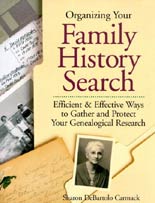
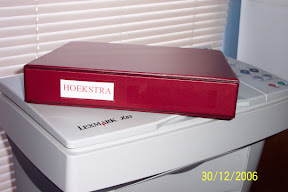
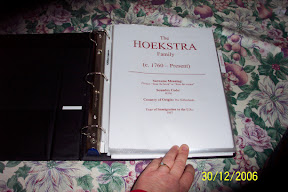
My new organizing system is pretty much based on what Sharon DeBartolo Carmack recommends in her book, Organizing Your Family History Search, with some adjustments that work specifically for my needs. I also am organizing one family line, the Hoekstras, in a binder, rather than in folders, in preparation for eventual publishing.

So, anyone out there willing to give it a go? Remember, it doesn't all have to be done by July 31st. Any progress is better than no progress! If you want to jump in, comment on this post or over at T.K.'s blog.

Friday, June 29, 2007

Finding Out More on My ROBBINS Family - Part I

As a family historian, you get so that you think you know a lot about your family. I have the disadvantage of having always lived far away from my extended family, and so sometimes there are gaps in my knowledge that don't get noticed until I start really analyzing my records. And then there are just the serendipitous surprises that make genealogy oh-so-fun!

It started off yesterday afternoon while examining the information I have on my paternal grandfather, Robert Lewis ROBBINS. I'm re-organizing and cleaning up my file folders, making sure I have copies of all the records I need, especially printouts of things I've found on the Internet. I've got my U.S. Research Checklist I created to help me remember to find certain "must have" records for each of my direct ancestors. There were some documents I figured I'd better scan and keep both on my hard drive and in my Picasa Web Albums. Copies of the documents are going into the file folders, while originals and photographs, as well as expensive copies I've paid for, are being placed in acid-free sleeves, ready to go later into a newly-rented safety-deposit box at my financial institution. This is something I've wanted to do for a long time to keep these heirlooms safe. And then there's the (dreaded) source citations I need to do properly in my RootsMagic software!

Besides my grandfather's birth and death certificates that I need to order, I realized I didn't have any land records for him. I knew he bought land in Coopersville, Ottawa County, Michigan at 185 River Road, on which he built his house and business--this was after he had served in World War II. I also knew he purchased property on Crockery Lake in the northern part of the county sometime after 1953, and there built a cement-brick cottage on the foundation of an old barn for family summer vacations. And I knew he bought a house in Coopersville sometime around 1972 at 131 Madison Street for his widowed mother to live in and for Grandma and him to stay at when they weren't snow birding in Texas. I thought he might also have owned land in several Texas counties, although it was more likely he rented lots for the various RVs and mobile homes he and Grandma had in their retirement.

The only evidence I had of his property records were oral history from my dad and one of my aunts, and a copy of the advertisement flyer the real estate auctioneers printed shortly before Grandma sold the house on Madison Street in 2005. I did a Google search on Crockery Lake to see if I could stumble upon some land records or assessment records though the county clerk's office. What I found instead was more than I could have imagined! The Chester Township History & Genealogy website has a wealth of information about its communities, including old photographs, biographies, history, and maps (including some of Crockery Lake). What surprised me was that on its Genealogies page the surnames Robbins and Lewis were listed. There isn't a search engine on the site, so I did my little trick of using Google to search a website: search term, followed by a space, then the word site followed immediately by a colon and the URL (no spaces between site and the end of the URL).

robbins site:http://mysite.verizon.net/res6xy3i/

(Notice that I didn't include the index.html from the URL, because I wanted Google to search the entire site, not just the index--or home--page).

Wow! Was I ever in for a treat! The first link I clicked went to the page about the American Legion Auxiliary founded in 1946 in Conklin. As I scrolled down the page, I noticed that Marie Robbins, Josephine Robbins, and Joyce Robbins were charter members of the Reinhart W. Roman Post 537. Why, those were the names of my great-grandmother, my granduncle's wife, and my grandaunt! Could it be...? A little further down the page, it said that Marie Robbins was the first President of the Auxiliary. Really? And yet, I wasn't done! Just a little further, and I found Great-grandma's smiling face staring back at me from the Internet. Holy cow! Gosh, I knew Great-grandma had been in the Auxiliary, because her grave had an Auxiliary marker at it. But I had never before heard she had been the movement behind getting an Auxiliary started in her community! And isn't that grand: a photo of her I didn't have before!

Well, then I went to the American Legion page, and there was information that my great-grandfather, William Bryan Robbins, Sr., and his son--my granduncle, Bill Jr.--were charter members of the Legion post. Very cool! Again, new information!

But, wait! There's more! In 1948, the Conklin school district published its one yearbook ever in its short-lived history. I browsed through the photos and text, not finding anything on my family, but being interested in the small-town history and nostalgic drawings. A quick check with my RootsMagic program confirmed that all my relatives were either too old, too young, or living in another community at that time to have attended school there that year. As I neared the end of the yearbook (third-to-last page), I noticed in the advertisement section there was a notice of compliments to the graduating class from Marie's Gift Shop...yes, that Marie! I had already written about Great-grandma's little shop in her AnceStory on my website, but it had always been a kind of vague story from the past. It suddenly became very real to me. This wasn't easy to find, either. I had to go to the Schools page, then click on the Conklin district page, and finally the yearbook page. It would have been easily overlooked, but somehow, I found it.

My Robbins family were latecomers to this area. They had arrived from McKean County, Pennsylvania at Hesperia, Michigan on the Newaygo-Oceana County border in the late 1860s, migrated south to Muskegon County in the 1910s, and settled in Conklin sometime in the 1930s. Yet, it is evident they were heavily involved in their community. Great-grandpa died in 1972 and Great-grandma moved to my grandparents' home in Coopersville. I do have some very faint memories of visiting my great-grandparents in Conklin in 1970, when I was three! I distinctly remember the inside of the little white house and eating a meal there. I also remember going to see Great-grandma there two years later when Great-grandpa died. She was sitting out in the yard with the grandaunts and uncles, and I ran to give her a big hug (prompted by my grandfather).

The Chester Township History website won the State History Award in 2005 from the Historical Society of Michigan for an outstanding website design, and it's easy to see why! The design has a standard I'd love to meet with my Atlas Project. Needless to say, my printer was very busy last night! I wrote the webmaster, asking for any more information she might have on the Robbins and Lewis families. I also fired off several e-mails to extended family members, excited to share my find with them.

What exciting, new discoveries about your family are awaiting you on the Internet or at your favorite archives?

(Coming up next: More finds on the Robbins family in online property records!)

Sunday, May 20, 2007

Using Funeral Homes for Genealogy

Last weekend, I wrote about connecting with cousins using the cemeteries where your ancestors are buried. Today I would like to talk about another great genealogical resource with Memorial Day connections: funeral homes.

If you have obtained your ancestors' or relatives' death certificates or obituaries or even their funeral cards, chances are you have the name of their funeral home printed somewhere on that document. Funeral homes are an excellent source of information, much like cemetery offices. Keep in mind that families often utilized the same funeral home service for several generations, which can help you find missing information on ancestors and relatives. Also, it's my understanding that funeral homes did not really come into much use until the late 1800s.

First of all, you'll need to find the funeral home. The documents mentioned above may not have the funeral home listed, or perhaps you've done a little investigating and discovered that a funeral home by that name no longer exists in that community. Don't be discouraged! Here are some tips for finding a funeral home. A great website is www.funeralhomes.com. This link will lead you to a database of funeral homes in the United States and Canada--good for current ones in business now. If your ancestor's funeral home is not listed, look for one with a similar name in the same city (Smith Funeral Home becoming Smith-Jones Mortuary, for example). You can always call a funeral home in the area and ask where the records for the obsolete business are now located. Very often, when one funeral home went out of business or was absorbed by another, the records were archived by either another funeral home in town or by the business that took over.

Many public libraries may have old copies of the Yellow Book (not to be confused with the Yellow Pages business directory in telephone books). The Yellow Book's full name is The National Yellow Book of Funeral Directors, and by browsing through several years' worth, you can often see the evolution of a funeral home business from one name to another to sometimes even another (Smith Funeral Home > Smith-Jones Mortuary > Jones Mortuary > Jones-Brown Funeral Parlor). The Yellow Book has a website, but it is only accessible for industry practitioners (a.k.a. Death Care Professionals). You may also wish to check city directories as well. And check with the local genealogical or historical society in the area to see if they can help you locate where old funeral home records are archived. Cyndi's List of Cemeteries and Funeral Homes is also helpful.

Once you've found the funeral home, you'll want to make a call. I prefer calls rather than letters, because it's quicker and often in a conversation with the funeral home employee I will think of other questions I wish to ask. I've created a "Funeral Home Employee Interview" form on my website here. It's been amazing what I have discovered by calling a funeral home. I've also been able to get copies of death certificates and funeral cards, names and addresses of family members, occupations and causes of death of the deceased, and names and addresses of cemeteries (especially helpful when one isn't listed in a death notice). George G. Morgan has a nice list of other items that can be found in funeral home records in his article here. As we near Memorial Day weekend, I encourage you to contact an ancestral funeral home.

Happy Hunting!

Connecting with Cousins on Memorial Day

Sunday, April 29, 2007

What I'm Reading These Days - Part 4


I've discovered a great printed resource in Sharon DeBartolo Carmack's Organizing Your Family History Search: Efficient & Effective Ways to Gather and Protect Your Genealogical Research (published 1999 by Betterway Books). My filing system has been needing revamping for a while. For many years, my records have been filed in folders categorized by surname (Midkiff, Robbins), location (Kent Co., Michigan; New York), and interest area (articles and seminar notes on probate records, censuses, etc.). While the location and interest area folders will probably remain the same, the surname folders are getting quite large and unwieldy. In many cases, I have three or four folders of information on the same surname, usually from different sources.

After browsing the Family History Store, I decided to switch to a color-coded system using Ahnentafel numbers as my filing sequence. My father's ancestors will be filed in blue folders, my mother's in red, my father-in-law's in green, and my mother-in-law's in yellow folders (I'm using my own products purchased at Office Depot). Using the recommendations from Sharon's book, every family group or couple that I am researching will have their own folder, marked with "M24/25" or "N16/17," etc. to indicate that this folder contains information on Miriam's ancestors (numbers 24 and 25 on her pedigree chart) or Norm's ancestors (numbers 16 and 17 on his pedigree chart).

Each folder will hold information on the couple's children. If the folder gets too unwieldy, I'll create a folder for each of the couple's married children, marked "M24/25.1" or "N16/17.3", showing that it contains information on the first child of my ancestors whose ahnentafel numbers are 24 and 25, or the third child of Norm's ancestors whose ahnentafel numbers are 16 and 17.

Color-coded family folders, labeled by surname, containing general research information, correspondence, and photographs will still be used, but will be much thinner and easier to manage than if they had all the documents for family members stored in them. Locations and interest areas will continue to be stored in manilla folders. I am also going to use orange folders for my mother's step-father's line and purple folders for my paternal grandmother's adoptive line, as I have done extensive research on these families. Although not biological ancestors, they have greatly influenced what my family is and who I am.

Organizing Your Family History Search is not just about organization of documents and records. A look at the table of contents gives a broad picture:
  1. Why Genealogists Need to Be Organized
  2. Creating and Maintaining a Family History Filing System
  3. Oh No! Not More Files!
  4. Making Your Research Trip Count
  5. Packing for Research Trips
  6. Organizing a Research Project
  7. There's More to Organize Than Your Research
  8. Finding Room in Your House for Your Genealogy Stuff
  9. Organization for Professional Genealogists
  10. Organizing and Preserving Your Genealogy for the Future
The book also includes an appendix, addresses, a bibliography, organization forms for genealogists, and an index. All of the forms in this book are freely available online at Family Tree Magazine. I can't recommend this book enough. Check it out at your local library or bookstore and see if you don't agree that this is a useful resource!

Monday, April 09, 2007

New Forms and Handouts Page on My AnceStories Website

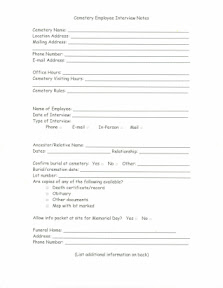
It's not pretty, it's still in beta, but I have uploaded a new page to my website for Forms and Handouts. Currently, there's only one graphic example shown (Cemetery Employee Interview Notes), but there are three forms available. Besides the Cemetery Employee Interview Form, I have also posted the Funeral Home Employee Interview Notes and Online Research Log.

I'll get the page fancied up and post more forms and handouts soon.

(UPDATE: 8 July 2008 - The U.S. Records Checklist and the Timeline forms have been added to the Forms and Handouts page of my website.)

Sunday, March 04, 2007

A Happy Discovery

Every once in a while, I stumble across a happy discovery in genealogy, usually when I'm least expecting it. Friday was one of those days. I was in a hurry, with a rushed before-work morning, trying to get things done because of the busy weekend ahead. I checked my e-mail, and was quickly scanning several messages from various RootsWeb mailing lists I subscribe to. For some serendipitous reason, I read through the entire message from the YORK mailing list, even though the subject heading was of no interest to me. It was a message gatewayed from the YORK message board, and mentioned a photograph of a grave in Bluebonnet Hills Cemetery, Colleyville, Tarrant Co., Texas.

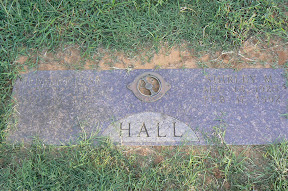
My grandaunt Shirley Marie (ROBBINS) HALL was buried in Colleyville, and that was all the information I had about her burial. Looking at Find A Grave had not been helpful, since there are 117 cemeteries listed at that site for Tarrant County, and although Bluebonnet Hills is listed as being in Colleyville, there are a number of cemeteries whose locations are simply listed as "Tarrant County, Texas." It's further complicated by the fact that Tarrant County is home of Fort Worth, so there are many cemeteries in the area. Doing a search on Aunt Shirley's name was not productive at Find A Grave, either.

Anyway, I clicked on the link in the YORK mailing list and it took me to the Tea for Two website, which is subtitled, "Cemeteries Photographed in Texas, Oklahoma, and the World." It was there I discovered that a photograph of Aunt Shirley and Uncle Herb's shared gravestone had been uploaded to the site! That photograph also gave me Uncle Herb's birth and death dates.


My next step is to obtain the phone number for the cemetery office using Qwest Dex, and then make a call. I've had a lot of success calling cemetery offices to get information, and I created a form to help me remember all everything I need to ask. If you would like a copy of this form, you can e-mail me (see my profile in the right-hand menu of this page), and I will send you one as a Word document.


Thursday, February 22, 2007

Research Log - HOEKSTRA

I spent a little over an hour the night before last working on some documents for my 3rd-great-grandfather (ahnentafel #58), Jan Martens "John" HOEKSTRA (1820 - 1909). I realized that I did not have a copy of his enumeration on the 1900 U.S. Federal Census, so I went to Ancestry to download and print it. The copy printed onto a standard 8 1/2" x 11" sheet of paper was rather small to read, so I then printed a copy of the free 1900 census form they offer. With pencil I filled in all the information on the form pertinent to Jan and third wife Grietje "Grace" [--?--] Van DAM, then placed both the census image copy and the filled-out form in my Hoekstra Family binder.

(The census image has been removed)

I then opened up my RootsMagic genealogy software, and used the Source Wizard feature to add all the pertinent census data to Jan and Grietje's personal records in proper format.

Observations I noted:
  • The couple are enumerated as "John" and "Grace" HOEKSTRA, anglicized versions of their forenames.
  • Jan's age (79) and date of birth (Mar 1821), while consistent with each other, are incorrect. He was 80 years old and born in March 1820, information shown in abstracts of the birth records found online in the archives of the Province of Friesland, the Netherlands. His county death record and obituary match his birth record abstract.
  • There are squiggles in the columns for "Number of years of present marriage" for both Jan and Grietje. They had been married for nearly 6 years at that point (I have their county marriage record). I know it was his third and her second marriage.
  • Jan's year of immigration (1881) and number of years of residence in the United States (19) were way off. He immigrated in 1867 and so had lived 33 years in the U.S. by 1900. I am beginning to wonder if this was Grietje's immigration information.
  • He was listed as a naturalized citizen. I then went to the State of Michigan's website and found a Jan Hoekstra listed in the Ottawa County Naturalization Index. The first paper for this individual is in Volume 2, Page 368. I can access these on microfilm through my local Family History Center to see if this Jan Hoekstra is the same man as my ancestor.
  • Jan is listed as a home owner of a mortgage-free home at 481 Wood Avenue, Muskegon (5th Ward), Muskegon Co., Michigan. Obtaining deed records would be a good idea. A while ago, I did a keyword search for "481 wood" at Ancestry's "Muskegon, Michigan Directories, 1887 - 1890" database. For the year 1887 - 1888, there were four Van DAM gentlemen, Guerin (laborer), Jeremiah (laborer at Ryerson manufacturing Co., boarder), John (laborer, boarder), and Joseph (laborer for T. D. Stimson). For the year 1889 - 1890, only Guerin (laborer) and Joseph (laborer at Ryerson manufacturing Co.) were listed at the home. Jan and Grietje were married in September 1894, and from his obituary we learn that he moved to Muskegon around 1895 from Holland, Ottawa Co., Michigan (likely at the time of his marriage to Grietje). I need to do further research on Grietje's first husband and children to see how the above names fit into her family group record. I think her first husband probably died, as did Jan's first and second wives, before she married Jan. But I don't know her husband's first name, and looking at a Van DAM family in Holland, Michigan in the 1880 U.S. Federal Census--a possible match for Grietje--does not clarify things for me, but rather leaves me with more questions. So I'll be doing more research on her first marriage and subsequent children later. And I'm curious about the transfer of the property from the Van DAM family to Jan HOEKSTRA.

Tuesday, February 06, 2007

Adoptive Family Ancestor Chart

Are you an adoptee, or descended from one? Or are there adoptees that have been added to your family circle? Family Tree Magazine now has a free three-generation ancestor chart available online that includes both the biological and adoptive ancestors of an individual. I'm definitely printing out a few copies. My paternal grandmother is an adoptee (I've traced both lines), and I have five adoptive first cousins, as well as two nieces, who are adoptees. I may even alter this chart to use for my mother, as she was raised by her step-father, and I've done a lot of research on his line.

Tuesday, January 23, 2007

Online Research Form

As I blogged in my New Year's Resolutions, I have wanted to keep better track of my online research and search results. When using online databases, it's so easy to lose track of exactly what you searched for, especially when refining your searches to adjust for name spellings, locations, ages, etc.

I created an Online Research Form to help me document my research a little more carefully and efficiently (hopefully, no more repeating searches with the same parameters). A sample of what I have done is shown below, and you can also view a full-size version of it here (use the magnifying class icon above the image to zoom in).


The purpose of this particular search is to find my 3rd-great-grandmother, Cornelia McCLELLAND on the 1860 U.S. Federal Census. This woman has been extremely troublesome to find in many records. I believe the main reason for this is that she was illiterate - she signed her name with an "X" on all the paperwork in the Widow's Applications for the pensions of her two Civil War veteran husbands. She may simply have had very little schooling, and by not being able to write down dates, had nothing to rely on except her memory. Every record in which she (or a relative) states her birthdate or her children's birthdates seems to never coincide with any of the others. The most consistent records indicate she was born in late 1856 or in 1857, in St. Clair, St. Clair Co., Michigan. I finally discovered her parents' names on one of her marriage records (she was married three times): Levi McCLELLAN and Clarissa CLEVELAND.

Some of the many spelling possibilities I've come up with for this family's surname are: McCLELLAN, McCLELLAND, McCLELAN, McCLELAND, McLELLAN, McLELLAND, McLELAN, and McLELAND. Now change the "Mc" to "Mac" and you have eight more spellings! Another possibility is "M'." I could also remove the "M'/Mc/Mac" altogether. I could change the letter "a" to any other vowel, including "y," and still get the same pronunciation. The "e" could also be changed to another vowel.

In addition, CLEVELAND could be spelled with or without the final "D," with a variety of vowels in the last syllable, and a variety of spellings (CLEAVE- CLEEV-, CLEFE-, etc.) in the first syllable.

Levi can be a mis-transcription of Lewis; Clarissa could be Clara, Clare, or Clair, not to mention Rissa, or LaRissa. Cornelia could be Cordelia, Corrie, Connie, Nell(ie), Delia, or mis-transcribed as a male, Cornelius.

Soundex searches can be extremely valuable, but wouldn't work in differentiating between McCLELLAN and CLELLAN. I'd have to search both. You can see for all these variations, I definitely need to keep track of what I am searching for! By listing every search I make for this family, I can make sure I've covered all the bases. I can also double-check previous searches when I get a brainstorm for a new spelling or nickname...or an idea of a different location they may have resided in.

If you would like a copy of this Online Research Form, drop me an e-mail at kidmiff@gmail.com. I will send it to you in a Word Document. It is set up in landscape view, and you may need to adjust your printer margins for it to print properly. I hope to eventually make this available online using Google Documents or Adobe, but I haven't figured out how to do that yet!

Saturday, December 30, 2006

My New Year's Genealogy Resolutions for 2007

Having already done some reflection on my genealogical accomplishments in 2006, it's time to look ahead to the New Year. Here are my resolutions:
  • To continue and to improve my process of recording my research, especially when I search online databases. It's so easy to quickly enter one search term after another, without stopping to record which spelling variation or soundex code I used in each search. I know I waste time by repeating searches later on. I think I'll create a form to help me.
  • To cite my sources properly. It's a lot of work, especially to go back and re-cite 20 years' worth of information that I used to enter in note form on my computer. Now that I have RootsMagic, its computerized source citation forms will ease that process, but it still will be time-consuming. My goal for this year is to get all the sources I currently have for my children's father's and my direct ancestors through our great-great-grandparents' generation cited properly. This includes printing up a lot of census records that I have accessed on Ancestry.com, but have not bothered to add to my hard copy files.
  • To photograph and log my genealogical "treasures," items that have once belonged to my ancestors and late relatives. My friend Beverly Smith Vorpahl once wrote a terrific article about the importance of documenting these items, so that they will not be carelessly disposed of in the event of your death. I also plan to continue to take steps to preserve these items and to educate myself in areas where I am not sure of how to do so. I have already ordered two books by Maureen Taylor, Uncovering Your Ancestry Through Family Photographs and Preserving Your Family Photographs: How to Organize, Present, and Restore Your Precious Family Images that should help me in these areas.
  • To begin to slowly change my hard copy files from a file folder system to a notebook system, using archival-safe, acid-free page protectors. Currently, I have all my hard copies for each surname I'm researching jumbled together within one (or more) file folder(s). This is not very organized, and downright messy. I have so much information now. I want to organize it by generation. I already started this project for my HOEKSTRA files. It's going to be time-consuming and expensive, but I have to think about the big picture: having hard copy data stored in a preservable format. I plan to color code the D-ring notebooks: blue for my father's lines, red for my mother's, green for my father-in-law's black for my mother-in-law's, and white for my Location and Subject files (county and state resources and research topics such as probate, land, military records, etc.).

  • To continue to blog at this location, and when I am lacking in time, to at least record my research in my Notepad Research Log (see my entry of December 29th). Also, to be consistent in writing both prompts and responses for my new blog, AnceStories2 (hope you'll join me!)

Sunday, July 16, 2006

Broken Links and Other Tips and Tricks - Free Syllabus

A couple of months ago, I taught a computer class offered exclusively for members of the Eastern Washington Genealogical Society. This class was titled "Broken Links and Other Tips and Tricks." Have you ever heard of a great genealogy website from a friend, or seen a link to a great new database in an e-mail or on a website...but when you've gone to the site (either by entering the URL yourself or clicking on a link) you get the dreaded 404 Page ("this page not found")? There are tips and tricks you can use to find the site you need. I wrote this presentation from things I learned from experience, plus from other tips I've found along the way over the years. For those who could not attend (and for all of you reading this blog), I am offering the syllabus for that class. It is a step-by-step procedure on how to find those sites when the links are broken. This syllabus is offered for free, no-strings-attached (I won't send you spam or put you on a mailing list). Just e-mail me (find my address in My Profile - see right-hand menu) and ask for the Broken Links syllabus.

P.S. This syllabus isn't just for genealogy websites...it will work for ANY kind of site you are looking for online.