Showing posts with label Texas. Show all posts

Thursday, March 27, 2008

Mary Emeline (WILBOURN) MIDKIFF


Source: Midkiff, Mary Emeline Wilbourn. Photograph. Taken before Sep 1919. Reproduction of original photograph in the possession of Miriam Robbins Midkiff, Spokane, Washington. 2008.

Mary Emeline WILBOURN was my husband's Great-great-grandmother Midkiff. She was born 11 Aug 1839 in Sandoval Twp., Marion Co., Illinois to Dr. John Wilks WILBOURN of Orange Co., North Carolina and Martha Susan DEADMOND of Bedford Co., Virginia. John and Susan's respective families had migrated to Marion Co., Illinois by 1831, when they married. Mary was the fourth of nine known children which included Rufus K. (b. c. 1833), Denita Frances (b. c. 1836), James Manissa (1837 - c. 1837), John Henry (b. c. 1843 - bef. 12 Mar 1878), Aramanthe E. (b. 1846), Thomas Jefferson (1849 - 1942), Sarah Jane (1851 - 1940), and Benjamin Franklin WILBOURN (1854 - 1944).

The Wilbourn family moved from Illinois to Grayson Co., Texas between 1843 and 1846, and were prominent in that early community. It was there on 24 Jul 1859 that nearly-20-year-old Mary was wed to Charles Anderson MIDKIFF. They lived in Sherman Township when the 1860 U.S. Federal Census was taken; a time when trouble between the North and South was brewing. Charles served with the Texas Cavalry for the Confederacy, along with two of his brothers. About that time, the family moved to nearby Springville, Cooke Co., Texas. During the war, their two eldest, William Preston (1862 - 1936) and Charles "Anderson" Jr. (1865 - 1948), were born. Louanna Ellen "Annie" (1868 - 1940), John Franklin (1870 - 1926; my husband's great-grandfather), Ethel Susan (b. 1874), and Thomas Jefferson "Tex" MIDKIFF (1879 - 1941) soon followed. An infant, Mae, did not survive.

The Midkiff family remained in Cooke County where they were enumerated in the 1880 U.S. Federal Census. Charles' occupation was a miller. Sometime within the next few years, they moved to Lexington, Cleveland Co., Oklahoma Territory, where some of their children were married and their first grandchildren were born. Ever on the move, the family may have also lived in Pottawatomie Co., Oklahoma Territory, and were definitely residing in Delta Co., Colorado by 1902, where Charles was cattle ranching.


The Midkiff Family in Delta Co., Colorado. Charles and Mary are in the center, surrounded by their children, children-in-law, and grandchildren.

Source: Midkiff Family at Home in Delta County, Colorado. Photograph. Taken c. 1902 - 1908. Original photograph in the possession of John and Mary Lou Midkiff, Midland, Texas. 2008.

On 10 Mar 1908, Charles wrote his brother in West Texas from Hotchkiss, Delta Co., Colorado and told him he had sold his ranch the summer previously, as he had been injured when his mules ran away with him, getting caught under the wagon and breaking his left leg. Because of being crippled, he could not work the ranch in the winter when the snow was so deep. This injury was probably also motivation for Charles and Mary to retire after a few years to Chico, Butte Co. in Northern California, where the warmer climate and town living were more suitable for the senior couple. Mary's mother and four younger siblings and their families, along with most of the adult Midkiff children with their families, also lived in the area; however, I haven't done enough research to discover if the Wilbourns or the Midkiffs emigrated to California first.

In 1914, both Mary and Charles are listed on the Butte County Voters Registration. California had granted suffrage to women in 1911, nine years before the federal government did so. After Charles died in 1919, Mary lived with their daughter Annie until her own death in 1923. Mary and Charles are buried in unmarked graves in the Wilbourn Family Plot in Chico Cemetery.


The "empty" grassy spot in the midst of the Wilbourn Family Plot in Chico Cemetery is the final resting place of Mary Emeline (WILBOURN) MIDKIFF, and her husband, Charles Anderson MIDKIFF, Sr. The graves of Mary's sisters can be seen in the foreground.

Source: Midkiff, Charles Anderson Sr. and Mary Emeline (Wilbourn) burial location, Chico Cemetery, Chico, Butte Co., California. Photograph. Taken 31 May 2006 by FindAGrave photo volunteer Laural N. D. at the request of Miriam Robbins Midkiff. Digital photograph in the possession of Miriam Robbins Midkiff, Spokane, Washington. 2008.

Saturday, November 03, 2007

Midkiff, Texas Receives Texas Historical Commission Mark

This morning at 10:00 am Central Daylight Time (which is, at the time of this blogging, occurring right now!), the community of Midkiff in West Texas is receiving a Texas Historical Commission Mark. Read more here.

There were actually two communities with that name, located in separate counties, but not too far from each other. The first was a general store and post office held in the early twentieth-century home of John Rufus Midkiff, on his cattle ranch in Midland County (the same county where George W. Bush retires on his vacations). John was the brother of my husband's great-great-grandfather, Charles Anderson Midkiff, Sr. Over time, this tiny community became a "ghost town," as recorded in the Texas State Historical Association's Handbook of Texas.

In the 1950s, the U.S. Postal Service was looking for a location in which to build a post office that could serve the rural cattle ranch and oil field areas. They picked a Upton County community, Hadacol Corners, and renamed it Midkiff in honor of the cattle ranching family that had pioneered in the Midland-Upton County area; the Midkiff zip code is 79755.

Mary Lou Midkiff, wife of a great-grandson of John Rufus Midkiff, recently wrote an interesting, well-researched and carefully cited book, Midkiff: A Texas Family, Town and Way of Life. Much of her material came from a trunkful of letters that was found in an outbuilding on the family ranch, which were written mainly by or to John's son Thomas "Oscar" Midkiff, Sr. By piecing together the family history with local history, Mary Lou has written a superb non-fiction account of the American West and of true cowboy history. Not coincidentally, the foreword was written by Western novelist Elmer Kelton, whose family history parallels that of the Midkiffs', as their ancestors knew each other and worked together. If you are interesting in purchasing this book, please visit Mary Lou's site.

Sunday, August 19, 2007

Filling in the Holes in My Robbins Family Tree

I mentioned in my last two blogs that I took my laptop with me on my camping trip, and used some of my downtime to input information from my hard files into my database, citing my sources along the way. It was good use of my time, because I didn't have Internet access to distract me from jumping back and forth between inputting data and looking up more records online (I tend to multitask all too often and am quickly distracted). Instead, I added many items to my To-do Lists, which are easily created for each individual in my RootsMagic software. Many of these were reminders to check online vital records indexes, especially for the states of Texas and Florida. A little lightbulb went off in my head when I realized that I had been mistakenly thinking of my Robbins family as Michiganders, instead of as Texans and Floridians. Yes, many of them were born and raised in Michigan, but my paternal grandfather's sisters and one of his brothers moved to Texas as adults, and his other brother moved to Florida. Also, my uncle's (dad's brother) first wife and their children moved to Florida after their divorce. So I had many names of aunts, uncles, and cousins to look up in databases at Ancestry.com.

Last night and today I have been visiting these databases, aided by Joe Beine's excellent Death Indexes Online and Online Genealogy Records and Resources for quick entrance to the desired online indexes. I'm also using Ancestry's US Public Records Index and US Phone and Address Directories, 1993 - 2002 to find recent addresses for my relatives. I've added quite a bit to my Robbins family tree using the above resources (citing them as I go!), along with photo captions and obituaries found in the scanned pages of my Grandaunt Joyce's scrapbook, which I recently received, and which has been the fount of recent posts on my Great-grandfather Robbins' service in the American North Russian Expeditionary Forces.

I used to be frustrated because I have been brickwalled on my Robbins ancestry at my 4th-great-grandfather, Joseph Josiah Robbins (1820 - 1905), while on many of my other lines, I've been able to zip right back into colonial America or cross the pond to Northern Europe. It has seemed strange that my maiden surname's line suddenly deadends after just a few generations back. But I realized that I really do have a wealth of information on my Robbins family, and in order to break down my brick wall, I need to invest in the time it will take to print up, download, scan, input and cite all the many documents and resources I do have. I've been fairly neglectful in attending to the details of this family, either assuming that I already know everything there is to discover, or being frustrated at the dearth of accessible records for those things I lack information on. Two of the strategies that professional researchers insist work well for breaking down our brick walls include going over and analyzing all the information one already has to discover new clues and determine what information is missing; and researching the collateral lines thoroughly. I'm hoping that my methodical steps will unearth some leads to tearing down my brick wall.

Saturday, July 07, 2007

Finding Out More on My ROBBINS Family - Part 2

A week ago, I blogged here about how I started out looking for possible online records for property owned by my paternal grandparents, particularly that owned by my grandfather, Robert Lewis Robbins, as I wasn't sure if or when my grandmother's name would be on any deeds. My purpose was to find some evidence for the oral history that my father and aunt have shared with me about family property. As I mentioned in Part 1, my online search led me to online records about my grandfather's parents and siblings; in turn, sharing those web pages with extended family has produced more oral history about those years, which is very exciting (I'm having a hard time keeping up with recording all of this!). But I also wanted to share in this post about some of the actual evidence of property ownership I did find online.

First of all, I went to FamilySearch to see if land records were available through the Family History Library for the locations and time periods I wanted. In the FHL online catalog, I did a place search for Ottawa (county) and Michigan, the county in which I know for sure that my grandfather owned at least three pieces of property. The catalog was not real helpful. I know that my grandfather bought his probable first piece of property after World War II, at 185 River Street in Coopersville (which reminds me...I need to figure out where he and Grandma lived between their marriage on 12 Oct 1940 and his enlistment in the service on 13 Oct 1942...a rental? with family? own home?). The deed records for Ottawa County end in 1939, and the mortgage records end in 1940; both are only indexed until 1901. This information will be helpful when I search for my grandparents' parents' land records, but not for my purpose at hand. There is a land atlas book for 1987 - 1989, which I can only view on site if I go to Salt Lake City. Again, it may be interesting, but won't provide exactly what I'm looking for, since I already know where the land my grandparents owned during that time was located.

My next try was to go to the Ottawa County Clerk's Office online. I simply Googled it as such: "ottawa county clerk" michigan. I used Michigan as part of the search term, because I figured there might be another county by that name in another state. When I found the site, I looked for the county assessor's department. I didn't find one, but I did find the Register [sic] of Deeds. Note to Ottawa County webmaster: a register is an item in which documents are recorded; a registrar is an official in charge of making sure documents are registered! From here, I could do a Property Search for Public Users, which was free limited access to the records. I could search by Owner Last Name, Parcel Number, Property Address Number, or Range of Property Address Numbers, as well as limit my search by Active or Inactive Parcels, or both. When I searched by Owner Last Name (Robbins) and both kinds of parcels, I found the information for the house my grandfather had purchased for his widowed mother to live in sometime around 1972 (131 Madison, Coopersville). The details stated that the property had been purchased before 1975. I also discovered that my grandparents had bought additional lots around the original property. For a very reasonable cost ($1.50 each), I can order deed searches for each parcel. I also was able to find rather current (from 1999 to the present) information on the 185 River Street property in Coopersville, as well as the surrounding three lots Grandpa bought later. I believe my grandfather sold these parcels on River Street when he retired to my uncle, along with the body shop business; my uncle sold everything in the 1980s, so the current owner's name is a stranger to me. I've put all these items on my "Records To Purchase" list, and printed up all the information I could off the website. The only thing I need to do is figure out how to find the parcel or address information for the lake cottage on Crockery Lake which Grandpa once owned in order to order those records as well.

My next searches were in various Texas counties where my grandparents "snowbirded" and later retired (along with several of my grandfather's siblings). I didn't know the county names for some of them: Glen Rose, Corpus Christi, Rockport, Fulton, San Antonio. So I used the county finder (U.S. Town/County Database) at RootsWeb, and came up with Somervell, Nueces, Aransas, Aransas (again), and Bexar counties, respectively. The Somervell County Clerk's Office has no records online; in fact, their website was pretty bare bones. Nueces County had tons of information, but I had to go through a free, but slightly time-consuming, registration process. It was worth it, because although I didn't find anything from 1982 through the present on my grandfather or his brothers, I did find a piece of property one of his sisters had co-owned with what looks like friends. The Bexar County Clerk's site brought me property information for my granduncle and his son, and the Aransas County Clerk's site gave me my grandmother's current property information.

One thing that I learned about looking at county clerk websites: each is as different from each other as can be, even within a state. Some county clerk's offices don't even have a website, or one that is well done (as modeled in the Somervell County, Texas example, above). Some have greatly detailed information, while others have the basics. Some offer all details for free, while others ask for payment for all or part of the information. Here in Spokane County, I can view online current (three years old or less) photographs of the property, and in Clark County, Washington, I was able to find very old photographs (c. 80 years old) and a footprint of the home of my parents-in-law, with information about additions to the main structure. On some websites, you need to find the assessor's or appraisal information, while on others, you must look for deeds, taxes, or just plain property records.

Most of the records you'll find at online county clerk websites are fairly current information, usually no more than five years old, with most being closer to three. It's not often helpful to find ancestors' records; however, it can be a way to find out who the current owner of an ancestral home is, or see a current photograph. It can also lead you to being able to purchase older records, as I discovered with my grandfather's properties.

Sunday, May 13, 2007

Connecting with Cousins on Memorial Day

Three years ago, my husband, children and I traveled across the state of Washington to spend Memorial Day weekend with my in-laws in Vancouver, Washington, which lies just across the Columbia River from Portland, Oregon. I always enjoy this cross-state visit, as the longest leg of it--driving along the Columbia River on the Oregon side--follows both the Lewis and Clark trail and the Oregon Trail. I enjoy imaging the explorers and pioneers traveling the same route, and seeing Mt. Hood towering in the distance.

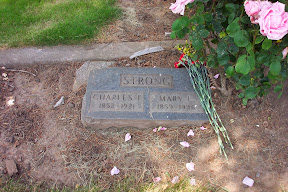
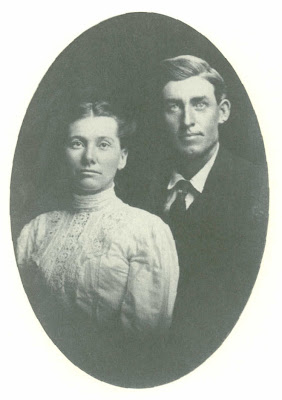
While in Vancouver, we went with Norm's parents and sister to Park Hill Cemetery in Vancouver, to visit and photograph the MIDKIFF, TOLLIVER, DAVES (step-ancestor), LUKE, and CHAPLIN graves. The following year, 2005, we made the same trip, and I insisted that we were going to travel down to the Willamette Valley to visit and photograph the grave of one of Norm's great-great-grandmothers, Rebecca Catherine (SNOOK) WESTABY, buried in Salem, as well as the graves of my great-great-grandparents, Charles Frisbe STRONG and his wife, Mary Lucy WRIGHT. Charles and Mary are two of only four of my ancestors buried west of the Mississippi River, and the other two are nowhere near my home! My paternal grandfather, Robert Lewis ROBBINS is buried at Ft. Sam Houston National Cemetery in San Antonio, Texas, and a 4th-great-grandmother, Lura Ann (JACKSON) PECK CRAPSEY, is apparently buried in St. Paul, Minnesota. So to actually be able to be within a few hours of an ancestor's grave is a big deal to me, and I wanted to take advantage of the opportunity.

When we arrived at Belle Passi Cemetery in Woodburn, Marion Co., Oregon, where Charles and Mary are buried, we found that the graves had already been cleaned and decorated. They were surrounded by other graves, obviously of the family of their daughter, Ethel Melissa (STRONG) HASTIE, who is buried there along with her husband, the Rev. Ezbon Roy HASTIE. I remember visiting the widowed Aunt Ethel in 1979, when we first moved to Washington State, and remembered meeting her son.


We were rather rushed on that visit, and so I didn't have time to try to find out how to contact the family. But on the way home, I had a couple of ideas that could work for you to help you connect with cousins on Memorial Day. Obviously, I could have looked up the Hastie family in the phone book in Woodburn, or on Dex Knows when I got home. But what if you are looking for descendants of an ancestor, yet you don't know your cousins' surnames?

First off, you need to know where your ancestor is buried. If their grave is in your hometown or nearby, you're in luck. If you are like myself and live far from your ancestral cemeteries, it's important to obtain death certificates and/or obituaries of your ancestors to determine their final resting places. I use Random Acts of Genealogical Kindness quite frequently to get obituaries of ancestors. They're easier and less expensive to access than death certificates. Once I have the name of a cemetery in hand, I use Find A Grave, Interment.net, Dex Knows, or Cemetery Junction to find an address and telephone number (check out Cyndi's List of Cemeteries as well).

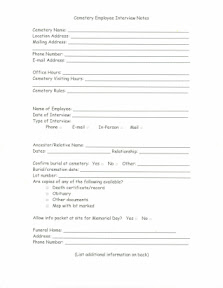
My next step is to cold call the cemetery office during local business hours. I have had so much luck with this! You would be amazed at how helpful cemetery employees are! From phone interviews I have discovered the names of other ancestors and relatives buried in the same cemetery, the names of the funeral homes that provided services (I'll post more about this in the future), the names and addresses of the lot owners (which may be obsolete, but may provide relatives' names). I always try to obtain the lot number of the grave(s) I am interested in, and sometimes the employee will mail me a cemetery map. I ask the cemetery employee if it's okay to send them an info packet that they could place on my ancestor's grave (see following paragraph). In fact, I have been so successful in this type of research, that I've created a form that I use to help me remember all the questions I want to ask when I call.

The fourth step is to write a letter explaining that I am a descendant of the ancestor buried in that cemetery, and that I am doing genealogical research on the family. I leave contact information: a phone number, mailing address and e-mail address. This letter is folded and sealed in a zip-lock bag and then placed in an envelope which is addressed either to the cemetery office or to a volunteer in the area that I've contacted through the local genealogical society or Random Acts. The cemetery employee or the volunteer can then place the info packet (my letter in a zip-lock bag) on the grave, hopefully weighted with a small rock or wedged into a crevice of the headstone, so it won't blow away. If this is done about a week before Memorial Day weekend, there's a chance that I could connect with another descendant of that ancestor who has come to the cemetery to clean and decorate the grave! If the cemetery doesn't allow an info packet left on the grave itself, ask if your letter could be placed in your ancestor's file at the office.

So what's the purpose of this? To hopefully connect with other relatives of a common ancestor and exchange information...photos, documents, stories, etc. It's likely that the two of you have missing information that the other may be seeking. Perhaps you'll break down a brick wall! Memorial Day weekend is only two weeks away, so I hope you'll take advantage of this tip. Good luck to you!

Thursday, March 08, 2007

Happy Birthday - March 8

Happy Birthday to:


Lillie (DAVENPORT) MIDKIFF, who was born on this day 130 years ago in Macon County, Georgia to Seaborn Ludwell DAVENPORT and Nancy JENNINGS. On 16 November 1894 in Arthur, Indian Territory, she married Thomas Oscar MIDKIFF, first cousin of my husband's great-grandfather, John Franklin Midkiff, Sr. Lillie and "Oscar" had 12 children--all of whom survived well into adulthood--and their incredible lives as a hard-working ranch family in West Texas have been documented in Mary Lou Midkiff's Midkiff: A Texas Family, Town and Way of Life. After reading this book, one can only shake one's head at the determination, courage, heartbreak, and endurance that cattle ranching in the west requires, along with the faith and support of an equally-tough ranching wife. A treasure trove of discovered family letters narrates the struggles and triumphs of this woman, her husband, their children, ranch and community. Lillie outlived her husband, dying at the age of nearly 95 on 23 January 1972 in Midland, Midland Co., Texas. She was laid to rest next to her husband two days later at Fairview Cemetery, Midland.

Sunday, March 04, 2007

A Happy Discovery

Every once in a while, I stumble across a happy discovery in genealogy, usually when I'm least expecting it. Friday was one of those days. I was in a hurry, with a rushed before-work morning, trying to get things done because of the busy weekend ahead. I checked my e-mail, and was quickly scanning several messages from various RootsWeb mailing lists I subscribe to. For some serendipitous reason, I read through the entire message from the YORK mailing list, even though the subject heading was of no interest to me. It was a message gatewayed from the YORK message board, and mentioned a photograph of a grave in Bluebonnet Hills Cemetery, Colleyville, Tarrant Co., Texas.

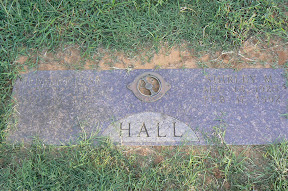
My grandaunt Shirley Marie (ROBBINS) HALL was buried in Colleyville, and that was all the information I had about her burial. Looking at Find A Grave had not been helpful, since there are 117 cemeteries listed at that site for Tarrant County, and although Bluebonnet Hills is listed as being in Colleyville, there are a number of cemeteries whose locations are simply listed as "Tarrant County, Texas." It's further complicated by the fact that Tarrant County is home of Fort Worth, so there are many cemeteries in the area. Doing a search on Aunt Shirley's name was not productive at Find A Grave, either.

Anyway, I clicked on the link in the YORK mailing list and it took me to the Tea for Two website, which is subtitled, "Cemeteries Photographed in Texas, Oklahoma, and the World." It was there I discovered that a photograph of Aunt Shirley and Uncle Herb's shared gravestone had been uploaded to the site! That photograph also gave me Uncle Herb's birth and death dates.


My next step is to obtain the phone number for the cemetery office using Qwest Dex, and then make a call. I've had a lot of success calling cemetery offices to get information, and I created a form to help me remember all everything I need to ask. If you would like a copy of this form, you can e-mail me (see my profile in the right-hand menu of this page), and I will send you one as a Word document.


Monday, February 19, 2007

18th Carnival of Genealogy is Posted

I tried to blog this earlier, and ran into a hiccup...so here goes again! Jasia, over at Creative Gene, has posted the 18th Carnival of Genealogy. The topic is "5 Best Tips for Specific Research Areas." Nine bloggers share their tips for researching in specific locations including Massachusetts, Michigan, Mississippi, Missouri, Northeast Indiana, Detroit (Polish ancestors), San Diego (CA), Texas, and Upstate New York. There also a blog on five generic tips that can be used for any kind of research. So take a look and check it out. Even if none of these research areas apply to you, you may get an idea or two of how to do research in your ancestral locations.

The topic for the 19th Carnival of Genealogy is "Shelter from the Storm: Stories of Home and Hearth." I encourage you to take a try at blogging on a specific topic...it's a lot of fun!