In honor of Women's History Month, International Woman's Day (March 8th), and as a part of the
20th Carnival of Genealogy, I'd like to present a biographical sketch of my maternal grand-aunt, Barbara Dorothy VALK.
Barbara began her life on 30 July 1918 in Grand Rapids, Kent County, Michigan, the daughter of
William James VALK and
Agnes TUINSTRA, and the twin sister of John, who was stillborn. She was the youngest surviving child and only daughter of this marriage, having six older brothers: Jim, George,
Bill Jr. (my grandfather), Chet, Oscar, and Ted. Her parents were first generation Frisian (Dutch) Americans, and she was named for her immigrant grandmothers, Berber J. (DeJONG) VALK and Doetje WIERSMA. Barbara had the red hair, blue eyes, fair, freckled skin and round Frisian build that many of the Valks inherited.
When she was born that summer morning, the United States was still embroiled in World War I, and the deadly 1918 (Spanish) flu pandemic was just beginning. This virus killed between 50 and 100 million people (many of them healthy, young adults) over the following two years, leaving more casualties than the war itself. Many scientists believe that this particular strain of flu caused cytokine storms, a fatal immune reaction in which the body overproduces immune cells to ward off disease and ends up causing significant damage to body tissues and organs (not unlike what happens with T-cells and cancer). This was in turn followed by an epidemic of encephalitis lethargica, which left 5 million dead in its wake. The symptoms of this disease include fever, sore throat, headache, double vision, delayed physical and mental response, sleep inversion, catatonia and lethargy. In acute cases, patients may enter a coma-like state. Patients may also experience "abnormal eye movements, parkinsonism, upper body weakness, muscular pains, tremors, neck rigidity, and behavioral changes including psychosis," according to
Wikipedia. Some scientists postulate that encephalitis lethargica may have been caused by the Spanish Flu.
Barbara's mother, Agnes, contracted the flu and family oral history states that the illness "went to her brain." Whether she contracted encephalitis lethargica is unclear, but she was institutionalized in at least two mental hospitals until her young death in 1921 at the age of nearly 36 at Cutlerville Psychopathic Hospital, south of Grand Rapids. The cause of death was myocarditis (inflammation of the muscular part the heart caused by a virus or bacteria). In the 1920 Federal Census, we see the impact this illness has had on the family: Barbara and three of her brothers--George, Chet and Ted--are living in the Blodgett Home for Children. Their eldest brother Jim is living with their paternal grandparents; brother Bill is living with the Jaarstra family (probably family friends or as-yet-unidentified relatives). Brother Oscar has not been found in the 1920 Federal Census; he may have been living with a foster family when the residents of Blodgett Home were enumerated, and returned to the Home before his foster family was enumerated. Their father is living alone at home, and their mother is enumerated twice: the first time, in a residence a few blocks from their home, around the corner from the Jaarstra family, and enumerated as a "widow" (Jan. 7th). The second time (Jan. 21st) she is listed as an inmate at Mitchelt Cottage at Kalamazoo State Hospital.
Nearly two years after Barbara's mother died, her father married a widowed first-generation German-American, Ida Eva (LAMBRECHT) SCHADLER, who had a young son from her first marriage. The family was reunited, with the exception of Oscar, who was raised by his foster family. Barbara's father and step-mother had eight more children--including another pair of twins--five of whom survived infancy: Jennette, Bob, Ray, and two daughters yet living. This family of twelve full, half-, and step-siblings, plus two adults surely must have crowded the home at 1006 White Avenue, N.W.!
Barbara's father was an elder at an independent Bible church called the Tabernacle in Wyoming Park, southwest of Grand Rapids. Here she met
Ruth HOEKSTRA, who was to become a lifelong friend. The Hoekstra and Valk teens shared many good times: Ruth's younger sister, Mary Lou, dated Barbara's brother Ted for a while, and Ruth started dating Barbara's oldest brother Jim, until Barbara told her he already had a steady girlfriend (Thelma, who he eventually married) in northern Michigan. Then Ruth began dating middle brother Bill, and eventually married him in 1943. Ruth and Bill's only child was my mother. Even after Bill and Ruth divorced, Ruth and Barbara remained steadfast friends. By this time, Barbara had attended Moody Bible Institute with the intentions of becoming a missionary, and was associated with the
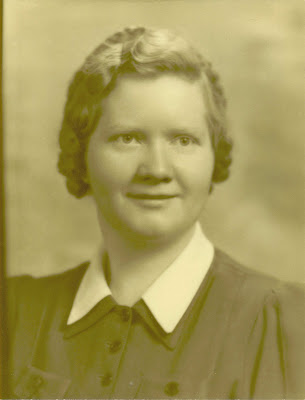
Africa Inland Mission. The portrait above was taken in Chicago and may have been her college graduation photo. Her brother Chet was killed during the Battle of the Bulge, and his 1944
obituary mentioned that Barbara was enroute to Africa. She first served in the
Belgian Congo; in fact, her father's
obituary of 1950 mentions her residence there, but she ended up spending most of the 38 years of African mission work in the
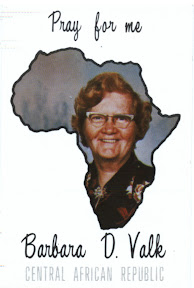
Central African Republic.
Barbara had an profound impact upon my mother. She was the main tie to the Valk side of the family, as my mother was raised by her mother and step-father. My grandmother was not too keen on having my mother spend much unsupervised time with her father's side of the family, as they had different family values. She would, however, let my mother attend family reunions as long as Aunt Barbara was there (on leave from mission work) to accompany her. I'm sure she was the inspiration behind my mother's desire to be a missionary as well. Later, when my parents were Salvation Army officers (ministers) working with Alaskan Natives, Aunt Barbara and my mother corresponded regularly around the globe. They had much in common. Both far from their families, living in remote areas with harsh living conditions, surrounded by people of differing races and cultures than their own, they found comfort in sharing their news, failures, joys, and prayers.
As a stamp collector, I enjoyed receiving the colorful, foreign-looking stamps from Aunt Barbara's envelopes. Her letters were regularly written on beautiful stationery purchased from local natives who had drawn or created the decorative artwork. She once sent a gift of a set of cards embellished with flowers whose "petals" were made of butterfly wings. She wrote of the work she was doing among the native women and children. Many were living in surroundings of poverty, domestic abuse, alcoholism, and terror of local witch doctors. She did her best to educate, encourage, and empower them. Barbara was afraid of no one; she stood up to chiefs and witch doctors alike to protect her mission and the women and children she worked with. The girls in her school became highly sought after as wives because not only were they well-trained in domestic skills, but they were older and able to bear children soon after marriage (the traditional way was to marry off daughters while they were yet children).
Barbara's life in Africa was not without upheaval. At one point, Africa Inland Mission abandoned the mission where she was working (perhaps due to the many revolutions in the country). Although not a Baptist, she sought after and received permission from
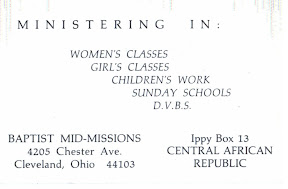
Baptist Mid-Missions to represent her and administer her financial support. She had to start all over with a new mission, school, and supplies from BMM.
She went through many revolutions in the countries she worked in, resulting in expulsions or evacuations, and lost all her belongings, having to start all over each time. During the dark and dangerous days of the Central African Empire (a dictatorship), she entreated her family, friends and supporters for their prayers. Letters from her arrived heavily censored. A note my mother sent at the beginning of the regime included a question as to whether or not freedoms were being upheld by the new government; Barbara never received the message. In fact, mail service became completely undependable, and my mother dared not send any gifts or monies for fear they would be stolen before they reached her aunt. The dictatorship was later overthrown and things returned to normal, much to the relief of many.
In the early 1980s, Barbara "retired" to a Baptist retirement community in Sebring, Highlands Co., Florida, called
Maranatha Village. She served her co-residents for eight years, no doubt leading women's Bible studies and prayer meetings. She also traveled to visit family, friends, and those who had supported her during her years in Africa. A dear friend and companion in Florida was her first cousin, Doris Tuinstra. I remember Barbara came and visited her brother Ted in Idaho and our family in Northeast Washington one summer while I was working at a Salvation Army camp. She spent several days with my folks, and they stopped by the camp so that we could visit a bit, as well. Ever the missionary, she commended me on the work we were doing with low-income children in the Christian summer camping program.
After eight years in Marantha Village, she returned to Grand Rapids to be closer to family as her health was deteriorating (she inherited the Valk tendency to diabetes). As long as she could, she visited and wrote many letters to her circle of loved ones, encouraging and exhorting. Some of her family members may not have appreciated her advice and admonitions (she
was a woman of strong opinion), but they were given out of a sense of duty and love towards God and family.
Barbara passed away on 13 January 2001 in Grand Rapids, survived by brother Ted, her half-brother Robert, two half-sisters, her step-brother, and many nieces and nephews. She truly was a part of the last generation of stereo-typical missionaries, for nowadays, mission groups have found it much more effective to train and send forth indigenous ministers to serve their own people. Nevertheless, a lifetime of work by this one--unassuming, straightforward--woman has had a lasting impact, literally upon the world. This good and faithful servant has gone to her reward.
I have asked for my mother's help with this sketch in making sure the details of Barbara's life were accurate. In my latest e-mail to her, I wrote, "I really enjoyed doing this. By putting all the events of her life that I knew about in order, I got a better sense of who she was as a person. I wish now that I had had a chance to really know her better, but feel like I know more about her now then I did before I wrote this. I guess that's really what family history is all about...putting together the pieces of our ancestors' and relatives' lives and understanding them as real individuals, not just names and dates from long ago."