Showing posts with label Van Klinken. Show all posts

Saturday, June 29, 2019

Sister Trip to Michigan: Part III

Monday, May 6, 2019:  Our third day of our trip and second full day in Michigan.  And what a day it was!

We checked out of our hotel in Grand Rapids and headed to the public library.  As we were leaving the hotel, I walked across the street to photograph this historic site marker, as Grand Rapids was once known as the "Furniture Capital of America."  Several of our ancestors worked in furniture factories in Grand Rapids.

(Click photo to enlarge)

The downtown branch of the Grand Rapids Public Library is a beautiful building. It was built in 1904 as a gift to the city by Martin A. Ryerson.  The library has been in existence since 1871.  In 1967, a wing was added to the back, and in 2001 it was completely renovated.  When I first approached the entrance, I wondered how many of our ancestors had entered this building and enjoyed the pleasure of reading.

Detail of the masonry above the main entrance of the GRPL
(click to enlarge)
My sister photographed me on the steps of the GRPL.
Photo courtesy of Katrinka Phillips.
(click to enlarge)

We headed to the Grand Rapids History & Special Collections department, which includes genealogical resources, on the fourth floor.  My goal was to locate some newspaper articles about our 3rd-great-grandfather, Charles H. Robbins, a Civil War veteran; an obituary of our 2nd-great-grandmother's sister, Nellie (Ton) Houseman; and some school census records featuring our adoptive great-grandmother Nellie M. Concidine, a school teacher, and our great-grandfather William James Valk and his sisters, Jennie and Gertrude.  While I obviously could spend days or weeks in Special Collections with all our Western Michigan ancestral records, these were a list of items I knew were reasonable to research with the little time we had to spend there.  I had found references to many of these items in the online databases of the Western Michigan Genealogical Society ahead of time.

We had located two of the articles and the obituary by the time my genealogy friend, Chris Korstange, arrived.  This was the first opportunity to meet in real life after being online friends for about 10 years.  Chris and I had connected through the old Random Acts of Genealogical Kindness website when he asked for a lookup to resources I had at my disposal.  In turn, he has done lookups for me at GRPL and local cemeteries. Chris is also a genealogy blogger, and with similar Dutch immigrant ancestry in Grand Rapids, it is pretty likely we will someday find an ancestral connection, either by being related to each other, or discovering our ancestors lived near, worked with, or worshiped with each other.  After a welcoming hug and introducing him to my sister, he helped us by looking up and making scans of the Kent County School Censuses while we finished looking for the rest of the articles.

Chris and I at the entrance of the Special Collections room
Photo courtesy of Katrinka Phillips
(click to enlarge)

Chris then drove us through the Heritage Hill Historic District with its grand homes (see what I did there?!) to what had once been the Delos A. Blodgett Home for Children, an orphanage where our paternal grandmother, Jane Marie York/Jeanne Marie Holst and her brother, and our maternal grandfather, William Valk, and his siblings, had once lived for short periods, at different times.

I had done some research in the past year, contacting the D.A. Blodgett - St. Johns non-profit organization to try to obtain records on our York and Valk families.  Although the full records have since been destroyed, I was able to receive scans of the index cards listing our families, with just enough information to confirm some of the theories I had made regarding their stays, as well as new information.  I will be blogging about this at a later time.  My inquiries to ICCF, the organization that currently occupies the Blodgett building, were never answered.  I had hoped to be able to tour the building's interior while we were in Grand Rapids. However, were able to get some good exterior photos.  As we wandered the front courtyard, I thought about the sad circumstances that had brought two of our grandparents and their siblings to this building.  Every family story I have ever heard on both the York and the Valk sides about Blodgett Home had the same theme:  it was not a nice place to be.  Whether it was because of the situations that led to their placement or their treatment while there, or a combination, I could feel the sadness of this place.  And yet, I felt personal gratitude, as well, because despite whatever occurred within these four walls, it was a place that filled a gap in family care that otherwise may have brought on worse trauma than what was already experienced.

The former D.A Blogett Home for Children, built 1908
920 Cherry St., NE
(click to enlarge)

Detail of the three-story pillars and balconies
(click to enlarge)

My sister and I in front of an ancestral home, of sorts
Photo courtesy of Katrinka Phillips
Taken by Chris Korstange
(click to enlarge)

Next stop, was Oakhill Cemetery, where our 3rd-great-grandmother, Maria Marina (Van Klinken) Ton Bijl, and very likely her husband Pieter Ton, are buried in unmarked graves in the Potter's Field. Chris helped us to locate the unmarked plot where Maria's brother Johannes "John" Van Klinken was buried. By then, it was starting to rain pretty hard.

Somewhere in this corner of Oakhill Cemetery, our 3rd-great-grandmother, Maria Marina (Van Klinken) Ton Bijl is buried.  Her husband Pieter Adriannse Ton is also likely buried here.
(Click to enlarge)

While these tombstones do not belong to our ancestors, I photographed them to show the condition of the few marked graves in Potter's Field (Permit Grounds) of Oakhill Cemetery: broken, dilapidated, uncared for.  These graves aren't even listed on the cemetery's map. You can see that they are inscribed in Dutch.
(click to enlarge)

We were able to identify this spot as the resting place of Maria's brother, Johannes "John" Van Klinken (1840 - 1913) using Oakhill Cemetery's grave mapping website.  We used some sticks to dig down to see if there was a gravestone covered by dirt, but were unsuccessful. It likely was never marked.
(click to enlarge)

This grave of Peternella de Jongh just south of Johannes Van Klinken's grave helped us to locate his grave, as the Oakhill Cemetery's grave mapping site listed hers as being in the same lot.
(click to enlarge)

This marker was in Potter's Field, next to the cemetery road.
It made me very sad to look at, as there is no information as to how many Blodgett Home children there were buried here, or who they were.
Photo courtesy of Katrinka Phillips.
(click to enlarge)

Chris returned us to the library parking lot where our rental car had been parked.  There we discovered that we had lost our rental car keys!  At this point, the rain was absolutely pouring down, so after quickly searching Chris' vehicle, the parking lot, the steps of the library, and the courtyard in front of it where we snapped photos, we reentered the library, dripping wet, to see if they had been turned in to the front desk.  They had not.  Our next search was the elevator, Special Collections room, and restrooms.  We quickly determined that they probably had been dropped at the cemetery.  Chris was kind enough to not only take us back out there, but tromp around in the downpour to help us find them.  After about 10 minutes, they were located, and he returned us to our rental car.  Thankfully, he did not need to drive us out to the airport to the rental car office get another set of keys!

After parting ways with Chris, we headed to west of the river to a cafe to dry off and grab a cup of coffee.  After the cloudburst ended, we headed over to the John D. Widdicomb Furniture Factory where our step-great-grandfather, George DeVries, had worked. It's business complex now, but we got some great photos of the four beautiful yellow brick buildings located on both the west and east sides of Seward Avenue, parallel to the railroad tracks.  I could just imagine how noisy and busy it was in its heyday, with the busy railroad bringing in lumber and shipping out completed furniture.

The southwest building, from the south
(click to enlarge)

The southwest and northwest buildings, from the southeast
(click to enlarge)

The southwest building, from the east
(click to enlarge)
The southwest building, from the northeast
(click to enlarge)

The northwest building, from the southeast
(click to enlarge)

South end of the southeast (original) building, from the west
(click to enlarge)

Detail of the old doors of the southeast (original) building, from the west
(click to enlarge)

Detail of the corner stone, east building"Widdicomb Furniture Co. 1877"
(click to enlarge)

North end of the southeast (original) building and south end of the northeast building
(click to enlarge)


North end of the southeast (original) building and south end of the northeast building
(click to enlarge)


North end of the northeast building, from the northwest
(click to enlarge)

North end of the northeast building, from the west
(click to enlarge)

Then we headed west to Coopersville in Ottawa County, where our dad and his siblings grew up. After checking in at our hotel, we met our dad's brother and youngest sister at her place, which just happens to be across the street from the home our grandfather built and where they all grew up.

The house and auto body shop our Grandfather Robbins built
Coopersville, Michigan
Photo courtesy of Katrinka Phillips
(click to enlarge)

Our dad's brother and youngest sister
Photo courtesy of Katrinka Pillips
(click to enlarge)

While visiting with them, sharing photos with each other of our of children and grandchildren and looking at old family photos, I held my own little Scanfest on my Flip-Pal scanner, scanning our Robbins great-grandparents' little memo book from 1938.  I also took this photo of Aunt Jo's artwork.  Josephine Rebecca (Huff) Robbins was married to our Great-grandfather Robbins' brother Lloyd.  She was the Robbins family genealogist for many years before she passed away in 1987.  I had forgotten that she was also interested in art.


After a long, full, busy day, we crashed in our hotel room.  More adventures awaited us the next day!


Sister Trip to Michigan: Part I
Sister Trip to Michigan: Part II

Pin It

Saturday, May 18, 2019

Pieter and Maria: Part III

(Part I and Part II)

In mid-to-late 1872, Pieter and Maria (Van Klinken) Ton moved from Cincinnati to Grand Rapids, Michigan with their three daughters, Nellie, Mary, and Jennie (my ancestor), who were about 11, 8, and 5 years old, respectively.

Left behind in the area were Maria's oldest daughter, Cornelia "Kate" Van Klinken and her husband Joseph Meyers, who settled across the Ohio River in Newport, Campbell Co., Kentucky. They eventually had two children, neither of whom married or had children themselves.

Also left behind were Maria's sister, Adriana Van Klinken and her husband Leendert "Leonard" Klinke, who lived in Cincinnati. They eventually had four children, none of whom married or had children, either.

Finally, Pieter's widowed brother-in-law, Izak Pape, and his son Jacob also remained in Cincinnati. It's unknown at this time if Jacob had any descendants. It's likely Pieter and Maria never saw these family members again.

In Grand Rapids, they were joined by Maria's brother, Johannes "John" Van Klinken, who apparently immigrated about 10 years after they did. It's not clear where he lived, or with whom, until he appears in the same neighborhood as them in the 1873 Grand Rapids city directory. That year, John married Barendina "Dena" Lendering. They had two boys who did not survive infancy.

Pieter continued to work as a laborer in Grand Rapids. He and his family attended First Christian Reformed Church, located then at 58 Commerce Ave., SW. On 17 June 1874, he died of consumption. While that term was used most frequently to describe tuberculosis, "an infectious bacterial disease characterized by the growth of nodules (tubercles) in the tissues, especially the lungs" (Wikipedia), it's quite possible it may have been lung cancer caused by his exposure to white lead. We do not have a burial location for him, as the city did not start recording burials until about three months after he died.

Without a husband, Maria had no means to support herself and her three young daughters. A year later, she married a widower who lived down the street, Dirk Bijl (Byle), who had a ten year-old son, and a five-year-old daughter. Sadly, Maria herself died 22 April 1878 of dropsy, an old term for edema, "a condition characterized by an excess of watery fluid collecting in the cavities or tissues of the body."

Maria was buried in the Potter's Field of Valley City Cemetery, now a part of Oakhill Cemetery. It's very likely that Pieter had been buried there, too. There are no plot maps for this area, and few tombstones. Across a path from Potter's Field, Maria's brother John Van Klinken is buried in a identified plot. When I planned my trip to Western Michigan for early May 2019, I put Oakhill on my list of places to see. (Update: here is my post about the visit to the cemetery.)

Potter's Field, Southeast Corner of Oakhill Cemetery, Grand Rapids, Kent Co., Michigan
Taken for me by Chris Korstange, 2007

Dirk Bijl remarried shortly after. Not wanted in their step-father and step-mother's home, the older girls, Nellie and Mary, worked as maids, living at those homes or in boarding houses. Nellie eventually married Martin Huisman (Houseman) and had six children. Mary married Charles Jerome Cleveland and lived in Muskegon, Michigan. They had one daughter.

Jennie went to live with her Uncle John and Aunt Dina Van Klinken. She had no more than a third-grade education. For a time, she lived with Mary and Charles in Muskegon. Eventually, she became a laundress, and that is probably how she met my ancestor, Martin Jans Hoekstra, who was a teamster, driving a delivery wagon for the American Steam Laundry Company in Grand Rapids.  A laundress' life was hard, hot, dirty, muggy, and dangerous work in commercial laundries.  Google has a historic book about what it was like: https://books.google.com/books?id=g55NAAAAYAAJ&lr=.  She was probably glad to give up the life of a laundress and start her life as a housewife.

Martin and Jennie married in 1886 and had four children, including my great-grandfather, John Martin Hoekstra. His daughter, my grandmother Ruth, had many fond memories of Jennie, who died when Grandma was 24.

I have a precious scrap of paper written by Jennie, with a few short memories of her parents scribbled on it: "I, remember when my mother was kind to me, and took the long walk, with her. Sundays after-noon. and her Love. I, remember the walk, my Father and I, took one evening. in Cincinnati Ohio: the Father's day. and mother's days are a blessing. Sunday Feb 14 - 1943."


I get emotional every time I read Jennie's note. She was not quite 7 when her father died, and almost 11 when her mother died. You can tell by her writing she was not well educated, but I'm so glad she took the time to share the few memories she had of her parents.

Pin It

Pieter and Maria: Part II

(click image to enlarge)

"Ohio, County Naturalization Records, 1800-1977," database with images, FamilySearch (https://familysearch.org/ark:/61903/3:1:3QS7-L996-KQJQ?cc=1987615&wc=4627-BFY%3A265564801%2C265694401 : 1 May 2019), Hamilton > Declarations of intention 1860-1873 > image 150 of 306; county courthouses, Ohio.

(Part I can be found here.)

Life for Pieter and Maria in America as Dutch immigrants was very hard. While they had arrived in New York City, it was not their ultimate destination; rather, it was Cincinnati, Ohio. It's not clear why they and the others from the Netherlands that they traveled with went to Cincinnati, which was not a typical Dutch immigrant settlement location, like Western Michigan, Wisconsin, Iowa, or Washington State were. However, Cincinnati was a growing city with a growing economy. River commerce was high and spurred many industries, such as steamboat construction. It was well-known for its pork packing center, and many German and Irish immigrated there in the years before the Civil War.

The Ton family lived in a succession of boarding houses, and Pieter worked as a laborer. They likely worshiped in the homes of their fellow Seceders, for although Christian Reformed Church history states a congregation started in Cincinnati in 1867, no church by that denomination (called Holland Reformed Church in those days) was found in the city directories until long after they had left the city.

They faced grief many times. In March 1860, Pieter and Maria had a second son, Louis, likely an Anglicization of Leunis, named for Maria's father. He was not listed with the family in the 1870 Federal Census, so he likely died young. Pieter's sister Suzanna (Ton) Pape died 10 October 1860 from "confinement", probably after giving birth to a son Jacob. Her daughter, Neeltje, has not been found in records beyond the ship's passenger list, indicating she also died young.

Pieter's work as a laborer was probably quite dangerous. One of his employers was Wood & McCoy's Eagle White Lead Works. A history of the company can be found at this link, with information about the various toxic products their employees were exposed to over a century-and-a-half: http://www.fundinguniverse.com/company-histories/eagle-picher-industries-inc-history/.  It is entirely possible that Pieter was familiar with processing white lead, used in those days as paint. There was a well-known method of processing called the "Dutch method" and it could be that Pieter had worked with this process in the Netherlands (https://en.wikipedia.org/wiki/White_lead). We shall see how working with this product may have affected his quality of life in the next post.

There were also celebrations. Pieter declared his intention to become a citizen on 22 January 1862 and was naturalized by 1870. By 1867, three daughters were born to him and Maria: Neeltje "Nellie"; Marina "Mary"; and my great-great-grandmother, Adriana, also known as "Jana" (YAH-nuh) or "Jennie". Maria's sister Adriana married Leendert Klinke in 1864, and Maria's daughter Cornelia married Joseph Meyer in 1874.

(Part III)

Pin It

Pieter and Maria: Part I

(click image to enlarge)

Manifest, S. S. E. C. Scranton, 7 December 1857, 6th page (unnumbered; contains passengers numbered 271-324), lines 29-32 (passengers 299-302), Peter Ton household; "New York, Passenger Lists, 1820-1957," digital images, Ancestry (http://www.ancestry.com : accessed 8 March 2014); citing NARA microfilm publication M237, roll 181.

On December 7, 1857, my maternal 3rd-great-grandparents, Pieter and Maria Modena (Van Klinken) Ton disembarked from the E.C. Scranton in New York City at the Emigrant Landing Depot at Castle Garden, America's first official immigrant center, 35 years before Ellis Island opened. They had left the port of Rotterdam on October 31, 37 days earlier.

With them were Maria's six-year-old daughter, likely from a previous relationship, Cornelia Van Klinken; Maria's almost-26-year-old single sister, Adriana Van Klinken; Pieter's married sister Suzanna Ton, her husband Izak Pape, and their two-year-old daughter Neeltje Pape; and about a dozen other Dutch immigrants heading to Ohio, along with many other European passengers headed to various U.S. destinations.

The Tons, Van Klinkens, and Papes were Seceders: a religious group who had split from the official state church of the Netherlands, the Dutch Reformed Church, both in the Netherlands and the United States. The Seceders would form what became the Christian Reformed Church. They were not unlike the Separatists, whom we know as the Pilgrims, who separated from the official state church of England, the Anglican Church, in the early 1600s.

They were also poor laborers from the municipality of Nieuwerkerk (New Church) in the Province of Zeeland (Sea Land); my only non-Frisian immigrant Dutch ancestors. Frisians are an ethnic minority in the northern provinces of the Netherlands and western areas of Germany, who are ethnically and linguistically closer to the English than the Germanic peoples of Western Europe. The Ton, Van Klinken, and Pape families were ethnically Dutch.

Pieter and Maria had been married only a year, and had had one son, Adriaan Ton, named for Pieter's father. Adriaan had been conceived before they were married; not unusual in a time and place where the marriage fee to the church was prohibitive for the lower classes. Many couples co-habitated and had several children before they could afford a church wedding. Maria's daughter Cornelia was five years old when her mother married, and there's little evidence that Pieter was actually her biological father. Baby Adriaan died at four months old; three months before his parents and extended family arrived in New York City.

For a drawing of a similar ship to the one the Ton and Van Klinken families traveled on, see http://freepages.rootsweb.com/~gerber/genealogy/gerbership.html.

(Part II)

Pin It

Saturday, July 21, 2007

One Day, Two Family History Centers, and Seven Families

Locate residents, organizations, and businesses in America's population centers within city directories.

Thursday morning I had to drive clear across town to drop my son off to meet with his math teacher. He will be an eighth-grader next year, and is taking an online math course this summer so that he can skip ahead two grades to take a sophomore math class next fall at my daughter's high school. His math teacher is teaching a summer school class at the high school on the South Hill of Spokane, about six miles from our home, and had some time to be available for Q&A and assistance with his graphing calculator. Matt had a little more than an hour to work on his lesson, so I thought I would take the time to visit the Southside Family History Center to see what kinds of materials they had available in their facility. We are lucky to have four FHCs in our county, and each one is unique as to the types of microfilms and microfiche they have on permanent loan, depending upon what records their patrons are researching and have ordered from the Family History Library in Salt Lake City.

In the 45 minutes while I was there, I wrote up two pages of notes, chatted with the volunteer on duty, and took a look around the facility. They don't appear to have microfilm scanner/printer software set up on a computer in tandem with a microfilm reader, like the FHC that I usually patronize on the Northside, although they did have several manual readers. They did have a good number of computer stations, more than the Northside does, but many of them were older models. They had a nice selection of books, including passenger lists and immigration indexes. I used their card catalog, organized by country, state or province, and county to see what microforms were available for my areas of research, and was very excited to see they have a large selection of Ontario county records for specific areas I'm researching, as well as some of my ancestral Michigan and New York counties. My son has two more sessions with his math teacher next week, and I plan to return for an actual look at the microfilm, along with my laptop and file folders, for in-depth referencing.

Later that evening, I planned to go to the Northside FHC to work on some lookup requests that had come to me through Random Acts of Genealogical Kindness, when I received a call from the FHC director, notifying me that the microfilm I had ordered only the previous Thursday, had arrived from Salt Lake City that afternoon! We were both very surprised, and I was so excited! Normally, it takes two or three weeks--sometimes more--before I get the microfilm I've ordered. And I was eager to take a look at this microfilm roll, which included the city directories for Grand Rapids, Michigan from 1875/76 through 1879/80. Thanks to Jasia's series, I had gotten enthused all over again to do research in city directories, and decided I would like to have more of these microfilmed records on permanent loan at my local FHC for ease of referral for whenever I discovered a new branch of one of my many Kent County surnames!

My earliest ancestors in the City of Grand Rapids were the TON and VanKLINKEN families, parents of one of my great-great-grandmothers, Jennie (TON) HOEKSTRA. Immigrants from the province of Zeeland, the Netherlands, they had moved to Grand Rapids by 1873 after first spending about 16 years in Cincinnati. Peter, the father, died the following year, and in 1875, Maria, the mother, married a widower with two children, Dirk BYL. Besides Jennie, Maria had two or three other daughters that survived infancy. In the 1873/74 and 1874/75 city directories for Grand Rapids, I had found the TON family, first on Taylor Street and then on Brainerd Street. Looking at the 1875/76 city directory, I did not find either a TON or a BYL family, even though I looked for alternate spellings. Both the 1876/77 and 1877/78 directories, however, listed a "Derk Byle," laborer, who resided at 96 Brainerd, and the latter listed John VanKLINKEN, Maria's brother, a laborer residing at 351 Taylor.

Actually, the 1875/76 directory was of no help, at least at first glance. None of my surnames I looked up appeared that year. The jackpot came in the 1876/77 and later directories, although I ran out of time to look at anything past 1877/78. The 1876/77 directory included a Kent County rural directory, which had my CONCIDINE, HIGBY, McDIARMID, and TUINSTRA families listed!

I also found the household of Beene STUIT at 321 First Street, Grand Rapids, in 1876/77; he was the husband of Catherina DEKKER, my great-great-grandfather Martin HOEKSTRA's half-sister.

I can hardly wait to go back and discover more!

Friday, November 24, 2006

Free Access to Subscription Sites during Thanksgiving Weekend

I have heard that there is free access to subscription genealogy websites during Thanksgiving weekend.

Ancestry offers free access to its Immigration Collection until November 30th. They've recently added 80.5 million names to the collection, mostly in passenger lists. If you find your ancestor on a passenger list, you may also be lucky enough to find an image of the ship posted. I blogged recently about finding my TON and Van KLINKEN ancestors at Ancestry. They came over on the E.C. Scranton, an image of which is not available. However, there is a drawing of a similar ship available here, along with the history of the Scranton.

Another site that is offering free access is the National Genealogy Society, which has opened up its "Members Only Section" to the public, using the user name member and the password ngspromo. Warning: the site was hit so many times, it was rendered virtually unusable. I sent out an e-mail to the webmaster, and received three very nice e-mails in response, encouraging me to keep trying. I was able to get in for a short period (15 minutes), but the results I got on the searches I made were rather disappointing.

Thursday, November 16, 2006

TON, Van KLINKEN, PAPE, TUINSTRA and Van ESSEN research

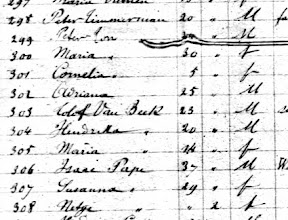
Found my 3rd-great-grandparents, Pieter TON and Maria Van KLINKEN, on Ancestry.com's passenger list (on the ship "E. C. Scranton," which arrived in New York on 7 Dec 1857). Pieter's name was right under Peter TIMMERMAN. The whole list was mis-transcribed. My Pieter is listed as "Peter Con Zimmerman" and so therefore, Maria, his wife is listed as "Maria Zimmerman." Zimmerman, by the way is German for "carpenter," and Timmerman is Dutch for "carpenter."


(click on photo several times to view zoomed image)

Also with Pieter and Maria are Adriana "Zimmerman" (Ton) and Cornelia "Zimmerman" (Ton), which I believe are Pieter's sister and perhaps a niece. [Correction: A closer look at the Zeeland Provincial Archives online database led to the discovery that Cornelia was the daughter of Maria Van KLINKEN, prior to her marriage to Pieter TON. It's not clear whether Pieter was Cornelia's father, although she is listed as "Cornelia TON" on the passenger list. I believe Cornelia died young, as she does not appear in the 1870 Federal Census with the rest of the family. In addition, Pieter and Maria named a later daughter Nellie (b. 1860). It was not uncommon for the Dutch to name a child after a deceased older sibling.]

There is also Pieter's sister Suzanna "Susanna" Van KLINKEN, her husband Izak "Isaac" PAPE and their daughter, Netye PAPE. ("Netye" is probably supposed to be Neeltje, who would have been named after Pieter, Suzanna, and Adriana's mother.) They are all with a group from the Netherlands headed for Ohio. My family records show Pieter and Maria lived in Cincinnati for 16 years, then moved north to Grand Rapids, Michigan. I'm not sure what it was about Cincinnati that attracted them...jobs, a Seceder's Church...?

---------------------------------
This evening at the Family History Center, I reviewed FHL microfilm # 1,377,933, Item 2: City of Grand Rapids [Michigan] Record of Burials, 1874 - 1877, and made some terrific finds!:

Van KLINKEN, Maria, age 51 [my records say 50], White, Female, Place of Birth: Holland, Disease: Dropsey; died 22 Apr 1878; buried in the Pottersfield, Valley City Cemetery, record #6168 - this is my 3rd-great-grandmother, mentioned above

TRIMSTRA (TUINSTRA?), Stjoestje, age 3 mos, 5 days, White, Female, Place of Birth: City; Disease: Cholera Infantum; died at 224 Elizabeth St., 24 Jul 1886; buried in Lot 75, Block K, Greenwood Cemetery, record #6046 - not sure if this is a TUINSTRA, but if so, she would be related

Van ESSEN, Meinn [sic - Meine], age 86, White, Male, Place of Birth: Netherland; Disease: old age; died at 2 Fifth Ave., 17 Jan 1887; Permit [4, 9, 7, C, G...?...can't read it], Valley City Cemetery, record #6471 - this is my 2nd-great-grandfather's father-in-law (of 3rd wife)

Van KINKEN [sic], Giertje, 52 yrs, 7 mos, 11 days, White, Female; Place of Birth: Netherland; Disease: malignant tumor; died at corner of Alpine & 10th St., 18 May 1887; buried in Lot 14, Block N, Greenwood Cemetery, record #6485 - this may be a relative of my Van KLINKENs