Showing posts with label Alaska. Show all posts

Sunday, February 16, 2020

Before MLK, There Was Elizabeth Peratrovich

Seventy-five years ago today, the first anti-discrimination law was signed on American soil.

It was more than two decades before the Civil Rights Act. Before Martin Luther King, Jr.'s famous speech. Before Rosa Parks's act of defiance on a Birmingham bus.

And it was brought to fruition by a soft-spoken Alaska Native woman you have probably never heard of.  It's long past time to learn her story.


Elizabeth Jean Wanamaker was born in Petersburg, Alaska on the Fourth of July, 1911, the daughter of a Native woman and an Irish man.  She was a member of the Tlingit nation, a tribe in Southeast Alaska, Northwest British Columbia, and the Southern Yukon Territory with a complex language and rich in culture, art, natural resources and oral history; a nation with a history of fierce warfare and a love of politics that transposed in modern times to powerful leadership.  Tlingit people are keenly aware of their heritage and can proudly cite their moiety and clan.  She would have been able to inform you at an early age that she was of a member of the Raven moiety, Lukaax̱.ádi clan and that her Tlingit name was Kaaxgal.aat.


When her biological parents were unable to raise her, she was adopted by another Tlingit couple, Andrew J. and Jean (Williams) Wanamaker.  Andrew was a fisherman, a lay minister for the Presbyterian church, and a charter member of the Alaska Native Brotherhood (ANB), a lodge for Native men which worked to combat discrimination.  Jean was a skilled basket maker.  Elizabeth's growing up years included several Southeast Alaska communities:  Petersburg; my hometown of Klawock where she met her future husband Roy Peratrovich; and Ketchikan, where both she and Roy graduated from the public high school, which had been integrated after the school board was successfully sued by a Tlingit couple more than a quarter of a century before Brown vs. Board of Education.  Elizabeth continued her education at Sheldon Jackson College in Sitka, Alaska and the Western College of Education (now part of Western Washington University) in Bellingham, Washington.

At the time Elizabeth was born, neither women nor Natives could vote.  Native Americans were not even given citizenship until 1924--four years after (white) women were given suffrage--and the last state to fully guarantee voting rights for Native people was Utah in 1962.  Alaska Natives, although in the majority population-wise, experienced a great deal of prejudice and discrimination from the Caucasian population in what was then Alaska Territory.  Segregation was common everywhere in Alaska. It was this world in which Elizabeth and Roy grew up and were married, on 15 December 1931.

At first they lived in Klawock.  Roy was from a prominent Native family.  The Peratroviches, descendants of a Croatian man and his three Tlingit wives, were well-known in Alaska.  They were acute businessmen and politicians.  Roy's younger half-brother Frank served in the Alaska Territorial House of Representatives, the Alaska Territorial Senate, the Alaska State House of Representatives, and the Alaska State Senate.  Both Roy and Frank served as mayor of Klawock.  Roy also served as a policeman, chief clerk, and the postmaster of Klawock.  Just as importantly, he became Grand President of the ANB, and Elizabeth became the Grand President of the Alaska Native Sisterhood (ANS).  The couple and their three children eventually moved to the territorial capital of Juneau, where they could be more involved with politics.

It was in Juneau that the Peratroviches especially noticed how strong discrimination was.  Signs stating, "No dogs or Indians" or "No Natives Allowed" were posted in front of many businesses.  When Roy and Elizabeth attempted to obtain housing in a nice neighborhood, they were refused on account of their race.  Three-and-a-half weeks after the bombing of Pearl Harbor, they wrote a letter to the territorial governor, Ernest Gruening:

The proprietor of "Douglas Inn" does not seem to realize that our Native boys are just as willing as the White boys to lay down their lives to protect the freedom that he enjoys.  Instead he shows his appreciation by having a "No Natives Allowed" on his door.  
We were shocked when the Jews were discriminated against in Germany.  Stories were told of public places having signs, "No Jews Allowed."  All freedom-loving people in our country were horrified at these reports, yet it is being practiced in our country.

The governor befriended the couple and together they worked to pass an anti-discrimination law through the territorial legislature in 1943.  Unfortunately, it failed with a tie vote of 8-8.  But Elizabeth and Roy didn't give up.  They traveled tirelessly across the territory, encouraging Natives to support their cause and urging many of them to run for legislature.  Two years later, the bill again came to a vote.  Although expected to pass this time, there was much heated debate and many onlookers, including the Peratroviches.  Elizabeth sat quietly listening to the arguments while knitting in the back of the gallery.

Senator Allan Shattuck expressed the sentiments of many prejudiced Alaskans when he debated:
Who are these people, barely out of savagery, who want to associate with us whites with 5,000 years of recorded civilization behind us?

When it came time for public comments, Elizabeth set down her knitting needles and, poised and dignified, made her way to the podium from the back of the gallery.  Intelligent and beautiful, she would have had the eyes and ears of everyone in the room.  The last to speak, she was clear and eloquent:
I would not have expected that I, who am "barely out of savagery," would have to remind the gentlemen with 5,000 years of recorded civilization behind them of our Bill of Rights.

Her passionate speech described what it was like to be treated as a second-class citizen in her ancestral lands, how difficult it was to be refused housing because of the color of her skin, and how dismaying it was for Native children to be barred from the theaters or stores.
No law will eliminate crimes but at least you as legislators can assert to the world that you recognize the evil of the present situation and speak your intent to help us overcome discrimination.

Her words were met with thunderous applause.  When the vote was taken, the bill was passed with a vote of 11 to 5.  On 16 February 1945, Governor Gruening signed the act with Roy and Elizabeth proudly looking on.


Elizabeth Wannamaker Peratrovich died of breast cancer on 1 December 1958 in Juneau and was buried in Evergreen Cemetery there.  Roy was laid beside her after he passed in 1989.

On February 6, 1988, the Alaska legislature declared February 16 to be "Elizabeth Peratrovich Day," which has been proudly celebrated by Alaska Natives ever since.

Every year a distinguished Native American is featured on the reverse of the U.S. Sacajawea golden dollar.  At the 2019 Alaska Native Sisterhood Grand Camp, the design of the golden dollar coin commemorating Elizabeth Peratrovich was unveiled.


UPDATE: On December 30, 2020, Google honored Elizabeth Peratrovich with a Google Doodle beautifully created by Native Alaskan artist Michaela Goade.  You can read more at the Google Doodle page here.


Sunday, January 10, 2010

52 Weeks of Online American Digital Archives and Databases: Alaska

This is the second post in a weekly series of Online American Digital Archives and Databases found for free at state, county, municipal, college and university history, library, and archive websites, as well as public and private library and museum sites, and historical and genealogical society sites.

Alaska

North to the future AND the past! If you are a regular reader of my blog, you know that I was born and grew up in Alaska, moving to Washington State when I was 12. I have had such fun looking at these sites and seeing historical photographs of the communities where I lived: Kodiak, Fairbanks, Metlakatla, Kake, and Klawock. I also ran the phrase "Salvation Army" through the search engines, as this organization has a long history of service in Alaska.

Did your ancestors or relatives come to Alaska to fish, work in lumber or mining, or were they lured by the Gold Rush? Check out these resources!

Alaska's Digital Archives - http://vilda.alaska.edu/cdm4/browse.php

Alaska State Historical Library Newspaper Name Indexes, Photo Collections and Online Exhibits (see bottom of page) - http://library.state.ak.us/hist/online_resources/online_resources.html

Sealaska Heritage Institute Digital Collections - http://www.sealaskaheritage.org/collection/digital%20collections.htm

Sitka National Park Photo Gallery - http://www.nps.gov/sitk/historyculture/ew-merrill-photographs.htm

Project Jukebox (Oral History Program at University of Alaska Fairbanks) - http://jukebox.uaf.edu/ - many recordings, transcribed interviews, photos, and maps


Alaska Film Archives on YouTube - http://www.youtube.com/user/alaskafilmarchives#p/u

---

Saturday, October 31, 2009

Happy Hallowe'en!

It's still Hallowe'en on the West Coast as I write this. The following photo is of the very first time I celebrated the holiday...I was 4 1/2 years old and remember it being taken. I had a clown mask, too, but didn't wear it when our picture was taken. The little girl on my left was our neighbor girl and it was taken in their home at that time; an Airstream travel trailer parked across the street from our mobile home. A few years later, both our fathers build homes outside of the little village of Klawock, Alaska on adjoining properties.

Miriam Robbins and neighbor girl [name withheld for privacy,] 31 October 1971, Klawock, Alaska. Original in the possession of Miriam Robbins Midkiff, [ADDRESS FOR PRIVATE USE,] Spokane, Washington. 2009.

Tuesday, October 20, 2009

The Clock, the Chart, and the Compass Rose

Education is not the filling of a bucket, but the lighting of a fire.
--William Butler Yeats

It all began in second period, where I assist some of my higher-functioning special needs students in a seventh-grade resource math class. The teacher had begun a lesson on coordinate graphs, explaining the x axis and the y axis and then showing the four quadrants of the graph. He labeled them I, II, III, and IV and explained what the Roman numerals meant and how they were numbered starting in the upper right-hand quadrant moving counterclockwise around.


All of a sudden, I was transported in time to a day somewhere between my fourth and sixth birthdays, to a hallway in our home in a small village in Southeast Alaska. While my mother had actually taught me how to tell time on a clock with Arabic numerals at age four, it was my dad that carried the lesson a little deeper. He showed me the clock hanging on the wall and pointed out the Roman numerals, explaining how they work: the ones, the fives, and the tens; how the positions of the numerals determine whether you add or subtract them; how when the clock reaches twelve, it starts all over again - twice a day; and how the clock had to be wound by pulling up the weights once a week.

It's not very likely that children today see many clocks with Roman numerals. In fact, other than in a school, it's not likely they see many analog clocks or watches at all. Thank heavens, analog clocks are still used in school! As it is, the terms clockwise and counterclockwise often have to be re-explained, not just to elementary school students, but even to some teens and twenty-somethings! To the students in yesterday's math class, understanding the four Roman numerals was new learning and remembering which way counterclockwise is was a review lesson. Once again I am reminded me of how fortunate I have been to have the parents I have: life-long learners who passed on their love of learning to me.

I can't tell you the times I've looked back at my childhood and remember experiences that prepared me for being a family historian and using genealogical research skills. Before age six, I knew how to read a map and a compass, and how to divide up a section of land! Oh, yes, indeed I did! And it was all done in simple, enjoyable little lessons, often before bedtime.


Also hanging on the hallway wall, opposite my bedroom door, was a chart of the waterways in our vicinity. I remember my dad showing me where our village was, located on the western side of the north half of Prince of Wales Island. I learned that all the numbers on the white part of the chart represented how many feet deep the water was in that area, and that all the squiggles with tiny numbers on the buff-colored parts were contour lines showing how high the many mountains and hills on the islands were. Many of the islands and straits had interesting names: there were Spanish names starting with San and Santa, Russian names ending with -of, and many British names with Prince, Princess, King and Queen at the beginning - all testament to the explorers who had sailed through over the previous centuries. Additionally, there were many little villages with difficult-to-pronounce names that had lots of Ks and Xs in them - native villages retaining their original Tlinget names.


And then there were the pajamas; the long sleeve, snap-up-the back shirt that snapped at the waist to the pink, footed leggings. On the front of the shirt was a design of a large compass rose. Well, that was a lesson in and of itself! I learned that N was for North and S for South. That NE was between North and East and stood for Northeast, while WSW was between W and SW and meant West Southwest!

Put the chart and the compass rose together and get another lesson! In Michigan, Dad told me, where he and Mom grew up, they didn't have all these islands and straits like we did in Alaska (well, not in Western Michigan, anyway; I learned more about the Great Lakes later). All the land, he said, was divided up into squares one mile long and one mile wide. Those were called square miles; easy enough for me to understand! Those square miles were also called sections and sometimes they were divided up in lots of different ways. If they were divided top to bottom, then you had a west half and an east half. If the west half was divided left to right, then you had the northwest quarter and the southwest quarter. Those could be divided up, too! Pretty soon, I knew what the south half of the northeast quarter of the southwest quarter of a section was. Boy, did that come in handy when 30-some years later I looked at land records!

Today's kids have X-boxes, iPhones, and netbooks. I had my parents who taught me the clock, the chart, and the compass rose. And from that, grew a genealogist. I'd take my childhood over anyone else's today!

Thursday, July 16, 2009

Tell Me Thursday: Catch of the Day

Miriam and Bryan Robbins, August 1973, Klawock, Alaska. Original in the possession of Miriam Robbins Midkiff, [ADDRESS FOR PRIVATE USE,] Spokane, Washington. 2009.

Did you ever remember getting your photograph taken on a special occasion, yet realize you never actually saw the photo? Did you ever wonder what happened to it? In the days before digital cameras, we had no way of knowing if a photograph "took," and then we had to wait for it to get developed (hopefully correctly) before we found out if it turned out all right.

I well remember this sunny August day and this photograph in Southeastern Alaska, 1973. I was six years old, and Dad and I had gone fishing in his boat, a treat for me. I still remember looking down over the side of the boat into the depth of whatever bay we were in and not being able to see the bottom...I used to like to scare myself that way! I was so excited when I hooked my fish...and then the unthinkable happened! My long hair got wound up in the reel as I was trying to bring him in. Dad heard me cry out and started to let the line out; then I really started crying! I was afraid I was going to lose my fish! He told me not to worry, and after he had gotten me free, helped me to reel in my fish.

It's hard to tell, but we're holding up three fish here, and mine's the biggest, I'm sure! I don't recall what they were, probably salmon (help me out here, Dad!), and I remember posing proudly so that Mom could take our picture. BUT, I remember feeling disappointed that I never got to see it. I wondered if it just had not turned out.

Then my uncle brought this snapshot with him when he visited last month from Michigan. Mom had sent it to my grandparents in a letter, and it has come full circle being returned to me. I was so delighted when I saw it...it meant as much to me as all the wonderful old ancestral photos I saw!

Wednesday, July 15, 2009

Wordless Wednesday: Catch of the Day

Miriam and Bryan Robbins, August 1973, Klawock, Alaska. Original in the possession of Miriam Robbins Midkiff, [ADDRESS FOR PRIVATE USE,] Spokane, Washington. 2009.

Friday, August 01, 2008

Pygmy Goats in Alaska

This was taken from the Fall 1976 edition of the National Pygmy Goat Association's Memo, and was written by my father, Bryan H. Robbins, from our home in Klawock, Alaska. A while ago, I invited my mother to write about her education as part of the 48th Edition of the Carnival of Genealogy. I thought it would be interesting to share my dad's writings with my readers, too!

In the remote rural villages of Alaska, milk comes only in a box or can, unless of course you have a homestead and can raise goats. Our 3/4 acre family homestead in a coastal village in southeast Alaska had some small livestock, but no fresh milk supply for our children. I was convinced that goats were the perfect answer for our place. The goats we needed had to be very efficient milkers or very small and not eat very much as dairy-mixed grain (or any feed) cost about $16.00 per hundred plus an additional nickel a pound freight to Klawock. High Alaskan prices are usually attributed to the high cost of freight. No live freight though, could be shipped on our weekly freighter. Whatever type of goat we got had to be small enough to put aboard a small airplane that is our lifeline to the outside world. In fact, all of our farm animals [chickens, ducks, geese, rabbits, and pigs] to date have been flown to our homestead.

Countryside & Small Stock Journal's pygmy goat news and pygmy goat advertisers started me thinking, investigating, and writing about pygmy goats. The pygmy seemed an answer to our small milking needs. The pygmy, being small, could browse efficiently on our rainforest brush, needing only small amounts of daily grain. Best of all, adult animals could be shipped by air, thus saving us a year of growing out a kid of dairy breed.

We soon found our girl: a beautiful, full-belted, two-year-old doe named Fatima. She was shipped to us from the Kings Valley Animal Family in Oregon, but we would have to wait until spring before our own "herd sire" would come to Alaska.

Our goat experiences began with a good laugh over a panic-stricken pilot who flew our pygmy from the Ketchikan airport to Klawock. The pilot had never heard a goat bleat and after taking off for Klawock, our goat started to cry. The poor man thought her crying was the stall warning of the aircraft signaling an imminent crash landing.

Having only one goat on the homestead can be a real problem too. Fatima would cry by the hour for company. A five foot fence didn't contain her, except when her horns were caught in it, which was nearly all the time. She also thought that she was a person and should live in our house with us. Whenever she got out of her pen, she would butt the front door wanting to come in for a visit. If we weren't home, she would go next door to the neighbors and cry on their porch. When they opened their door, she would run inside and sit on their couch. We had to get her proper company before the following Spring. Soon, we were able to locate another two-year-old doe and arranged to have her bred before being shipped to us. The second doe, Graycie, flew in by mail plane a short time later. Soon things began to settle down at the homestead and stay in the barnyard.

Graycie was a beautiful agouti and definitely in a family way when she arrived. She continued to grow in size as her term progressed, to the point of reminding us of a burro with a full pack. One of the neighbors said he was going to make her a "wide load" sign to wear. There was good reason for that wide load she was carrying. In August, she presented us with four of the cutest little kids we had ever seen. She had a perfect set: two does and two bucks.

Oh! now we had fresh milk, too, not much, but so fresh. It was sweet and nutty in flavor and not at all like what comes out of a box or a can. It was our children's first whole fresh milk too.

Two months later our buck arrived and our doe was rebred. I continued milking her for a total of five months until she got down to a cup of milk per milking. Then she was dried off to prepare for her next kidding. I was only expecting twins this time, but when her time arrived I sat with her all day and night because she had such a difficult delivery before. I sat with her around the clock; since there were no further symptoms, I went to bed. She delivered again--four kids. But alas, without assistance, two were lost. With Graycie's multiple births, it won't be long before we have a large herd of pygmies in Alaska.

Does the pygmy have a place on a modern homestead? Yes, I believe she does - in a greater capacity than just a pet. A year and a half has not been sufficient time to make an accurate evaluation of the pygmy in comparison to other goats; but for us, the pygmy has filled a void that no other animal could have provided. They pygmy has given us milk and companionship, and the hope for a future cash crop to aid our homestead economics. I'm sure that isolated Alaskans and other homesteaders could take advantage of the cutest, most affectionate and newest goat there is...The American Pygmy Goat.

© Bryan H. Robbins, April 1976
Used with permission.
Submitted for the 53rd Carnival of Genealogy.

Tuesday, April 01, 2008

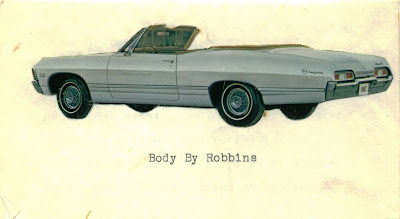
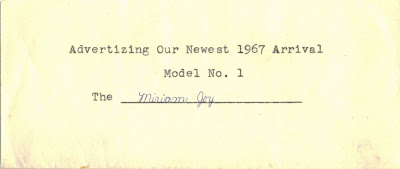
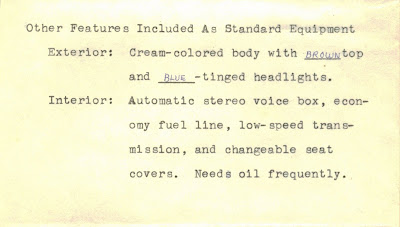
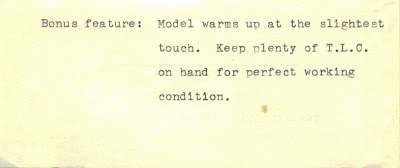
1967 Model No. 1


Source: Robbins, Miriam Joy. Birth Announcement. Created March 1967 by Faith Valk Robbins. Original pasted in baby book of Miriam Joy Robbins in the possession of Miriam Robbins Midkiff, Spokane, Washington. 2008.

It's no surprise that my parents came up with this clever birth announcement for their first model of little Robbinses. You have to understand that Robbinses have been working on cars probably as long as they've been invented. My great-grandfather was a chauffeur before he joined the Army in WWI. In fact, that's how he met my great-grandmother...he was driving the hearse for her grandfather's funeral. My grandfather was working in the automotive repair business when he enlisted in WW2, and after he was discharged from the Army Air Corps, he started Robbins Body Shop in Coopersville, Ottawa Co., Michigan. His father and brothers helped out, and his sons--my dad and uncle--grew up learning how to repair cars; not just body work, but engine work as well. In 1967, when my parents were living in Kodiak, Alaska and assisting in missions work there, both of them worked for a tire shop to bring in much-needed income; dad worked in the shop and mom did the bookkeeping.


(before)

While they were expecting me, my parents took a ride one evening on the mountain road to the ski resort. Mom was getting rather large with me and decided to wear her seat belt, just to see if it would still fit (these were the days before retractable seat belts; remember them?). They hit some ice on the road and ended up rolling their 1958 Lincoln Continental down the side of the mountain. Fortunately, the only injury sustained was a cut on Mom's knee from some glass as she exited the vehicle when it was all over. I guess I didn't like that bumpy ride, because Mom said I kicked all night long, so she knew I was okay (and probably protesting!). They made their way walking to the ski lodge and spent the night. The phone at the lodge only worked sporadically, and no one knew where my parents were, so some excitement was stirred up among their friends until they were found!


(after)

You can see they were in need of a new vehicle. They researched what they wanted and ended up with a pile of car folders and advertisements. One of them got the idea that these would make great birth announcements, so back to the dealer they went to get more brochures!


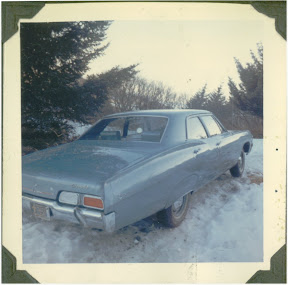
They eventually purchased a 1967 Chevy full-sized sedan. They had it all: a new baby, a new car--and shortly after--a new residence and jobs, when they transferred to Fairbanks from Kodiak to begin work with The Salvation Army.

Source: 1958 Lincoln Continental and 1967 Chevrolet sedan. Photographs. Originals affixed in "Our Memories" Scrapbook (1965 - 1970) in the possession of Bryan and Faith (Valk) Robbins, Colville, Washington. 2008.

Friday, March 21, 2008

Alaskan Russian Foods

As many of my readers are aware, I was born and grew up in Alaska, living in five different communities. The "city" where I was born was Kodiak, on Kodiak Island, where the Russian influence can still be felt in the culture, religious practices, and surnames of the Native Alaskans living there. While Kodiak is near the top of the Aleutian chain of islands creating the Southwest panhandle of the state, the Southeast panhandle--where I spent most of my childhood--also felt Russia's hand and can be seen in the architecture of the old Russian Orthodox churches in Sitka (the capital under Russia) and Juneau (the current state capital). However, the Native Alaskans of the Southeast panhandle were more religiously influenced by the Presbyterian, Catholic, Lutheran, and Salvation Army churches.

Russian Church, Kodiak, Alaska


St. Michael's Cathedral, Sitka, Alaska

(For more views of beautiful Russian Orthodox churches
in Alaska--onion domes and all--click
here.)


Two wonderful Russian dishes I remember eating as a child were pirok and kulich. Pirok is a fish pie that my mother would make as a simple, filling main dish, using canned or fresh Alaskan salmon. It is especially tasty topped with a tomato-based cocktail sauce, such as what you would eat with shrimp. Kulich is also known as Russian Easter bread, and is a delicious treat, made sweet from candied fruit and heavy with many eggs (made of course, to celebrate the end of Lent and self-denial). Dad was usually the one who made kulich, and our favorite way to eat it was lightly toasted with lots of butter! In fact, just thinking about it makes me want to haul out my breadmaker and make a loaf this weekend to eat with Easter breakfast!

I believe the following recipe is from Alaskan Cookbook for Homesteader or Gourmet by Bess Cleveland; Berkeley, California: Howell-North Books, 1960.


PIROK
Pastry for double-crust pie
2 c. cooked rice
1 onion
3 hard-boiled eggs
1 can salmon or 1 lb. fresh salmon, deboned
salt and pepper to taste

Line pie with pastry. When steaming rice, add 1 chopped onion. When done, mix with canned salmon, including juice. Mix well. Season with salt and pepper to taste.

Put 1/2 rice and fish misture in unbaked pie shell. Press quartered hard-boiled eggs into mixture, top off balance of rice and fish. Cover with piecrust, seal edges well and cut steam vents. Bake 1/2 hour (1 hour for fresh salmon) or until well browned. [A temperature is not given; I cook mine at about 425° F.] This is a dish brought to Alaska by the early Russian colonists, and was first made with salt salmon.

Traditionally, the kulich dough was braided, then baked. However, when Dad made this, he would bake it just as he and Mom did our sourdough-raisin bread: in greased coffee cans, creating a nice round load, easily sliced and able to fit into a standard toaster. While the sourdough-raisin bread, which was our everyday bread, was made in two-pound coffee cans, the kulich, more of a dessert than a sandwich bread, was usually baked in one-pound cans. I am adapting my Mr. Coffee bread-maker's recipe for a one-pound dried-mixed fruit bread, which yields a similar result.

KULICH

1 egg plus enough water to equal 1 c.
2 c. + 1 T. bread flour
1/2 t. salt
2 T. honey
1 T. dry milk
1/2 c. bran cereal
1/2 c. chopped candied mixed fruit
1/2 c. raisins
1/2 t. nutmeg
1/4 t. baking soda
1 1/2 t. yeast

Place ingredients into your breadmaker according to its suggested guidelines and use the Whole-Loaf (as opposed to Dough) Sweet Bake setting (setting 8 on Mr. Coffee breadmaker). Yield: 1 one-pound loaf.

Sunday, December 16, 2007

Advent Memories No. 16: Christmas at School

Christmas at School


What did you do to celebrate Christmas at school? Were you ever in a Christmas Pageant?

I've already shared how Santa came to my childhood hometown of Klawock, Alaska on his Cessna from Ketchikan, but before he arrived, we students had been busy decorating our classroom. Every classroom had a tree, which was gaily decorated with lights, ornaments, and red-and-green paper chains (no political correctness and sanitized holidays in those days!). The ornaments were often pictures we had cut out, colored and covered with glitter, hung on the tree with yarn or unbent paper clips. As the school custodian, there was nothing Dad hated more than glitter! Those little metallic bits would have drops of glue on them before accidentally getting brushed to the floor, laid with those rubber-backed carpet tiles. No matter how well he vacuumed during the holidays, the carpet would be littered with glue-encrusted bits of glitter that never really came free as they embedded themselves in the fibers. But we kids never worried our little heads about that! We listened to Mitch Miller and Alvin and the Chipmunks sing Christmas songs on the record player, and I remember our teacher getting out a book of classic Christmas songs and teaching us The Twelve Days of Christmas, as we giggled our way through what seemed to us very silly lyrics.

Every year, there was a Christmas play--or actually a series of plays--usually based on a theme, performed by each classroom. One year, it was old classic tales, with "The Bremen Town Musicians" and "Bartholomew and His 500 hats." I think our class did "Puss in Boots." Another year, each class did a play based on a Christmas song. I was the title character in our Rudolph the Red-nosed Reindeer skit. Someone was very clever, and took old, clean, dry bleach bottles, cut a large hole in one side, painted them brown, colored the lid end black and somehow added eyes and antlers. This was a "hat" that each of the reindeer actors wore. My "nose" was a red plastic Kool-aid mug, I think, that was taped on to the lid end. I also narrated the Frosty the Snowman play for another class that year. Still another year (I think this was 1973 - second grade) we acted out fairy tales. Our class performed Little Red Riding Hood, and I was the star. I loved acting and being the center of attention, probably not helped any by being an only child for the first seven years of my life! The reason I was given many starring and narrating roles was probably because 1) I was a good reader and could memorize my lines quickly; and 2) I wasn't bashful onstage and didn't mind speaking in front of an audience, which is not the Native way. Most of the students in my classes were naturally shy and soft-spoken.

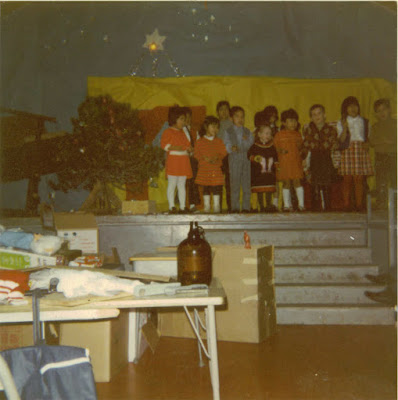
The plays were first performed in the ANB/ANS hall until the school district built a gymnasium that had a stage at one end. Unfortunately, the only photograph I have is the following, which I believe was Christmas 1971 (Kindergarten). I am the smallest one in the front row dressed in a native Tlinget dress with two salmon on the front, because a group of us had performed a native dance just before our class sang a carol.
We must have been singing "Jingle Bells," because many of us have hand-held sleigh bells. It was either this year or the following year when each class presented a different country in the "Christmas Around the World" theme. The finale of that particular evening was a piñata that was broken. How we students scrambled to grab the candy that fell! Believe me, it was a free-for-all!


This post is a part of the "Advent Calendar of Christmas Memories" meme created by Thomas and Jasia. You, too, can write your own Christmas memories, either for your personal journal or blog. Click on their names for the list of topics. To see what others have written, go here.

Wednesday, November 14, 2007

Loving Genealogy...For Over 30 Years!

This evening I was going through the box of letters that my mother wrote to her parents from Alaska during the years 1966 through 1978. I was looking in particular for letters written around Thanksgiving to see if I could find any that matched my earliest memories of that holiday, with the hope of writing something for the Carnival of Genealogy. I wasn't real successful; the letters Mom wrote about Thanksgiving didn't jar any particular memories, and the memories I do have must have been of years when she didn't tell Grandpa and Grandma about how we celebrated the holiday.

As often happens while doing genealogical research, as I was looking for one thing, I found another. I noticed one letter was dated March 20, 1977, the day after my 10th birthday, so of course I stopped and read through it. I had brought cupcakes to school to share with my class, and then my family put together a treasure hunt in order to find my birthday gifts. I was given the first clue, and each subsequent clue was on the gifts I found. This became a family tradition for many years for my siblings and me, and it appears to be the first time that it occurred. Because my mother mentions that my grandparents' birthday package had not yet arrived from Michigan, I am guessing that she thought up this treasure hunt as a way to keep me from being too disappointed that their gifts would be late (I remember that mail delivery, especially of packages, was not always reliable in Alaska). That evening, we had a nice ham (home-grown) dinner with mashed potatoes (probably also home-grown), ham gravy with raisins, coleslaw (again, home-grown cabbage), with "fresh, sweet goat's milk." Dessert consisted of butter brickle cake with chocolate frosting and egg custard. Yum!

What really caught my eye, however, was a paragraph near the end of the letter. The following evening, our family (my parents, my not-quite-three-year-old brother, and I) had sat and looked at my parents' wedding album, and also read through a typed copy of the Strong Family Tree (my maternal great-grandmother's family). We didn't have a television, so reading books, writing, drawing, playing games, or working on our stamp collection, etc. were our sources of entertainment. Mom writes:
We looked at our wedding pictures tonight and at the Strong family tree. Adriaen [my brother] said, "Mommy kissing Dad" and he was also impressed with the [photo of the wedding] cake we were eating! Miriam liked the old-fashioned names like Return, Experience, Thankful, Josiah, etc. [1]

So at ten years old, I was already interested in the family tree! I do remember being fascinated with all that information going back to Elder John Strong of Massachusetts. A few years later, we made a month-long Christmas trip back to Michigan, and Mom wrote down four pages of notes about my dad's family tree from a conversation with my paternal great-grandmother. I savored those, too! After over 30 years, I still haven't stopped enjoying learning about my ancestors and family history! I hope I have at least 30 more years of discovery and pleasure, research and fascination to look forward to!

[1] Letter from Faith (Valk) Robbins (P. O. Box 97, Klawock, Alaska 99925) to Adrian and Ruth (Hoekstra) DeVries (464 Kenwood St. NE, Grand Rapids, Michigan 49505), 20 March 1977; held in 2007 by Robbins (current address unpublished for privacy reasons).

Sunday, October 07, 2007

New Prompt (Week Twenty-Five) Available at AnceStories2

I just posted a new prompt at AnceStories2: Stories of Me for My Descendants called "Your First Job."

I had several "first" jobs growing up. The first time I made any money apart from my parents was selling earthworms (25 cents a dozen) to fishing customers of the Log Cabin Resort next door (well, it wasn't a resort in those days...just a gift shop and a place where you could hire a fishing or hunting tour guide). It was owned (and still is) by the Fabry family just outside of Klawock, Alaska. (Skip Fabry was my fifth- and seventh-grade teacher.) On our little farm, we raised rabbits for meat and skins in a metal tool shed like the kind you could buy from Sears or Wards. Under the rabbit cages, we had deep stalls filled with earth to catch the rabbit droppings. Dad had ordered earthworms from somewhere and added them to the stalls to break down the compost. All of our food waste and garden waste was added and mixed into this compost pile. This rich composted soil was then mixed into our garden soil to fertilize it, along with the worms, which would naturally aerate the garden soil by digging little tunnels through it. I would get a spade and start digging and find a dozen worms, which I would place in an empty coffee can with more soil, cover it, and take it up the hill to the Fabrys.

My next two jobs were during high school. The first one was at my high school in Colville, Washington, where my dad worked as a custodian. He had heard from the cooks that there was a helper's position open. Every day, I would leave fourth period ten minutes early, go to the cafeteria, wash my hands and help serve lunch. The first few years, I worked right in the serving area. One of my duties was heating up and serving "chuckwagons," which were a meat and cheese sandwich on a sesame seed bun, heated briefly in a microwave so that the cheese would melt. They were in high demand...even more than hamburgers and pizza. I believe it was in my junior or senior year that I was put in charge of the salad bar, where would collect payment from the students. This job entitled me to a free lunch, and having a 50-minute lunch period, I had plenty of time to meet up with my friends and socialize before going on to fifth period. I worked in the cafeteria all four years of high school, and my experience there was a good asset for my resume for my next job. I enjoyed the cooks I worked with (I still remember the names of two of them: Earlene and Shirley), and in my senior year they all chipped together to buy me a nice gift for graduation. I also enjoyed the opportunity of checking out the cute guys that came through the lunch line. ;-) Sadly, I was such a nerd, none of them paid any attention to me! Besides which, I had no clue then that "cool" girls would rather be caught dead than work in the cafeteria! But I didn't think of those things; I thought of it as a good job experience and a way to earn a good, hot lunch.

The first job I had where I had to fill out an application and pay taxes was working at The Salvation Army Camp Gifford at Deer Lake in Eastern Washington, near the city of Loon Lake, off Highway 395. You may remember that my parents worked for The Salvation Army in Alaska; when we moved to Eastern Washington, we would occasionally attend services at the Corps (church) in Spokane, which is how I learned about the job opportunity at Camp Gifford. I worked there for all or part of the summers of 1982 - 1986. In the summer of 1982, I worked half the 10-week summer as a staff-in-training (SIT) and half as a kitchen helper, although really, it was the same job. I was listed as an SIT because it was a probationary period, but all that summer and the next, I had the same duties. Two other girls and I helped the cook prepare three meals and a snack and serve them. The last three summers there, I was a counselor. I have such wonderful memories of my summers there, and in writing about this, I realized I'll have to write in more detail about those times, for my kids' sakes. There were a lot of first experiences those summers: my first boyfriend, my first kiss, learning how to swim, and learning how to water-ski were some of those great times. I also learned that having a job required paying expenses; besides paying taxes, I had to contribute towards the cost of gas for the 70-mile round-trip journey required for my dad to pick me up each Saturday morning, and then repeat Sunday evening to begin the next session. My money was used to purchase school clothes, yearbooks, and any extras that I wanted to have over the next year.

I feel fortunate because most all of the jobs I've had were pleasant, learning experiences where I made new friends and enjoyed what I did to make a living. I'll never be rich from the wages I've earned, but my life has been enriched because of the jobs I've had.

Saturday, September 01, 2007

The Legend of Joseph Josiah ROBBINS

See images of your Civil War ancestors' Pension Index cards.

When I was growing up, one of the favorite things I loved to hear when I being tucked in bed by my father were the old family stories. Living in Southeast Alaska in the '70s, no one had television, unless they lived in one of the cities like Ketchikan. So good books and other printed material, oral stories, and recorded music (once our little farm outside of town got electricity) were our main forms of entertainment. How grateful I am now for that childhood!

The one story I heard occasionally was of father-and-son ancestors, Joseph Josiah ROBBINS and Charles H. ROBBINS, who had both fought in the Civil War. Ol' Charlie had had plenty of adventures and because my grandfather remembered him (Charlie was Grandpa's great-grandfather) and attended Grand Army of the Republic reunions with him, those adventures which provided plenty of material for good family tales were quickly passed down the generations. Charlie himself helped proliferate the legend of his father.

Joseph Josiah ROBBINS had fought in the Civil War as an old man on the side of the Yankees, went the story. He had joined up because he already had military experience fighting in the Mexican War of 1848. While out West during in 1849, he had headed towards California to hunt for gold with the other Forty-Niners, but changed his mind and returned to his family in Pennsylvania. While in Union Army, he was captured by the Rebs and incarcerated in the infamous Andersonville Prison in Georgia. Conditions there were so terrible, that Joseph had gone blind from scurvy. In an interview by a reporter from a local paper not long before his death in early 1934, Charlie told of how his father had been a participant in a prisoner exchange, and thus had been returned to the Union Army. He had lived to be 99 years old.

Nine years ago this month, I sent off to the National Archives for a copy Joseph's pension application. I believe I spent a total sum of $20.00 (those were the days!). I received 25 legal-sized photocopies of documents from his file, and what a treasure trove they were! First of all, they confirmed his service as a private in Company E, 58th Regiment, Pennsylvania Volunteers from 26 September 1861 to 9 January 1865, with a little more than a year-long detachment with the 7th Massachusetts Battery. Joseph, although at age 41 would have been much older than most of the recruits, was certainly nowhere near being an old man! The records provided a first name and a death date and place of a wife we had never heard of, prior to his marriage of our ancestor. They also gave the date and place of marriage to my ancestor Marinda and confirmed that her maiden name also was ROBBINS (still working on how they possibly could have been related to each other!). There were all sorts of juicy tidbits including how difficult it had been for first his wife (who would have also been elderly during that time), and later his son and daughter-in-law, Ben Franklin and Helena (SWEET) SKINNER ROBBINS, to care for him in his elder years, blind and senile as he was. There were no nursing homes in those days, no respite care, no traveling nurses or Hospice services to assist the family.

The pension records confirmed that Joseph was indeed blind, and that it was related to his military service; but it lists in detail how that disability came to be. While Joseph was at Cliffburne Barracks in Washington, D.C. in early June 1864, he was hospitalized at Satterlee Hospital for fainting, bleeding from the nose, and chronic inflammation of both eyes. His biography in History of Manistee, Mason, and Oceana counties, Michigan..., which as far as I can determine, corroborates with all sworn statements in his pension records, describes the cause as sunstroke. A week after he was discharged at Chapin's Farm, Virigina, he sought out both a doctor and a lawyer in Philadelphia and applied for his first Invalid Army Pension, stating that he had "lost almost the entire sight of both eyes rendering him unfit to follow his occupation," which was farming. The pension records give a clear picture of the difficulties that Joseph and his family members had because of his disability from the time he returned home from the war until his death in Newfield Township, Oceana County, Michigan on 27 July 1905. He was 84, not 99, as son Charlie claimed.

Nowhere in his pension records is there any mention of capture, imprisonment, or a prisoner exchange. There is also no evidence that he served in the War with Mexico; but then, it's not likely that information would show up in these records. Their purpose was to determine that Joseph had become disabled through his military service during the Civil War, and that he deserved a pension, as did his widow Marinda, after his death. Attempts I've made to verify possible service during the War with Mexico have led nowhere. In the Civil War Prisions database maintained by the National Parks Service, I have not been able to find Joseph, even though I've used a variety of spellings, first and last name combinations, and initials.

I believe that Joseph's story was confused in his son Charles' elderly mind with other tales he may have heard from his GAR comrades, or perhaps with the tragic tale of his best friend and step-brother-in-law, Angelo CRAPSEY, whose experiences in the infamous Confederate Libby Prison caused him to go insane and later kill himself after the war's end. So although the account of Andersonville made for a lively legend, the real story of Joseph's service during the Civil War was a fascinating account, nonetheless!

(See a photo of Joseph's grave here.)
---------------------------------------
Bibliography:

History of Manistee, Mason and Oceana counties, Michigan ... Chicago: H.R. Page & Co., 1882.

Michigan. Oceana County. County Clerk's Office, Hart. Death Registers. Joseph J. Robbins entry.

Robbins, Bryan H., oral history. Various dates from c. 1970 through c. 1984, at Robbins homes in Alaska and Colville, WA. Transcript held in 2007 by Miriam Robbins Midkiff,
Spokane, WA.

Robbins, Robert L., oral history. Summer 1989, at Midkiff home near Deep Creek, WA. Transcript held in 2007 by granddaughter Miriam Robbins Midkiff, Spokane, WA. Mr.
Robbins is now deceased.

Unknown. "Charles Robbins is One of First to Visit Hesperia." Photocopy of typed transcribed undated clipping, c. 1931 - 1933, from unidentified newspaper, possibly in Newaygo County, Michigan. Owned 2007 by Miriam Robbins Midkiff, Spokane, WA.

United States. National Archives, Washington D.C. Civil War Veteran's Father's Pension Application File of John Crapsey, application no. 284,159, certificate no. 380,350.

United States. National Archives, Washington, D.C. Civil War Veteran Pension Application File of Joseph J. Robbins, application no. 60,087, certificate no. 193,978. Includes documents from Civil War Veteran's Widow's Pension Application File of Marinda Robbins, application no. 833,911, certificate no. 623,194.

United States. National Park Service, Washington, D.C. Civil War Prisons database, Andersonville. Online <http://www.itd.nps.gov/cwss/prisoners.htm>. Viewed 1 September 2007.

View the Brady Civil War Photos collection.

Sunday, August 26, 2007

Genea-Google-ology and the Search for a Detroit Sailor's Family

Discover Navy Widows' Certificates.

Google has wonderful bells and whistles that are of immense value to us "geneahistorians." I like to call them Genea-Google-ology Tools! Have you tried Google Alerts? You can be alerted with a message sent to your e-mail inbox every time your surname of interest (or other keyword or phrase) shows up on the Internet!

For instance, every time any of the words midkiff, sweers, tuinstra, valk, or westaby show up online, I get a handy-dandy e-mail letting me know, along with a link to that site. The above surnames are some of the more unusual ones in my husband's and my ancestries. You can also choose a phrase (put your search terms within quotation marks) or a combination of words (use the plus [+] key). I have genealogy+michigan as another alert, which searches for both words (not necessarily together) on a website or blog. You can control where your results come from, too: news, blogs, web, groups, or comprehensive (all).

You can also tweak your alerts a bit, by narrowing your results using the minus ( - ) key. Using only tuinstra as a search term, I was getting links to dozens of articles written by well-known journalist Fons Tuinstra, stationed in China. I changed my alert to tuinstra -fons to get better hits. I was also getting a lot of hits for a Joost Valk that did not apply to my genealogy, so again, I made a change to valk -joost. I still get some unconnected hits, but they have decreased in volume considerably.

"So how do I set up Google Alerts for myself?" you may be asking. Go here to begin. As far as I can tell, you do not need a Google account or Gmail address to set up an alert. The process is fairly simple, and once you sign up, you should start receiving alerts soon. As a matter of fact, you can control how frequently you receive these alerts, too: once a day, as it happens, or once a week. And you can edit your alerts at any time!

This morning, I received an alert on my genealogy+michigan search terms, and was linked to a blog, which in turn linked to an article from the Detroit Free Press, which told of the search for the family of a Detroit sailor who went down in a submarine with 70 others, off the Aleutian Islands of Alaska during World War II. Seems like the submarine, the USS Grunion, has possibly been found (it was located, but then was "lost" again); but the family of Navy Seaman Second Class Byron A. Traviss has not. Searchers are hoping to discover his family's whereabouts before the sub's location is found again.

Readers are encouraged to make contact if they know of the whereabouts of the Traviss family.

A Different Kind of Family

Read original ratified Indian treaties.

This really doesn't have anything to do with genealogy, but this morning my dad instant messaged me about an article in the Seattle Post-Intelligencer that he knew I'd be interested in.

A new totem pole was dedicated at The Center for Wooden Boats...a 24-foot pole that was carved by five young carvers (including at least one girl) from my hometown of Klawock, Alaska, to return the favor of a gift to a man who had created a canoe to honor the community where his wife once lived. These teens were trained by none other than my "Indian brother," Jon Rowan, a master carver and teacher at my childhood community. A celebration involving other Tlinget communities, as well as Haida, Tshimshian (both also from Alaska) and Duwamish (Washington state) tribes, took place yesterday as the pole was raised into position. Each figure on the pole tells part of a story, and I'm sorry to say there aren't better photos of the pole, nor was their anything really written about the story behind it. According to what I can tell, the top figure is a wolf, the next-to-the bottom figure is a killer whale, and the middle figure is holding a canoe.

The article is located here, and there is a photo gallery link you can click on (photo 9 includes a shot of Jon). The Heenya Kwan dancers are the troupe from Klawock. When I was in elementary school, I was a part of this group and had a beautiful black-and-red button dress and blanket made by Jon's grandmother. In ancient times, the buttons were made of abalone shells, but now they are purchased plastic pearly-colored buttons. I also had a headband that I had beaded myself with blue, red, black and white seed beads. (I'll try to find a photo later and add it to this post). Looking at these photos, I can hear the drum beating and I know which native Tlinget songs are being sung. The last sentence of the article mentions one of my favorite treats: smoked salmon. Yum! If I had known this celebration was taking place, I would have made an effort to take the 6-hour drive over to Seattle to be present!

My family was "adopted" into the Tlinget community, with my father being a Raven and my mother and siblings and I being Eagles. Jon, his mother and his siblings were also Eagles, so we were considered siblings, too. It's a complicated sort of family structure, created--no doubt--to prevent incest by the ancient ancestors of the Southeast Alaskan natives. In the old days, the tribe was divided into two clans, the Raven (who has supernatural powers) and Eagle (his friend). There are also sub-clans. For instance, the Wolf is a sub-clan of the Raven, and the Killer Whale is a sub-clan of the Eagle (my blanket had killer whales on the back of it). You could not marry another person of the same clan; it was considered incest, no matter how far apart you may have been related. In this matriarchal society, the children of a couple were considered to be members of the mother's clan, and her brothers and male cousins would take on the father's role and help to raise her children. Her husband, meanwhile, would instruct and care for his sisters' and female cousins' children.

Chiefdom was passed on to the nephew on the sister's side, rather than from father to son. And the tribe had its own form of Social Security: old widowed people were married off to young men and women, who were young and strong enough to care for their elderly spouses. When their spouses died, they could pick someone of their own choice (provided their spouse wasn't of the same clan), knowing that when they were old and alone, a strong, healthy teen would be assigned to care for them in their elder years. Of course this system was obsolete by the time we arrived in Klawock in February 1971.

One of the things I think my father enjoyed the most about being a minister to this community was his visitation duties: checking on the sick and elderly, he loved to sit for hours at a time (which was considered proper and respectful) and listen to the old people--who still could speak the native language--tell the old legends in halting English and describe how life in the village used to be. One elder told my father of the three wives he had had during his lifetime (I just checked the Social Security Death Index, and he was born in 1900). The first wife was an elder, and he cared for her when he was young. The second wife was a woman he fell in love with from his own clan. He married her, but the elders came and took her away from him. He always referred to her as the "wife I loved." After this, he found a woman from the other clan. I've always thought this was a tragically romantic story!

See the actual check the U.S. gave to Russia for payment of Alaska, in American Milestone Documents (free)!

Sunday, June 24, 2007

New Prompt (Week Twenty) Posted at AnceStories2

I just posted another prompt over at AnceStories2: Stories of Me for My Descendants. It's been a month since I posted a journaling prompt; life's been very busy this past month, but it's been more than that. I was enjoying posting my own responses to my prompts here on this blog, but I got bogged down with the last one, "Your Community." I started writing a great post, got a touch of writer's block on it, and additionally, could not find the photos I wanted to scan to illustrate it. It was too much and I gave up! Blogging, in my opinion, is supposed to be fun, so if it stops being fun, I don't do it!

Anyway, this week's prompt is "Your Reads," and it's all about the magazines, newsletters, or newspapers that you grew up with or subscribe to today. When I was little, my maternal grandmother always used to subscribe me to Humpty Dumpty and Highlights! magazines. My mother had had Highlights! as a child, and I purchased subscriptions for my children when they were little, too. Highlights! has always accepted children's submissions of short stories, poems and drawings for publications. I wasn't into writing back then, but I would occasionally send off some original artwork. They never were published, and looking back, I know why!

My parents always received Guideposts and Reader's Digest and National Geographic. Dad had his NGs encased in specially purchased storage boxes. Some of the oldest were water-damaged from when the Nenana River flooded Fairbanks, Alaska when I was a baby, filling our apartment with 2 1/2 feet of water. And speaking of National Geographic, when I was 12, I received a year's subscription to National Geographic World (for kids). I always liked the posters of wild animals in those.

I don't really remember our family having a subscription, but the local newspaper for our area was the Ketchikan Daily News. Our barn made the front page in 1978 when a tremendous windstorm blew through Southeast Alaska and uprooted and snapped trees all over Prince of Wales Island. A huge spruce next to the barn was uprooted, and it took the barn with it. Another regional magazine was Alaska magazine (of course!).

Being in the ministry, my parents also received religious publications. I remember New Wine magazine (the Charismatic movement), Decision (Billy Graham's publication) and The War Cry (the publication of The Salvation Army). I also enjoyed reading Sunday School papers, because they usually had a serial story done up in comic book style on the back page. At school, I remember getting Scholastic newsletters, and being able to order paperback books from them.

As my parents really got into their little homestead and farming lifestyle, they subscribed to Mother Earth News, and received the National Pygmy Goat Association newsletter (Dad was on the board for a few years, and even wrote a couple of articles for the newsletter, including one about shooting the bear on our front porch. What? I haven't told you that one? Maybe later...). They also received a magazine about New England rural life (which I can't for the life of me remember), and the newsletter for a Frisian-American ethnic society (again, the name slips my mind).

In my home today, you'll find my genealogy magazines, Internet Genealogy and Family Tree Magazine, as well as quarterlies and/or newsletters from the Eastern Washington Genealogical Society, the Western Michigan Genealogical Society, the Grand Rapids (Michigan) Historical Society and the Potter County (Pennsylvania) Historical Society. We also receive Energy Times, Smart Computing, Guideposts, and Nostalgia (Inland Empire edition), as well as quarterly publications from our health insurance and auto/home insurance companies. My husband subscribes to Reminisce, Reminisce Extra! and Good Old Days magazines. My teenage daughter receives Seventeen and Cosmo Girl, and my son loves his subscription to Mad magazine. We also tend to pick up many favorites at our local library, as well as visit magazine and newspaper websites online.

What do you read? What did your ancestors read? What (and how) will your descendants read?

Sunday, May 13, 2007

New Prompt (Week Eighteen) at AnceStories2

"Your Neighborhood" is topic of the journaling prompts over at my other blog, AnceStories2: Stories of Me for My Descendants. Did you have a favorite hangout, secret hideaway, or haunted house in your neighborhood? I imagine you have favorite memories of running around your neighborhood as a child, something our children don't often have opportunities to do. Leave a record of these memories for your descendants in a journal.

Although my mother was very protective (with good reason), I still had a lot of freedom in roaming my neighborhood as a child...more than my kids have today in theirs. For eight years, we lived in and near the town of Klawock, Alaska (population about 300 in the 1970s) located on Prince of Wales Island in the Southeast Alaskan panhandle. If you click on the link to Klawock, the photo on the page does not actually show the town; it shows the rural area to the north of Klawock, and my childhood home is located on the bay behind the blue tarp in the photo. You can't see the house, it is in the woods to the right of the bay. Although it looks quite small, it's about a half-mile from the tarp to the buildings seen behind it.


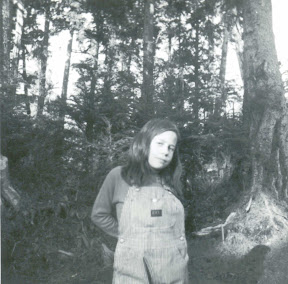
Miriam, age 11, in the Alaskan woods on our family's farm

My best friend was Chon [pronounced "shawn"] and she and I and her older brother Shannon, who was in the same grade as I, would ride our bikes from one end of town to the other (about a mile in length). When I use Google Earth or Windows Live Local to "visit" Klawock these days, I can see that all the streets are named now, as well as paved. When I was a kid, the roads were dirt and heavily pot-holed, and none of them were named. They were great for bike rides!


Chon, age 9


Shannon, age 12, in his best Last of the Mohicans pose

Chon, Shannon, and I would hike the heavily-wooded trail up the Klawock River, which emptied into the bay near her home, and often see deer. There are no snakes in Alaska, so that was never a worry, although I was always wary of black bears. Sometimes we would ride over to Crystal Dairy, which was a little convenience store in a mobile home, located halfway between her home and mine. We would buy a Shasta soda or a Popsicle, the kind you could split in two, each piece with its own stick.


A class field trip to the Klawock River.
Miriam (age 5) is standing in the red sweater;
Shannon (age 6) is sitting on the left.


Sometimes we would be invited to play at the home of the chip mill owner when his granddaughters were visiting from Ketchikan. We were not supposed to play on the mountains of wood chips and sawdust that were piled in the mill yard, but we never could resist. I shudder to think how we took our lives into our hands and played and climbed and rolled down and dug into those huge hills of chips and sawdust. It would have been so easy to have them collapse on us and be suffocated!

I never learned to swim until I moved to Washington State. We did not have a pool on the island, and mom wouldn't let me swim with the native kids on the beaches in town because the sewer dumped into the water there. When we moved to our place about a mile out of Klawock, we would sometimes go wading at the waterfront on our property. But there were no nice sandy beaches...just tidal mud flats with seaweed, scurrying small crabs, and the occasional clam squirting out at you as you walked by. It was also too cold to go swimming, and on a really "hot" day (75*F), the water was still pretty chilly for anything more than wading waist deep.

One of my favorite hideouts was a "cubbyhole" that Chon could access from her bedroom. Her room was located next to the stairway on the second floor, and a large cupboard was built from her room into the unused space over the stairs. Louvered hinged doors concealed the cubbyhole, and as it was about three feet from the floor, you had to scramble to climb in. It was a two-story cubby. The floor of the "top story" was even with the bottom of the cupboard doors. A trap door in the floor led to the "bottom story" of the cubbyhole, which was really only big enough for two little girls to squeeze into. Once, Chon's cat, Thomasina, had a litter of kittens there. I still have dreams about being a kid and playing in the cubbyhole!

And last, but not least, I remember we used to think it was so fun to slide down the stairs of her home on our rear ends. It was a long flight of stairs, and as my home was single-story, it was quite the attraction! However, one day we were really stupid and did it over and over again, wearing shorts instead of long pants. We had horrible rug burns on our legs for weeks after that! I'm surprised I don't have scars!

What are the memories of your neighborhood?

Wednesday, April 04, 2007

Bertha Wilma (VALK) MEYERING KRAMER (1924 - 2007)

I received an e-mail today from one of my mother's cousins, informing us of the death of my grandaunt, Bertha Wilma (VALK) MEYERING KRAMER. She was the eldest child of the marriage of my maternal great-grandfather, William James VALK, and his second wife, Ida Eva (LAMBRECHT) SCHADLER. The widowed William and Ida brought a total of eight children to their marriage (seven were his [one other died in infancy], one was hers), and then proceeded to have eight more children, five of whom survived infancy. Bertha's death leaves only two children remaining of this household: Ida's son from her first marriage, and their youngest daughter.

I don't ever remember meeting Aunt Bertha, who was my maternal grandfather's younger half-sister, although it's possible I may have met her as an infant or very young child on one of our frequent visits to Michigan from Alaska. Bertha's obituary can be found online at the Grand Rapids (Michigan) Press.

Update: I've analyzed Bertha's obituary here, sharing the discoveries I made.

Monday, January 15, 2007

Childhood Food Memories

I feel very blessed to have had the childhood I did, although for years, I did not appreciate it! I was born and grew up in Alaska, living in mostly Native American-populated villages. My parents were Salvation Army officers (ministers), doing mission work with the various native tribes. When I was older, they built a house by hand (no power tools), and they had a little farm, living nearly completely off the land. Because of this environment, I have had rich and varied experiences that many my age have not, and can understand and relate to the lives of my ancestors who lived pre-electricity, pre-running water, and pre-supermarkets.

Coming along hand-in-hand with these experiences was the assortment of foods that I enjoyed. I was born in Kodiak, whose native peoples were heavily influenced by the Russian culture. Here my parents learned to make pirok (salmon and rice pie, flavored with onion and hardboiled eggs), and kulich (Russian Easter bread - a heavy bread full of eggs and dried fruit, baked in a coffee can). Living on a minister's salary was not easy. I may be mistaken, but I believe that at that time, The Salvation Army paid its officers stationed in Alaska and Hawaii the same salary as those in the "Lower 48." This was disproportionate, since the cost of living in those two states is much higher, due to shipping charges being passed along by retailers to the consumers. I well remember eating pancakes and salmon frequently at the end of every month. In fact, salmon, so outrageously priced at my local supermarket, was as common as hot dogs are for most people during my growing up years. My parents owned a succession of several small outboard boats long before we had a car, as it simply was more practical to have a vehicle one could use on water to bring home the bacon--er salmon--with. For most of my childhood, we lived in or near the village of Klawock, on Prince of Wales Island, the third-largest island in the U.S. (after Long Island, New York, and Whidbey Island, Washington). The road from Klawock to Craig, a larger town mostly populated by Caucasians, was a treacherous 7-mile logging road remnant, and it was more convenient and less time-consuming for my parents to boat down than drive. Prices were slightly lower in Craig, and so they often did their shopping there. Later on, they would order by telephone to a grocery store in Ketchikan, and have their goods shipped over on a freighter that came to P.O.W. Island once a month.

Besides the many varieties of fish (salmon, halibut, coho, red snapper - some of which I helped Dad catch), there were clams, crab, and seaweed harvested from the sea. My favorite treats were the seaweed that would be spread on sheets on the rooftops in the summer to dry, and smoked salmon (nearly everyone I knew had a smokehouse). The kids I knew growing up loved Indian Cheese (fermented salmon eggs) with eulachon oil (a candlefish), but it was too strong for me. And speaking of kids, many would go salmon fishing on the bridge that spanned the mouth of the Klawock River where it fed into the bay. Fish that were considered "too small" were rarely tossed back in the water, but left to rot on the bridge or roadside. Dad often tells how when we moved to Northeast Washington and he saw the price of salmon in the supermarkets, he would remember all the rotting fish on the bridge, and silently mourn! I hated live crabs...they always looked malicious...and you had to put them in a large pot of water and slowly boil them to death. Once a crab crawled out of a pot Mom had on the stove, and I remember her shreiking and pushing it back in with a broom handle!

In addition to the bounty of the sea, the land gave as well. I don't really remember Dad going hunting, although I know he did. I do remember eating venison once in a while, although some may have been given to us by neighbors. I loved the way my mom prepared venison in a kind of barbeque sauce. In the fall, it was very common to see deer carcasses hanging off people's front porches to drain all the blood out of the meat before cutting it up.

Dad once shot a bear on our front porch--which is a blog for another day!--and he and Mom made delicious sausage from the oily meat, which I loved to eat for breakfast with waffles.

I fondly remember picking elderberries, blue huckleberries (erroneously referred to as blueberries by area residents), thimbleberries (a favorite of mine), and salmonberries (a wild raspberry with colors ranging from yellowish-orange to maroon). Mom and Dad made the best jams, jellies and pies. I did hate picking salmonberries, as they had thorns and their thin whip-like branches always seemed to slap me in the face when I followed Mom into the berry patches, with old coffee cans hung by our necks with strings to leave both hands free for picking. I remember always being a little nervous about black bears when berry picking, and to discourage any in the area, we would always sing loudly in the berry patches. When out playing in the woods, sometimes I would snack on wild currants, but I never remember anyone picking any to make jam or anything else with it. After my parents started their little farm, Mom experimented with drying ground salmonberries on waxed paper in our egg incubator, and came up with some great fruit leather.

Wild asparagus, a green about four inches high and a quarter-inch in diameter resembling the domestic asparagus, could be found near the beaches, and I liked it with butter and salt. But I disliked goose tongue, another wild green that looked like long, wide blades of grass. When steamed, its texture was too soggy for my liking.

The growing season was short and very wet (160 - 180 inches of rain a year), so mostly root crops flourished in my parents' garden: potatoes, carrots, turnips and radishes. There were also peas, lettuce, cabbage, kale and rhubarb. Dad tried strawberries in a barrel, but they never amounted to much. He had a green thumb, and grew beautiful roses, tulips, morning glory and honeysuckle, in addition to the vegetable garden.

On the farm, which we liked to refer to as the homestead, we raised goats, rabbits, pigs, chicken, ducks, and geese. Dad brought in Pygmy goats, because the miniature adults could be shipped in dog kennels in the small engine planes that delivered to the island. That way, he didn't have to wait for (goat) kids to grow up before breeding, milking, or butchering. Some friends of ours owned a restaurant and lodge; being from Texas, they had a barbeque pit for preparing their famous Tex-Mex foods. Dad bartered and was able to have a whole goat barbequed over the pit for several days...one of the most delicious meals I've ever eaten! Of course, we drank goat's milk, and the folks experimented a bit with cheese-making, which if memory serves me right, ended up being a bit like Feta. We had two pigs at two different times, and each time Dad and Mom made wonderful sausage, as well as bacon, ham, head cheese and cracklings. The first time we had rabbit, they didn't tell me what it was, but kept making comments about how the "chicken" had four drumsticks! Of course, we had plenty of chicken, duck, and goose, along with eggs galore.

Mom made good old-fashioned sourdough bread from an old Alaskan recipe, sweetened with molasses and raisins (which kept the bread moist). She would bake it in coffee cans, a good half-dozen loaves at a time, then wrap them in foil or plastic bags to keep fresh. She made this bread for years, even after we moved to Washington, and it was a favorite Christmas gift among the neighbors from our home.

My parents felt it was important to starting incorporating elements of Dutch culture into our home. As a white child in a village of Indian children, I learned a great deal about the Tlinget culture at school, where we had "blocks" - elective classes in native dance and song, mythology, language, and crafts (beading, blanket making, and woodcarving). While this was certainly an enriching education, they wanted me to understand that I had my own heritage of which to be proud, and this was probably the beginning of my interest in genealogy. They determined that between them, I probably was nearly half Dutch and half English, with a bit of Heinz 57 thrown in for good measure. Being from Western Michigan, heavily populated by Dutch immigrants, they were familiar with the Dutch culture. One of the many things they did was to find a cookbook of traditional Dutch foods. Favorites included vijfschap (Five Kinds) - a beef stew with five kinds of vegetables and fruit (potatoes, onions, carrots, celery and apples) - and olie bolen (literally, "oily balls"), what we know as donut holes.

My all-time favorite treat growing up (and even now) was banket (bun-KET), a traditional Dutch pastry with almond paste filling. My grandfather would make it and send it in our Christmas package from the relatives on my mother's side of the family. A huge box would arrive, plastered over with sheets of stamps. Grandpa worked for the US Postal Service in Grand Rapids, Michigan, and he, along with my dad and myself, collected stamps. The box was a gift in itself! After Christmas, Dad would carefully cut the cardboard, then place wet towels over the stamps to soak them off, later to be mounted in our albums. Inside the box, everything was packed in the Sunday comics, another treasure in itself. We were not regular subscribers to the nearest paper, The Ketchikan Daily News, and even then, its comics were in black-and-white. The Grand Rapids Press, however, had Sunday comics in full, glorious color! At the top of the carefully wrapped and packed Christmas presents would be the banket, wrapped in foil and still semi-frozen. Dad would cut the pastry into one-inch diagonal slices, and we would enjoy every bite. There never seemed to be enough!

In 1997, I wrote my grandfather, and asked him for the banket recipe. At that time, he was 81 years old, and I figured I may not have many opportunities to ask him. As a matter of fact, he lived another 9 1/2 years, passing away just a few days ago, on January 6th. Every year when I make this treat for my family and friends,I think fondly of my grandfather, and next Christmas, it will be with a mixture of loss and joy. I've included the recipe here, in this very long blog, as a tribute to my grandfather. Although complicated, time-consuming, and expensive (almond paste is not cheap!), the results are worthy!


BANKET

Pastry:
4 c. sifted flour
1/2 t. salt
1/4 t. baking powder
1 lb. margarine (good quality)
1 c. cold water

Filling:
1 lb. kernel or almond paste (kernel is cheaper and tastes as good, says Grandpa)
2 c. sugar
2 whole eggs and 1 egg yolk (save white for glaze)
1/4 c. flour
2 t. vanilla

Glaze:
1 egg white
granulated sugar

To make pastry, crumble or chop margarine into flour, salt, and baking powder mixture until mixed fine. Add water and mix well. Form dough into flat ball; wrap in waxed paper and chill overnight.

For filling, crumble or chop paste (a blender or food processor can be used, says Grandpa, but I used a hand pastry cutter). Add sugar and flour and mix. Add two whole eggs, egg yolk, and vanilla and mix well. Form into a flat ball, cover or wrap, and chill in refrigerator overnight.

Divide pastry and filling into 8 equal parts each. Shap pastry dough into an oblong ball. Roll the ball away from you on a floured pastry cloth into a strip about 3 inches wide by 12 - 14 inches long.

Take one piece of filling and roll with palm of hand into a long rope a little shorter than the pastry strip. Roll the filling onto pastry. Brush one edge and the ends of pastry with water, fold the ends over the filling, and roll the pastry around filling toward moistened edge. Press lightly to seal and place each finished roll lengthwise on an ungreased cookie sheet, seam side down. Put 4 rolls on each sheet.

Beat egg white and brush on top of rolls; sprinkle with sugar. Prick rolls with fork at one-inch intervals. Bake in preheated oven 425* about 25 - 30 minutes or until light brown. Makes 8 rolls.