Sunday, December 02, 2012

Advent Calendar of Christmas Memories No. 2: Holiday Foods

Holiday Foods

Did your family have any traditional dishes for the holidays? Was there one dish that you thought was unusual?

A couple of traditional holiday sweets we had while I was growing up were banket (bun-KET) and olie bollen (OH-lee BOH-len), traditional Dutch desserts. Banket is similar to Danish kringle in that it is a rolled pastry log with sweetened almond paste filling, cut into small slices. Every year we would hope my grandfather wasn't too tired from his working his long hours at the post office in Grand Rapids, Michigan, so that he could make banket and send it to us in Southeast Alaska, and later in Northeast Washington. He would wrap it in foil and freeze it, then send it in our packages of Christmas gifts. (See recipe and photos here.)

Olie bollen literally means "oily balls" or "fat balls" and they are what we know as donut holes. I buy these, both plain and with powdered sugar, almost every year for my family at my local supermarket and often bring them to class on St. Nicholas Day, while I tell my students about our Dutch traditions.

For Christmas dinner, Mom would always make a big traditional meal, usually with whatever meat we had raised on our farm. We had a variety of poultry to choose from: chicken, duck, or goose. We also had rabbit, ham, or chevon (goat meat). Along with the main meat dish, there would be mashed potatoes and gravy, home-grown cooked vegetables, cranberry jelly, and pickles and black olives. Dad's favorite dessert was mince-meat pie, and I think one year, we had homemade mince-meat after we had butchered a hog. I also remember homemade apple pie with slices of cheese.

When we have Christmas at my house, I don't usually go all out with a large, sit-down dinner. My kitchen is pretty small, and it's hard to crowd a dozen people around my dining room table, even with all the leaves out, so I'll often have a buffet instead. Depending on the time when we open gifts, sometimes it will be a brunch with crackers, meats, cheeses, and the like. At other times, I'll have plates of sub sandwiches with side dishes. Always, we have several desserts to choose from.

When we go over to my brother-in-law's place, we'll sometimes have a traditional meal, especially if it's Christmas Eve. If we meet between Christmas and New Year's, we often have a comfortable dinner of homemade stew, rolls, and a salad, followed by dessert. My brother-in-law is a pretty good cook, and usually makes the stew.

In the past, New Year's Eve was normally spent at home. All evening, we would graze on any leftover goodies that may have survived Christmas Day. Sparkling cider was bought for the kids when they were young, and my drink of choice to see in the New Year used to be rum and Coke. Lately, I prefer a glass of wine or champagne.


This post is a part of the "Advent Calendar of Christmas Memories" meme created in 2007 by Thomas and Jasia. You, too, can write your own Christmas memories, either for your personal journal or blog. Visit Geneabloggers to participate and to read others' posts on these topics.

Saturday, December 01, 2012

Advent Calendar of Christmas Memories No. 1: The Christmas Tree

The Christmas Tree


Did you have a real tree or was it artificial? How big was the tree? Who decorated the tree?

I lived in the woods of Southeast Alaska and Northeast Washington for most of my childhood... yet we had an artificial tree for most of those years!

We must have had real trees when I was very little, but I never remember decorating them or seeing them set up. I do have vague memories of seeing a tree in our living room in Kake, Alaska and again in our mobile home in Klawock, Alaska; they would have been real. Sometime in the mid-1970s after my parents built their house about a mile outside of Klawock, they got a small artificial tree and decorated it with red and white velveteen-covered doves, roses and ribbons. Since we did not have electricity out on this farm, we did not have lights on the tree. It was a family joke that we lived in one of the largest forests in the nation, yet we had an artificial Christmas tree. It did make sense because most of the trees around our home were very tall, and it was wasteful to cut down small trees for Christmas that could have instead grown up to be good for lumber, firewood, or shade. I think we kids always helped decorate the tree.

The first year I were married (1987), I had a real Charlie Brown Christmas tree. My former husband worked for The Salvation Army Family Services department, and a bunch of Christmas trees had been donated to give to needy families. He brought the last one home on Christmas Eve after the department had closed for the holiday. That tree was so bad, no needy family had even wanted it! It stood about three feet tall, and there was no bad side to place against the wall...every side was the bad side! I only had a handful of decorations, but I did the best I could to fix it up! It had kind of been an impromptu thing, as my former husband really wasn't into celebrating Christmas at that time, and only brought it home after I had protested, "We have to have a tree!"  Over the years, I have had a couple of artificial trees that served their purpose well. This year I am planning to decorate the tree in a different way as a tribute to my ancestors and love of genealogy. Stay tuned!

This post is a part of the "Advent Calendar of Christmas Memories" meme created in 2007 by Thomas and Jasia. You, too, can write your own Christmas memories, either for your personal journal or blog. Visit Geneabloggers to participate and to read others' posts on these topics.

Monday, November 19, 2012

Mug Book Monday: George Rice WESTABY, I (1822 - 1894)

"Mug books" are collections of biographical sketches usually found within county histories of the late nineteenth- and early twentieth-centuries, particularly in the United States. On Mondays, I'm highlighting ancestors or relatives who were featured in these mug books.


"The Salem M. E. Church.--This church, located on a picturesque rural spot at the junction of the roads leading from Thompson's Mills to Schapsville, and from Apple River to Elizabeth, on section 23, was erected in 1869. It was the first built in the township, Christopher Columbus Thompson and William Witham being the active men to whose zeal, exertions and influence the Methodists are indebted for  its erection, George Westaby donating the land (one acres) on which it stands. It is a commodious frame building, 23 by 44 feet; cost $1,600, and is clear of debt. It was dedicated by Rev. S. A. W. Jewett. Rev. Archibald Smith, of the Rock River Conference was the first pastor. He died in 1869, and was succeeded by Rev. F. R. Mastin, Messrs. Roberts, Brotherton and Kennedy, in the order as mention. W. J. Liberto at present holds service fortnightly, the pulpit on alternate Sundays being filled by Mr. William Witham and other local preachers. The congregation numbers forty members, and has a large attendance at Sunday services. The people of all denomination (Catholic included), and many of no religious belief, subscribed towards its erection. Henry Evans, William Witham, Ichabod Sampson and George Westaby were the first trustees. The present ones are William Sincox, William Witham, Charles Westaby, John Bastian and William Chapman."


"Westaby C. farm; Sec. 25; P. O. Houghton.
"WESTABY GEORGE, Farmer; Sec. 23; P. O. Houghton; son of Thomas and Mary Westaby, of Barron [sic - Barrow-upon-Humber], Lincolnshire, Eng., where he was born Nov. 19, 1822; was married April 12, 1850, to Miss Ann, daughter of Wm. and Maria Wilson, of Alton LeMoor [sic - Holton le Moor], Lincolnshire, and emigrated to this Co. same year; she was born Oct. 22, 1822; they have four children: Stephen, born June 12, 1852; Tom, March 12, 1855; Wilson, July 17, 1857, and George Rice, March 29, 1863; they lost by death two daughters and one son; they are raising a grand-nephew of Mrs. Westaby, Thomas Wilson, born in Eng. Aug. 28, 1864, whom she brought to this country on her return from a visit to her native home and relations; Mr. W. owns 584 acres valued at $11,680; is Road Commissioner; has been Overseer of Highways; School Director four terms; Assessor and Collector several years; Republican in politics; Independent in Religion; donated site (one acre), for the Salem M.E. Church, and was a member of the Building Committee.
"Westaby S. farm; Sec. 25; P. O. Houghton.
"Westaby W. farm; Sec. 25; P. O. Houghton."

---

George Rice WESTABY, I was my children's paternal 4th-great-grandfather. There is mention of his parents, Thomas WESTABY and Mary SPAULDING, wife, Ann WILSON, and their son, George Rice, Jr. (who went by "Rice"), and parents-in-law William WILSON and Maria [--?--], all of whom are also direct ancestors of my children.

"Independent in Religion" doesn't mean non-denominational or non-religious. In older English census records, the Independents were listed with the Congregationalists. They have similar roots as the Separatists (known in America as the Pilgrims of Plymouth Colony), and the Puritans of Massachusetts Bay Colony.

Charles WESTABY, mentioned in the paragraph about the Salem Methodist-Espicopal Church, as well as the first entry of Westabys ("C. Westaby") in the biographical listings for Thompson Township, was George's brother, who emigrated with him in 1850. The "S. Westaby" and "W. Westaby" listed after George were likely his nephews, either Spencer or Spaulding, and William, as they are farming in the same section as Charles. However, it is possible they could instead have been his sons, Stephen and Wilson.

This information was taken from The History of Jo Daviess County, Illinois, containing A History of the County, Its Cities, Towns, Etc.: A Biographical Directory of Its Citizens, War Record of Its Volunteers in the Late Rebellion, General and Local Statistics, Portraits of Early Settlers and Prominent Men, History of the Northwest, History of Illinois, Map of Jo Daviess County, Constitution of the United States, Miscellaneous Matter, Etc., published in Chicago by H. F. Kett & Co., 1878. The paragraph regarding the Salem M.E. Church is found on pages 610 and 611, whereas the biographical sketches are found on pages 794 and 795. This county history, along with many others, can be found at the Internet Archive and Google Books.

Saturday, November 17, 2012

Scanfest Postponed Until After the Holidays

Just a heads up on the state of Scanfest: I had originally considered hosting Scanfest on Sunday, November 18th, but I will not be available to do that tomorrow. Next weekend is Thanksgiving, and my plans are still up in the air, with the weather determining if I'll spend the holiday in the area or on the other side of the state. My Christmas plans are also indeterminate at this time, so I've decided to wait until January to host the next event, rather than make vacillating Scanfest dates.

In the meantime, as you spend time with your relatives over the holidays, be sure to ask if they have any old family photos you can borrow to scan...or if you have a portable scanner, such as the Flip-Pal, bring it along with you to scan on the spot. If you don't have a portable scanner, and are unable to borrow the photos, bring along a quality digital camera and take high-resolution photographs of the original images.

Enjoy your family time. I hope to see you on January 27th for our next Scanfest!

Wednesday, October 24, 2012

October Scanfest is Cancelled

I'm so sorry to announce that the October Scanfest will have to be cancelled. My adult daughter is moving into an apartment this weekend after living with me for the past six months. She will need my assistance in getting the last of her things moved next Sunday.

After I am sure of my Thanksgiving plans, I will announce the next Scanfest. It will tentatively be on November 18th.

Thank you for your patience and understanding.

Monday, October 01, 2012

Mug Book Monday: Samuel Austin SNOOK (b. 1859)

"Mug books" are collections of biographical sketches usually found within county histories of the late nineteenth- and early twentieth-centuries, particularly in the United States. Each Monday, I'm highlighting ancestors or relatives who were featured in these mug books.


     "SAMUEL A. SNOOK, proprietor of a well-known hardware store in Johnstown, Cambria county, Pennsylvania, is a representative of one of the old pioneer families of this country, being of the eighth [sic - sixth or seventh] generation of the Snook family in America.
     "William Snook, the great-great-grandfather of Samuel S. [sic] Snook, was the great-grandson [sic - son or grandson] of the pioneer ancestor of the Snook family, who emigated to this country from Germany. He married and raised a family.
     "Matthias Snook, son of William Snook, married Christina Kleckman [sic - Maria Christina Kleckner], and had a number of children.
     "Levi Snook, son of Matthias and Christina (Kleckman [sic]) Snook, was a farmer in Center [sic - Centre] county, Pennsylvania, where his death occurred in 1877 [sic - 1889]. He was a strong supporter of the Union party. He married Sophia Kleckmer [sic - Margaretha Wolfart(h)], and raised a family of children: 1. Matilda, married John Frazin. 2. Rueben [sic] W., of whom later 3. Jacob W., married a Miss Stover. 4. Elizabeth, married George Walford. 5. Kate, married John Rute. 6. Matthias, unmarried, was killed during the Civil war. 7. Elias W., married Rinda Reid, 8. Amelia, married Charles Bierly. 9. Barbara, married Nathaniel Courier. 10. Levi W., married a Miss Berry.
     "Reuben W. Snook, eldest [sic - third] child of Levi and Sophia (Kleckmer) [sic - Margaretha Wolfart(h)], was born in Center [sic] county, 1833. He followed the occupation of farming in Clinton county, Pennsylvania, for about ten years, then removed to Bellefonte, Center [sic] county, Pennsylvania, residing there for about five years, and is at present (1906) living in retirement in Forsythe, Rosebud county, Montana. He is a member of the German Reformed church. He married Mary Walker, daughter of Daniel and Mary [sic - Hannah] (Erhardt) Walker. Daniel Walker was a farmer and mill owner, and one of the largest landholders in Myles [sic - Miles] township. He had children: Samuel, Jerry, Jonathan and two daughters. The children of Mr. and Mrs. Reuben W. Snook were 1. Samuel A., of whom later 2. Emma, married Amos Fehl. 3. Ellen, married Ira Brungard. 4. Rebecca, married George Westaby. 5. Sadie, married James Kenealy. 6. Annie, married a Mr. Armstrong. 7. William. 8. John. 9. Edward. 10. Howard. 11. Elizabeth. 12 Maggie. [Correction: some of these children were not Mary Walker Snook's, but were instead Reuben's through his second wife, Elizabeth Nearhood. There are also children missing from this list.]
     "Samuel A. Snooks [sic], first son and eldest child of Reuben W. and Mary (Walker) Snook, was born in Myles [sic] township, Center [sic] county, Pennyslvania, May 23, 1859. He was educated in the public schools of Bellefonte, where he was apt and studious. He then served a three years' apprenticeship to the wire drawing trade, and then held a positon of clerk in the Cambria County Bank of Johnstown; was with Bantly Fronheiser for three years, and then in the hardware business with John Dibert until 1889, when the flood of May 31, of that year, destroyed the building. Mr. Snook established a hardware store at No. 514 Main street, in 1899, and has conducted this very successfully up to the present time (1906). He is highly respected and esteemed by a large circle of friends and business acquaintances. He is a member and trustee of the United Brethern church, and a stanch supporter of the Republican party. He is a member of Johnstown Council, No. 401, Royal Arcanum.
     "He married, April 10, 1889, Annia G. Shaffer, daughter of Samuel and Mary (Kantner) Shaffer, who had six children: Sarah, John E., Mary, Catherine, of Allentown, Annie and Margarett. Samuel Shaffer was a salesman. The children of Samuel A. and Annia G. (Shaffer) Snook are: Earl, born February 9, 1890. Clyde, October 11, 1892. Mary E., November 27, 1894. Robert W., October 3, 1898. John S., February 5, 1901."

---

Samuel Austin SNOOK was the brother of my children's 3rd-great-grandmother, Rebecca Catherine (SNOOK) WESTABY. There is a great deal of genealogy in this biography, some of it correct, some of it definitely not so. While transcribing this biography, not only did the genealogical errors make me cringe, but so did the obvious and numerous spelling and punctuation errors. Of great interest to me, however, is the note that Samuel's business was destroyed by the Johnstown Flood of 1889. This was one of the worst disasters in history of the United States in which 2,209 people were killed from the South Fork Dam on the Little Conemaugh River bursting, causing 20 million tons of Lake Conemaugh to cascade down the river. It damaged or destroyed five towns, killed 99 complete families, and caused $17 million dollars (the equivalent of over $407 million dollars today) of damage. To date, only the Galveston Hurricane of 1901 and the attacks of 9/11 in 2001 produced more casualties. Several movies and numerous books, including one written by Pulitzer Prize-winning author David McCullough, have featured this disaster.

This biographical sketch was taken from Volume III of the History of Cambria County, Pennsylvania with Genealogical Memoirs, by Henry Wilson Storey, published by The Lewis Publishing Company of New York and Chicago, 1907. Samuel's sketch was found on pages 626 and 627. This county history, transcribed and with images, can be found at the Cambria County, Pennsylvania GenWeb site.

Sunday, September 30, 2012

Monday, September 24, 2012

Mug Book Monday: Reuben Wohlford SNOOK (1833 - 1912)

"Mug books" are collections of biographical sketches usually found within county histories of the late nineteenth- and early twentieth-centuries, particularly in the United States. Each Monday, I'm highlighting ancestors or relatives who were featured in these mug books.


     "REUBEN W. SNOOK.--Born in Center [sic - Centre] county, Pa., June 27, 1833, and reared and educated in that sturdy old commonwealth, Reuben W. Snook brought to Forsyth, Mont., the qualities of industry and frugality for which the people of his native state are distinguished, and has put them to good and productive usefulness. His parents, Levi and Margaret (Wohlfort [sic]) Snook, were born in Pennsylvania and they there died; the former in 1879 [sic - 1889] and the latter in 1881 [sic - 1882]. Their ancestors on both sides of the family came to the United States with a Germany colony in 1684, and settled near York, Pa., where they were profitably engaged in farming for generations. [Correction: The SCHNUCH family came to Dutchess County, New York c. 1736 and the WOLFARTH family came to Berks County, Pennsylvania sometime before 1730. Reuben's maternal grandfather, Phillip WOHLFARTH, I did immigrate to York County, Pennsylvania from Berks County.] Reuben Snook remained at home working on the farm and attending the district schools in his neighborhood as he had opportunity until he reached the age of maturity. After leaving school he learned the trade of a carpenter. He worked in his native state as a journeyman and railroad bridge builder until 1883. In the spring of that year he brought his wife and children to Montana and located at Forsyth. There he followed the business of contracting and building for eight years, and erected most of the frame buildings that were put up in the early growth of the town--about forty in all. In 1893 he quit working at this trade and homesteaded a ranch on the Yellowstone which he sold soon after and removed to his present ranch, one mile from Forsyth. This ranch, compromising 168 acres, was purchased by Mr. Snook in 1890, and is devoted to horses, cattle, farming and dairying. Mr. Snook also owns valuable town property in Forsyth. In politics he is a Republican, and has rendered faithful service in various official stations. He was a justice of the peace for a number of years, was appointed public administrator in the spring of 1901, and was census enumerator in 1900 for district No. 104, then in Custer county.
     "Mr. Snook was married in Center [Centre] county, Pa., in 1858, to Miss Mary Walker, a native of that state, who died there in 1873 [sic - 1870]. He contracted a second marriage in 1874 [sic - c. 1871], at the same place, being united on that occasion with Miss Margaret [sic - Elizabeth] Nearhood, also a Pennsylvanian by nativity. They are the parents of seven children: Annie, wife of W. H. Armstrong, a stockman near Forsyth; William, living at home; John and Howard, cowboys; Edward, an Alaska miner; and Lizzie and Maggie, living at home. The children of the first marriage are: Austin, married and living at Johnstown, Pa.; Emma, wife of Amos Fehl, a tanner at Clearfield, Pa.; Helen Martha, wife of Ira Blumgard, a farmer in Center [Centre] county, Pa.; Rebecca, wife of Rice Westerby [sic - George Rice Westaby, II], living at Forsyth, Mont., and Sadie, wife of J. H. Kenealy, a dairyman, near Forsyth."

---

Reuben Wolhford SNOOK was my children's 4th-great-grandfather on their father's side. The above biography, while giving a detailed description of Reuben's life in Montana, is an example of how such biographies can be riddled with simple errors such as spellings and dates which are off by a few years, as well as gross errors such as the completely incorrect background on the immigration from Germany to colonial America. While I'm still sorting out Reuben's children by both wives, I do believe several children are missing from the lists detailed here. There is also a family story that says the Snooks first went to California from Pennsylvania, before heading to Montana, but so far, I've found no documents to back this up.

Forsyth, Montana was originally a part of Custer County. In 1901, Rosebud County was formed from part of Custer County with Forsyth as the county seat.

This biographical sketch was taken from Volume Part II of Progressive Men of the State of Montana, published in Chicago by A. W. Bowen and Company, c. 1902. Reuben's sketch was found on pages 1815 and 1816. This county history, along with many others, can be found at the Internet Archive.

Sunday, September 23, 2012

Scanfest is Coming!


The September 2012 Scanfest will take place here at AnceStories this coming Sunday, September 30th, from 11 AM to 2 PM, Pacific Daylight Time.
 
What is Scanfest? It's a time when geneabloggers, family historians, and family archivists meet online here at this blog to chat while they scan their precious family document and photos. Why? Because, quite honestly, scanning is time-consuming and boring!

Scanfest is a great time to "meet" other genealogists, ask questions about scanning and preservation, and get the kick in the pants we all need on starting those massive scanning projects that just seem too overwhelming to begin.

To get started, you need to know the basics about scanning:

1. Don't use commercial glass cleaners (i.e. Windex) or paper towels to clean your scanner's glass plate. Use a soft, clean cloth, preferably microfiber. If you must use a liquid, use water sprayed directly onto the cloth  and make sure to let the plate dry thoroughly before placing photos or documents on it.

2. Wear cotton gloves (available at many art and/or photography supply shops) when handling photos and old documents.

3. Don't slide the photos around on the glass plate. Place them exactly where you want them. Photos should NEVER be scanned by a scanner that feeds the document through the machine, but ALWAYS on a flat-bed scanner.

4. Set your scanner to scan at no smaller than 300 dpi (dots per inch). Many experts recommend 600 dpi for photographs.

5. Photographs should ALWAYS be scanned and saved as .tif files. Use "Save As" to reformat the .tif file to a .jpg file for restoration and touchups, emailing, or uploading to an online photo album. ALWAYS retain the original scan as a .tif file.

6. Documents can be scanned as .pdf files or .tif files.

7. When you are done scanning your photos, don't put them back in those nasty "magnetic" photo albums. Place them in archival safe albums or boxes found at websites such as Archival Products or Archival Suppliers. Do NOT store any newsprint (articles, obituaries, etc.) with the photos. The acid from the newspaper will eventually destroy the photograph.

Now about the chatting part of Scanfest:

We will be using Blyve, a live blogging platform that you access right here at AnceStories. This is a new platform to us, so please be aware that there may be some technical difficulties or delays as we try out this new product.

On Sunday at 11 AM, PDT, come right here to AnceStories and you'll see the Blyve live blog/forum in the top post. It's not really a "chat room," per se, it's more like a live forum and anyone visiting this site can read and see what is happening in the forum.

You will not need to download any software.

We look forward to having you participate with us!

Monday, September 17, 2012

Mug Book Monday: Jeremiah "Jerry" F. YORK, II (1855 - 1946)

"Mug books" are collections of biographical sketches usually found within county histories of the late nineteenth- and early twentieth-centuries, particularly in the United States. Each Monday, I'm highlighting ancestors or relatives who were featured in these mug books.


     "Jerry F. York, a well-known and progressive farmer of Atlas Township, this county, was born in that township and has lived here all his life. He was born on a pioneer farm in section 36 of that township, south of the village of Goodrich, March 28, 1855, son of John H. and Anna (Crothers) York, both of whom were born in Erie county, New York, who came to Michigan in 1850 and settled in this county, where they spent their last days.
     "John H. York was born in 1823, son of Jeremiah and Rhoda (Sweers) York, the former of whom was a soldier in the War of 1812 and a person of prominence in his home community, a well-to-do farmer, who at one time and another held various local public offices. John H. York grew up to the life of the farm and in 1847 married Anna Crothers, who was born in 1825, daughter of John and mary (Wycoff) Crothers, the former a native of Pennsylvania and the latter of the state of New York. In the fall of 1850 he came with his family to this state and settled ona farm of forty acres in the north half of section 36 of Atlas township, this county, and there established his home. He later added to his farm until he became the owner of one hundred acres and was accounted one of the substantial farmers of that neighborhood. He was a Republican and he and his wife were members of hte Methodist Protestant church, in which he was a class leader and in which his wife served as a steward. He died on November 12, 1898, and his widow survived until February, 1904. They were the parents of seven children, of whom three are deceased, one who died in infancy, one who died when two years old and Marium, who married Henry Frick and died in 1912. The survivors are Mrs. Ella Dillenbeck, of Atlas township; Mrs. Matilda Watkins, of Goodrich; Jerry F., the subject of this sketch, and James L., who is living on the old home.
     "Jerry F. York remained on the old home farm until his marriage in December, 1877, after which he began farming for himself. For two years he continued farming on the old home place and then moved to the village of Goodrich, where he made his home for sixteen years, a part of which time he was engaged in the harness business. In January, 1896, he bought a farm of sixty acres in section 10 of his home township and ever since has made his home there, doing well at his farming operations and becoming quite well circumstanced. Since moving there he has bought more land adjoining and now has a well-kept farm of one hundred and twelve acres. He and his wife are members of the Maccabees and he is a member of the Masonic lodge at Ortonville.
     "Mr. York has been twice married. It was on December 23, 1877, that he was united in marriage to Rachel Ann Baxter, who also was born in Atlas township, daughter of Eli and Rachel Ann (Cummings) Baxter, both members of old families in this county, having come here with their respective parents in the days of their youth and growining up amidst pioneer conditions of living. Eli Baxter, who lost his life while serving as a soldier of the Union during the Civil War, was a son of Edward and Mary (Herrick) Baxter. Mrs. Rachel A. York died on May 26, 1880, leaving one child, a daughter, Leno, who married Robert Goodfellow, now living at Castle Rock, Washington, andhas four children, Lee, Warren, Loretta and Lola Lillian. On April 22, 1896, Mr. York married, secondly, Eva Cummings, who also was born in Atlas townshp, daughter of Edward and Susan (Dalby) Cummings, the former a native of this county and the latter of Erie county, New York, who are still living on the old Cummings homestead north of Atlas, for many years honored and useful residents of that community. Mr. and Mrs. York are rearing a lad, Clarence Streater, whose care they assumed in June, 1906, when he was six years old. Jerry F. York is a Republican and has been treasurer for twelve years of school district No. 10, Atlas township, and is serving his third term as justice of the peace.
     "Edward Cummings, father of Mrs. York, is an honored veteran of the Civil War and for many years one f the most influential residents of his part of Genesee county. He was born on a farm in section 3 of Atlas township, January 22, 1844, son of Lewis and Elsie (Cummings) Cummings, both natives of Erie county, New York. Lewis Cummings was born in 1814, son of Stephen Cummings and wife, the former of whom was a solder in the War of 1812, and grew to manhood on a farm in his native county. There he married Elsie Cummings and in 1836 came to the then Territory of Michigan with his wife and two children, Rachel and Orlando, and settled on a tract of four hundred acres in section 3 of Atlas township, this county, which he had picked out ona previous trip to this part of the country, and there he and his family established their home in a little log house, being among the very earliest of the settlers of that part of Genesee county. Lewis Cummings was a good farmer and a man of excellent judgment and prospered in his affairs, until he presently came to be regarded as the wealthiest man in Atlas township, the owner of six hundred and forty acres of fine land and ever interested in movements having to do with the advancement of the community of which he was from the very first one of the leading factors. He was for many years member of the Congregational church at Goodrich and was ever foremost in local good works, so that at the time of his death on October 1, 1883, he was widely missed in that community. Lewis Cummings was thrice married, his first wife, Elsie, having died in 1851, leaving seven children, four sons and three daughters, Orlando, Oscar, Stephen, Edward, Rachel, Loretta and Elsie.
     "When the Civil War broke out Edward Cummings was still in his teens, but he enlisted for service in the Union army and served until the close of the war as a member of Company I, Thirtieth Regiment, Michigan Volunteer Infantry. Upon the completion of his military service he resumed his place on the old homestead farm in Atlas township and has lived there ever since, the owner of two hundred and twenty acres of his father's considerable estate. On April 19, 1866, he was united in marriage to Susan Dalby, who was born about twelve miles from the city of Buffalo, in Erie county, New York, in 1839, daugher of Benjamin and Sarah C. (Paxton) Dalby, the former a native of Pennsylvania and th latter of New York state, who came to Michigan with their family in 1855 and located about twelve miles south of Pontiac, whence they moved to Goodrich, in this county, where Benjamin Dalby conducted a blacksmith shop the rest of his life, his death occurring about 1871 and that of his widow in the spring of 1888. On April 19, 1916, Mr. and Mrs. Cummings celebrated their golden wedding anniversary and were the recipients of heartfelt congratulations on the part of their hosts of friends in this county. During her earlier years Mrs. Cummings was a school teacher in this county, having taught sixteen or seventeen terms of public and private, or 'select' school, and amonght ehosts of youngsters who learned their letters under her careful tutelage was the editor of this history, who has never ceased to entertain the highest regard for his old teacher."

---

This is indeed a long biography! Although Jerry YORK was not my ancestor, he was the older brother of my great-great-grandfather, James L. YORK, who is given a brief mention at the end of the second paragraph. He was named for his paternal grandfather, Jeremiah F. YORK, I, and was frequently called "Jerry". Jerry's ancestors, John H. YORK, Anna CROTHERS, Jeremiah F. YORK, I, Rhoda SWEERS, John CROTHERS, and Mary "Polly" WYCKOFF are all my ancestors and are mentioned here as well. This biography may sound familiar, since the one of Jerry's father, John H. YORK, was featured in last week's Mug Book Monday. This biography was published 24 years later, so there is updated information from his father's; namely, the deaths of his parents and sister Marium.

There is a great deal of information on the CUMMINGS family in this biography, since both of Jerry's wives were CUMMINGS descendants and were first cousins to one another. This is a great example of paying attention to those families who intermarried with your own, because by tracking them, you can often track immigration trails and further your own research. The CUMMINGS family lived near the YORK family in the Town of Clarence, Erie County, New York, before both families migrated to Atlas Township, Genesee County, Michigan. Also noted is that both Stephen CUMMINGS and Jeremiah F. YORK, I served in the War of 1812. It's possible they served together, although I have not found information to prove so. What I have discovered is that many New York War of 1812 Veterans moved to the western part of the state after the war, notably Niagara and Erie Counties, having previewed the land while being stationed at Black Rock near present-day Buffalo. This was the case for my Jeremiah F. YORK, I, who had originally been from Saratoga County, New York in the eastern part of the state. 

This biographical sketch was taken from Volume II of History of Genesee County, Michigan: Her People, Industries and Institutions With Biographical Sketches of Representative Citizens and Genealogical Records of Many of the Old Families by Edwin O. Wood, LL. D., President, Michigan Historical Commission, published in Indianapolis by the Federal Publishing Company, 1916. Jerry's sketch was found on pages 609 through 612. This county history, along with many other Michigan ones, can be found at the Michigan County Histories and Atlases Digitization Project website.

Wednesday, September 12, 2012

Wordless Wednesday: John Dennis CONCIDINE (1854 - 1925)

John Dennis Concidine. Bef. 1925. Original photograph privately held by Catherine Robbins, [ADDRESS FOR PRIVATE USE], Coopersville, Michigan. 2012.

Monday, September 10, 2012

Mug Book Monday: John H. YORK (1823 - 1898)

"Mug books" are collections of biographical sketches usually found within county histories of the late nineteenth- and early twentieth-centuries, particularly in the United States. Each Monday, I'm highlighting ancestors or relatives who were featured in these mug books.
     
     "JOHN H. YORK. Our readers will be pleased to find upon this page a sketch of one of the most worthy and venerable citizens of Atlas Township, Genesee County. This septuagenarian is a representative of the best class of our citizens, and is a native of Erie County, N. Y. His birth took place December 27, 1823 and he is a son of Jeremiah and Rhoda (Sweers) York, the latter being a native of Vermont and the former a soldier in the War of 1812.
     "From early youth John York was engaged in the work of a farmer and received his education in the district schools of his native county. His father was a prominent man in his township and served as Constable, Collector and Deputy Sheriff for eleven years.
     "Our subject was married March 11, 1847 to Anne [sic - Anna] Crathers, who was born in Erie County, N. Y. December 11, 1825, and was a daughter of John and Mary (Wycoff) Crathers. The father was a Pennsylvanian and the mother a native of the Empire State. Seven children have blessed the home of our subject and five are now living, namely: Marian, wife of Henry Frick; Jeremiah; Ellen, now Mrs. Alton Dillenbeck; Matilda, who married Charles Watkins; James. Milton and John N. are deceased.
     "In the fall of 1850 Mr. York removed with his family to Genesee County, and settled upon the farm where he now lives, a property which was then only partially improved. Upon this he has bestowed great labor and has it now in an excellent condition. It comprises one hundred acres of some of the best land in the county and it is in a highly productive condition. All this is the result of the united efforts of our subject and his wife, who have labored shoulder to shoulder through the hard times of pioneering and together have accumulated a property which provides well for them in their old age.
     "Mr. York has served as School Director and is active in promoting all educational movements. He and his wife are both members of the Protestant Methodist Church in which he is Class-leader, and Mrs. York is now serving her third year as Steward in the church. He is a Republican in politics and both he and his wife are highly esteemed members of society."

---

John and his wife, Anna CROTHERS (CRATHERS is an alternate spelling) were my 3rd-great-grandparents. It is believed that both of them were born and married in what is now the Town of Clarence in Erie County, New York. Listed in this biography are four of my 4th-great-grandparents: Jeremiah F. YORK, I; his wife Rhoda SWEERS; John CROTHERS; and Mary "Polly" WYCKOFF. Also listed is my 2nd-great-grandfather, James L. YORK, John and Anna's son. Finding this biography many years ago was like winning the lottery, as John's great-granddaughter, who was my paternal grandmother, was an adoptee, and I was building this family tree from scratch, with little information. I used this biography for a spring board to check vital and census records, land records, and to order Jeremiah's War of 1812 Veteran's Pension Record from the National Archives, which provided me with even more material. The land in Genesee County that John farmed was originally claimed by his (presumed) uncle Stephen YORK as part of his bounty land for serving in the War of 1812, although it appears that Stephen never resided on it, but remained in Erie County, New York.

This biographical sketch was taken from Portrait and Biographical Record of Genesee, Lapeer and Tuscola Counties, Michigan, containing Biographical Sketches of Prominent and Representative Citizens, together with Biographies of all the Governors of the State, and of teh Presidents of the United States, published in Chicago by the Chapman Brothers, 1892. John's sketch was found on pages 600 and 601. This county history, along with many other Michigan ones, can be found at the Michigan County Histories and Atlases Digitization Project website.

Wednesday, September 05, 2012

Wordless Wednesday: The ROBBINS Children, First Day of School, 1955

Four of Five Children of Robert Louis and Jeanne Marie (Holst) Robbins. First Day of School, Coopersville, Michigan. September 1955. Original photograph privately held by Catherine Robbins, [ADDRESS FOR PRIVATE USE], Coopersville, Michigan. 2012.

Monday, September 03, 2012

Mug Book Monday: Ezra DICKINSON (1798 - 1886)

"Mug books" are collections of biographical sketches usually found within county histories of the late nineteenth- and early twentieth-centuries, particularly in the United States. Each Monday, I'm highlighting ancestors or relatives who were featured in these mug books.


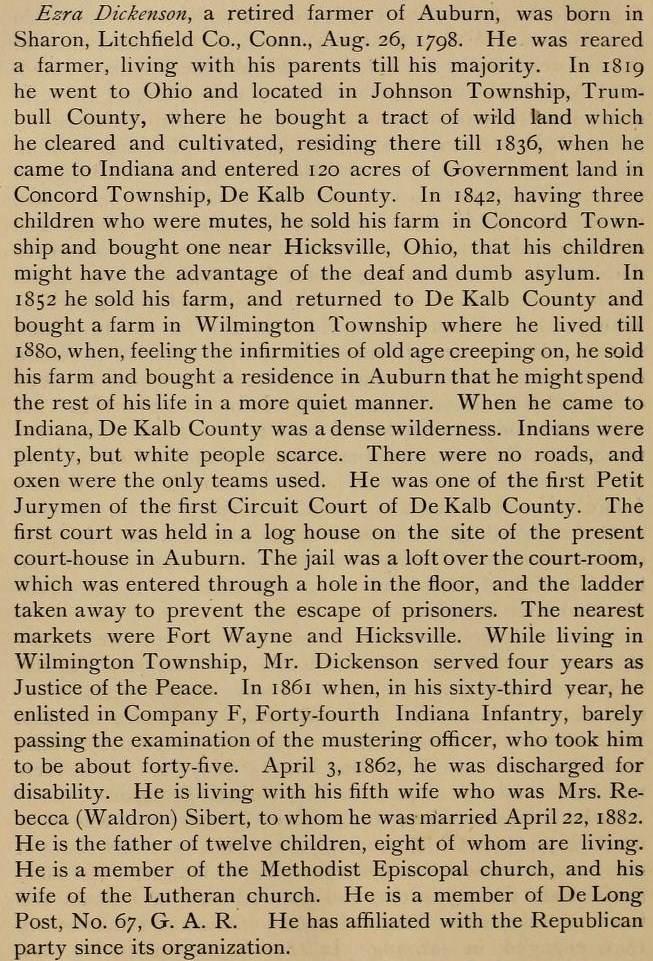
Ezra Dickenson [sic], a retired farmer of Auburn, was born in Sharon, Litchfield Co., Conn., Aug. 26, 1798. He was reared a farmer, living with his parents till his majority. In 1819 he went to Ohio and located in Johnson Township, Trumbull County, where he bought a tract of wild land which he cleared and cultivated, residing there until 1836, when he came to Indiana and entered 120 acres of Government land in Concord Township, De Kalb County. In 1842, having three children who were [deaf] mutes, he sold his farm in Concord Township and bought one near Hicksville, Ohio, that his children might have the advantage of the deaf and dumb asylum. In 1852 he sold his farm, and returned to De Kalb County and bought a farm in Wilmington Township where he lived till 1880, when, feeling the infirmities of old age creeping on, he sold his farm and bought a residence in Auburn that he might spend the rest of his life in a more quiet manner. When he came to Indiana, De Kalb County was a dense wilderness. Indians were plenty, but white people scarce. There were no roads, and oxen were the only teams used. He was one of the first Petit Jurymen of the first Circuit Court of De Kalb County. The first court was held in a log house on the site of the present court-house in Auburn. The jail was a loft over the court-room, which was entered through a hole in the floor, and the ladder taken away to prevent the escape of prisoners. The nearest markets were Fort Wayne and Hicksville. While living in Wilmington Township, Mr. Dickenson served four years as Justice of the Peace. In 1861 when, in his sixty-third year, he enlisted in Company F, Forty-fourth Indiana Infantry, barely passing the examination of the mustering officer, who took him to be about forty-five. April 3, 1862, he was discharged for disability. He is living with his fifth wife who was Mrs. Rebecca (Waldron) Sibert, to whom he was married April 22, 1882. He is the father of twelve children, eight of whom are living. He is a member of the Methodist Episcopal church, and his wife of the Lutheran church. He is a member of DeLong Post, No. 67, G. A. R. He has affiliated with the Republican party since its organization.

---

Ezra was my fourth-great-grandfather. His first wife, Cynthia PHILLIPS, was my ancestor, as was their daughter, Lucy May (DICKINSON) KIMBALL, who is one of the four children deceased by the time this sketch was published. Several years ago, I highlighted Ezra's Civil War service here.

This biographical sketch was taken from History of De Kalb County, Indiana, together with sketches of its cities, villages and towns, educational, religious, civil, military, and political history, portraits of prominent persons, and biographies of representative citizens, published in Chicago by Inter-State Publishing Co., 1885. Ezra's sketch was found on page 864. This county history, along with many others, can be found at the Internet Archive.

Wednesday, August 29, 2012

Wordless Wednesday: Benjamin Henry KIMBALL (1845 - 1924)

Benjamin Henry Kimball. Bef.1924. Original photograph believed to be privately held by Steve Robbins, [ADDRESS FOR PRIVATE USE], Muskegon, Michigan. 2012.

Monday, August 27, 2012

Mug Book Monday: John D. CONCIDINE (1823 - 1906)

"Mug books" are collections of biographical sketches usually found within county histories of the late nineteenth- and early twentieth-centuries, particularly in the United States. Each Monday, I'm highlighting ancestors or relatives who were featured in these mug books.


      "John Considine was the eldest son of Dennis and Nora (Gilligan) Considine, and was born in Ennis, County Clare, Ireland. He was brought to the United States when four years old by his parents, who lived in Rochester, N. Y., four years, and then went to Wyoming county [New York] and spent the remainder of their lives. In 1849 Mr. C. went to Grand Rapids and engaged in the lumber trade seven years, when he purchased 80 acres of land, sec. 16, Byron tp. He gave 33 acres to his son when he attained his majority. He was married in Bowne, Trent [sic Kent] Co., Dec. 25, 1849 to Elizabeth, daughter of Duncan and Mary (McPherson) McDiarmid, who is of Scotch ancestry, and was born at Wheatland, Monroe Co., N. Y., Oct. 2, 1829. Of nine children four are living, born as follows: Effie, Aug. 23, 1852; John D., Sept 3, 1854; Mary E., Aug. 16, 1863, and James W., April 25, 1869."

---

John was my adoptive third-great-grandfather. The family name was generally spelled with a second C: CONCIDINE. This sketch lists six other direct, albeit adoptive, ancestors: his parents Dennis and Honora ("Nora"); his wife Elizabeth; her parents Duncan and Mary; and their son John Dennis, listed here as John D. I have found the senior John listed in other documents as John D, and the younger as John Dennis. It's likely they both were John Dennis, Senior and Junior, but until I find clarifying documents, I have them as John D. (the elder) and John Dennis (the younger) in my database. John Dennis CONCIDINE's daughter was Nellie May. She and her husband Alfred Henry HOLST adopted my paternal grandmother.

Four of the five children (all who seem to have died young) who not listed in this sketch were Amy, b.c. 1854; Mary, b. c. 1856; Peter, b. c. Nov 1859; and a stillborn child born 21 Sep 1867. The last child is unknown.

This biographical sketch was taken from History of Kent County, Michigan; together with sketches of its cities, villages and townships, educational, religious, civil, military, and political history; portraits of prominent persons, and biographies of representative citizens, published in Chicago by Charles C. Chapman & Co., 1881. John's sketch was found on page 612. This county history, along with many other Michigan ones, can be found at the Michigan County Histories and Atlases Digitization Project website.

Sunday, August 26, 2012

Saturday, August 25, 2012

Surname Saturday: GUSTAFSDOTTER and Related Surnames

This family is my adoptive great-great-grandmother's line. I first saw the surname as GUSTAVSON, which would be a common Americanization/Anglicization of her Swedish surname, although the correct Swedish spelling would be GUSTAFSSON. My ancestor's proper surname was GUSTAFSDOTTER, because she was "Gustaf's daughter" and not his son. Patronyms (surnames based on the father's first name) were used in Sweden by all social classes (nobility often took traditional surnames) until 1901, when the Names Adoption Act was passed and patronyms were banned.


Stories and History:

Rather than list the direct paternal line of Ida Charlotta GUSTAFDOTTER from her earliest known ancestor down to the present as I do in most Surname Saturday posts, I am listing her complete ahnentafel as known, using my ahnentafel numbers. I use the letter "B" after each ahnentafel number to distinguish my adoptive family ahnentafel from my biological one.

Ahnentafel #1 - myself

Ahnentafel #2 - my father (living)

Ahnentafel #5 - Jane Marie YORK, a.k.a. Jeanne Marie HOLST (1924 - 2012)

Ahnentafel #10B - Alfred Henry HOLST (1882 - 1952) - read his AnceStory here

Ahnentafel #21B - Ida Charlotta GUSTAFSDOTTER (1861 - 1939) - Born in Hamneda, Sweden, Ida was one of eight children, and as a young adult immigrated with a number of her siblings to Hannover, Germany. There she met Johan Deidrich HOLST, whom she married on 6 Feb 1880. With their young son Alfred, they left Germany on the ship Lessing via the port of Hamburg, stopping at LaHavre, France, and arriving in New York City on 5 Jul 1883. Their destination was Western Michigan, where Johan's sister and brother-in-law, Anna and Claus BORCHERS lived. The HOLSTs first lived in Spring Lake Township, Ottawa County, Michigan, where their daughter Annie was born. Their next three children, Jennie, Mary, and Margaret (Maggie) were born in Crockery Township., Ottawa County, followed by their youngest son John's birth in Ravenna Township, Muskegon County in 1894. Another child died young. The family lived in Sullivan Township in Muskegon County in 1910 and 1920, but had returned to Ottawa County by 1930, living in Coopersville for the rest of their days.

Ahnentafel #42B - Gustaf NILSSON (1822 - 1869) - born in Vittaryd, Sweden; m. Martha Stina SVENSDOTTER by 1848; died in Hamneda, Sweden.

Ahnentafel #43B - Martha Stina SVENSDOTTER (b. 1826) - born in Hamneda. She and Gustaf had eight known children, several of which emigrated to Germany. It's possible Martha emigrated there as well after Gustaf's death, as I do not find her death listed in the Swedish parish records.


Ahnentafel #84B - Nils - Gustaf's father; no further information is known.

Ahnentafel #86B - Swen Bosson HURTIG (1794 - 1850) - Martha's father, born, married to Anna (1821) and died, all in Hamneda

Ahnentafel #87B - Anna JONASSON (1801 - 1885) - Martha's mother, also born and died in Hamndea. Had at least seven children.

Ahnentafel #172B - Bo MANSSON - Swen's father; no further information is known

Ahnentafel #173B - Marta Stina SVENSSON - Swen's mother; no further information is known

Ahnentafel #174B - Jonas - Anna's father; no further information is known

Ahnentafel #354B - Mans - Bo's father; no further information is known

Ahnentafel #356B - Sven - Marta's father; no further information is known


More About the GUSTAFSDOTTER and Related Families, plus useful resources:

1. Online database (I update this at least once a month): GUSTAFSDOTTER/GUSTAFSSON ancestors and relatives (no info on living persons available)

2. Some GUSTAFSDOTTER obituaries

3. Posts about GUSTAFSDOTTER ancestors and relatives on this blog

8. ArchivDigital - Swedish genealogy subscription site with digitized church records - free access available at many FamilySearch Centers (special free access this weekend, 25 and 26 August 2012)

9. Anna-Karin's Genealogy Blog - helpful information (in English) on researching Swedish families and records. Anna-Karin personally helped me with my GUSTAFSDOTTER research! She also has a terrific genealogical podcast (also in English), here.


The GUSTAFDOTTER Immigration Trail:

Vittaryd, Sweden > Hamneda, Sweden > Ottawa Co., MI > Muskegon Co., MI > Ottawa Co., MI > AK > Stevens Co., WA > Spokane Co., WA

Friday, August 24, 2012

Scanfest is Coming!


The August 2012 Scanfest will take place here at AnceStories this coming Sunday, August 26th, from 11 AM to 2 PM, Pacific Daylight Time. (I apologize for the late reminder, but until recently, wasn't sure if I would be available to host this event.)
 
What is Scanfest? It's a time when geneabloggers, family historians, and family archivists meet online here at this blog to chat while they scan their precious family document and photos. Why? Because, quite honestly, scanning is time-consuming and boring!

Scanfest is a great time to "meet" other genealogists, ask questions about scanning and preservation, and get the kick in the pants we all need on starting those massive scanning projects that just seem too overwhelming to begin.

To get started, you need to know the basics about scanning:

1. Don't use commercial glass cleaners (i.e. Windex) or paper towels to clean your scanner's glass plate. Use a soft, clean cloth, preferably microfiber. If you must use a liquid, use water sprayed directly onto the cloth  and make sure to let the plate dry thoroughly before placing photos or documents on it.

2. Wear cotton gloves (available at many art and/or photography supply shops) when handling photos and old documents.

3. Don't slide the photos around on the glass plate. Place them exactly where you want them. Photos should NEVER be scanned by a scanner that feeds the document through the machine, but ALWAYS on a flat-bed scanner.

4. Set your scanner to scan at no smaller than 300 dpi (dots per inch). Many experts recommend 600 dpi for photographs.

5. Photographs should ALWAYS be scanned and saved as .tif files. Use "Save As" to reformat the .tif file to a .jpg file for restoration and touchups, emailing, or uploading to an online photo album. ALWAYS retain the original scan as a .tif file.

6. Documents can be scanned as .pdf files or .tif files.

7. When you are done scanning your photos, don't put them back in those nasty "magnetic" photo albums. Place them in archival safe albums or boxes found at websites such as Archival Products or Archival Suppliers. Do NOT store any newsprint (articles, obituaries, etc.) with the photos. The acid from the newspaper will eventually destroy the photograph.

Now about the chatting part of Scanfest:

We will be using Blyve, a live blogging platform that you access right here at AnceStories. This is a new platform to us, so please be aware that there may be some technical difficulties or delays as we try out this new product.

On Sunday at 11 AM, PDT, come right here to AnceStories and you'll see the Blyve live blog/forum in the top post. It's not really a "chat room," per se, it's more like a live forum and anyone visiting this site can read and see what is happening in the forum.

You will not need to download any software.

We look forward to having you participate with us!