Welcome to my blog about my genealogical research: my triumphs, my challenges, my research notes...plus some tips and links for you.
Showing posts sorted by relevance for query Easter. Sort by date Show all posts
Sunday, April 12, 2009
Wednesday, April 01, 2009
April 2009 Calender of Events
April brings the primrose sweet,Scatters daisies at our feet.
--from "The Garden Year" by Sara Coleridge
Holidays, History, and HeritageApril is...
National Volunteer Month (United States)
(See my post on being a volunteer back during Random Acts of Kindness Week.)
National Jewish-American Heritage Month (United States)
April 5: Palm Sunday (Christianity)
April 6: National Tartan Day (United States)
Sunset of April 8th - April 15th: Passover (Judaism)
April 10: Good Friday (Christianity)
April 12: Easter Sunday (Christianity)
April 13: Easter Monday (United Kingdom)
April 19: Patriot's Day (United States)
April 19: Dutch-American Friendship Day (Netherlands, United States)
April 25: ANZAC Day (Australia, New Zealand)
April 27 - May 4: Yom Hashoah/Holocaust Remembrance Week (global/Judaism)
April 30: Valborn/Walpurgis Night (Sweden)
Do any of the above events feature in or affect your heritage, culture, or family history?
April Carnivals and Other Events:Need help? Read my post, "How to Submit a Post to a Carnival", here.
Posted April 1 - the 2nd Edition of the Graveyard Rabbits Carnival - Burial Customs
Posted April 3 - Bound for Mom - The Roadside Café
Posted April 8 - the 69th Edition of the Carnival of Genealogy - "What If": Rewriting History
Posted April 10 - Bound for Mom - Driving Lessons
Posted April 15 - the 12th Edition of the "I Smile for the Camera" Carnival - A Noble Life
Posted April 18 - the 70th Edition of the Carnival of Genealogy - Uncle, Uncle!
Posted April 22 - Bound for Mom - The World is Not Flat
Posted April 22 - the 18th Edition of the Carnival of Central and Eastern European Genealogy
- Easter and Passover Traditions
Posted April 30 - the 4th Edition of the Canadian Genealogy Carnival - Black Sheep Canadian Ancestors
Please note: the 18th Edition of the Cabinet of Curiosities was postponed until host Tim Abbott recovered from illness. Stay tuned.
April 1 - Data Backup DayRead the latest "Today is Backup Day!" post by Thomas MacEntee at Geneabloggers.
Scanfest: Sunday, April 26th, 11 AM - 2 PM, Pacific Daylight TimeGo here to learn how to join Scanfest and our group of chatting, scanning family archivists, historians, and bloggers!
Go here to add the above deadlines and dates to your Google Calendar,courtesy of Thomas MacEntee of Destination: Austin Family.
It's spring! Farewell
To chills and colds!
The blushing, girlish
World unfolds
Each flower, leaf,
And blade of turf--
Small love-notes sent
From air to earth.
The sky's a herd
Of prancing sheep,
The birds and fields
Abandon sleep,
And jonquils, tulips,
Daffodils
Bloom bright upon
That wide-eyed hills.
All things renew.
All things begin.
At church, they bring
The lilies in.
--"April," by John Updike
Labels:
Calendar of Events
| Share this : | Email This BlogThis! Share to X Share to Facebook |
Thursday, April 01, 2010
April 2010 Calendar of Events

The cuckoo comes in April,
He sings his song in May;
In the middle of June he changes his tune,
In July he flies away.

Holidays, History, and Heritage
April is...
National Volunteer Month (United States)
(See my post on being a volunteer back during Random Acts of Kindness Week.)
National Jewish-American Heritage Month (United States)
Sunset of March 29th - April 5th: Passover (Judaism)
April 2: Good Friday (Christianity)
April 4: Easter Sunday (Christianity)
April 5: Easter Monday (United Kingdom)
April 6: National Tartan Day (United States)
April 11 - 18: Yom Hashoah/Holocaust Remembrance Week (global/Judaism)
April 19: Patriot's Day (United States)
April 19: Dutch-American Friendship Day (Netherlands, United States)
April 25: ANZAC Day (Australia, New Zealand)
April 30: Valborn/Walpurgis Night (Sweden)
Do any of the above events feature in or affect your heritage, culture, or family history?

April Carnivals and Other Events:
Need help? Read my post, "How to Submit a Post to a Carnival", here.
Posted April 1 - the April 2010 Edition of the Graveyard Rabbits Carnival - Anonymous Graves
Posted April 3 - the 92nd Edition of the Carnival of Genealogy - Dance!
Posted April 19 - the 2nd Edition of the Carnival of African-American Genealogy - Grandma's Hand
Posted April 29 - Shades of the Departed - The Civil War
Posted April 29 - the 19th Edition of the Carnival of Irish Heritage and Culture - Poetry

April 1 - Data Backup Day
Read the latest "Backup Day" post by Thomas MacEntee at Geneabloggers.

Genealogy Television Shows
(check your local listings for accurate local airing times and reruns)
The Generations Project
Monday Nights at 8 PM on BYU-TV
April 5, 12, 19, 26
Who Do You Think You Are?
Friday Nights at 8 PM on NBC
April 2 - Brooke Shields
April 9 - Sarah Jessica Parker (repeat)
April 16 - no episode
April 23 - Susan Sarandon
April 30 - Spike Lee

Scanfest: Sunday, April 25, 11 AM - 2 PM, PDT
Go here to learn how to join Scanfest and our group of chatting, scanning family archivists, historians, and bloggers!

Go here to add the above deadlines and dates to your Google Calendar, courtesy of Thomas MacEntee of Destination: Austin Family.
It is not Spring until you can plant your foot on twelve daisies.

Labels:
Calendar of Events
| Share this : | Email This BlogThis! Share to X Share to Facebook |
Sunday, March 31, 2013
Sunday, March 23, 2008
Happy Easter
Happy Easter to all my readers!
| Share this : | Email This BlogThis! Share to X Share to Facebook |
Friday, March 21, 2008
Alaskan Russian Foods
As many of my readers are aware, I was born and grew up in Alaska, living in five different communities. The "city" where I was born was Kodiak, on Kodiak Island, where the Russian influence can still be felt in the culture, religious practices, and surnames of the Native Alaskans living there. While Kodiak is near the top of the Aleutian chain of islands creating the Southwest panhandle of the state, the Southeast panhandle--where I spent most of my childhood--also felt Russia's hand and can be seen in the architecture of the old Russian Orthodox churches in Sitka (the capital under Russia) and Juneau (the current state capital). However, the Native Alaskans of the Southeast panhandle were more religiously influenced by the Presbyterian, Catholic, Lutheran, and Salvation Army churches.
Two wonderful Russian dishes I remember eating as a child were pirok and kulich. Pirok is a fish pie that my mother would make as a simple, filling main dish, using canned or fresh Alaskan salmon. It is especially tasty topped with a tomato-based cocktail sauce, such as what you would eat with shrimp. Kulich is also known as Russian Easter bread, and is a delicious treat, made sweet from candied fruit and heavy with many eggs (made of course, to celebrate the end of Lent and self-denial). Dad was usually the one who made kulich, and our favorite way to eat it was lightly toasted with lots of butter! In fact, just thinking about it makes me want to haul out my breadmaker and make a loaf this weekend to eat with Easter breakfast!
I believe the following recipe is from Alaskan Cookbook for Homesteader or Gourmet by Bess Cleveland; Berkeley, California: Howell-North Books, 1960.
Traditionally, the kulich dough was braided, then baked. However, when Dad made this, he would bake it just as he and Mom did our sourdough-raisin bread: in greased coffee cans, creating a nice round load, easily sliced and able to fit into a standard toaster. While the sourdough-raisin bread, which was our everyday bread, was made in two-pound coffee cans, the kulich, more of a dessert than a sandwich bread, was usually baked in one-pound cans. I am adapting my Mr. Coffee bread-maker's recipe for a one-pound dried-mixed fruit bread, which yields a similar result.
(For more views of beautiful Russian Orthodox churches
in Alaska--onion domes and all--click here.)
Two wonderful Russian dishes I remember eating as a child were pirok and kulich. Pirok is a fish pie that my mother would make as a simple, filling main dish, using canned or fresh Alaskan salmon. It is especially tasty topped with a tomato-based cocktail sauce, such as what you would eat with shrimp. Kulich is also known as Russian Easter bread, and is a delicious treat, made sweet from candied fruit and heavy with many eggs (made of course, to celebrate the end of Lent and self-denial). Dad was usually the one who made kulich, and our favorite way to eat it was lightly toasted with lots of butter! In fact, just thinking about it makes me want to haul out my breadmaker and make a loaf this weekend to eat with Easter breakfast!
I believe the following recipe is from Alaskan Cookbook for Homesteader or Gourmet by Bess Cleveland; Berkeley, California: Howell-North Books, 1960.
Pastry for double-crust pie
2 c. cooked rice
1 onion
3 hard-boiled eggs
1 can salmon or 1 lb. fresh salmon, deboned
salt and pepper to taste
Line pie with pastry. When steaming rice, add 1 chopped onion. When done, mix with canned salmon, including juice. Mix well. Season with salt and pepper to taste.
Put 1/2 rice and fish misture in unbaked pie shell. Press quartered hard-boiled eggs into mixture, top off balance of rice and fish. Cover with piecrust, seal edges well and cut steam vents. Bake 1/2 hour (1 hour for fresh salmon) or until well browned. [A temperature is not given; I cook mine at about 425° F.] This is a dish brought to Alaska by the early Russian colonists, and was first made with salt salmon.
Traditionally, the kulich dough was braided, then baked. However, when Dad made this, he would bake it just as he and Mom did our sourdough-raisin bread: in greased coffee cans, creating a nice round load, easily sliced and able to fit into a standard toaster. While the sourdough-raisin bread, which was our everyday bread, was made in two-pound coffee cans, the kulich, more of a dessert than a sandwich bread, was usually baked in one-pound cans. I am adapting my Mr. Coffee bread-maker's recipe for a one-pound dried-mixed fruit bread, which yields a similar result.
KULICH
1 egg plus enough water to equal 1 c.
2 c. + 1 T. bread flour
1/2 t. salt
2 T. honey
1 T. dry milk
1/2 c. bran cereal
1/2 c. chopped candied mixed fruit
1/2 c. raisins
1/2 t. nutmeg
1/4 t. baking soda
1 1/2 t. yeast
Place ingredients into your breadmaker according to its suggested guidelines and use the Whole-Loaf (as opposed to Dough) Sweet Bake setting (setting 8 on Mr. Coffee breadmaker). Yield: 1 one-pound loaf.
| Share this : | Email This BlogThis! Share to X Share to Facebook |
Friday, November 21, 2008
Using Ancestry's MyCanvas Program for Creative Christmas Fun
Oh, my.
I can't remember the last time I've such fun with graphic design. Maybe a number of years ago, when I created my family tree website. Or when I purchased Paint Shop Pro and learned how to pixel paint.
Except when I was building my website, I was still new to HTML coding (which I taught myself, with the help of online tutorials like Lissa Explains All), and when I was pixel painting, I was trying to figure out how to create I-frames (what I did worked with Internet Explorer, but not with Mozilla Firefox--my browser of choice).
So my creativity was tempered with a lot of learn-on-the-fly and frustration.
Lately I've been hearing a lot about Ancestry's MyCanvas program in various press releases on blogs--a program in which you can create personalized items like family history books, recipe books, photo albums, posters, calendars and the like. I had tried out playing around with making a family history book a while ago, but it didn't really interest me. There's this hesitation I have about putting genealogy into print, knowing that a family history is never really complete or accurate (thus my preference for websites and blogs, where one can easily update, correct, delete or add information as it becomes available). I received an e-mail yesterday from Genealogy.com, a member of The Generation Networks family, of which Ancestry was also a part. This message was advertising several MyCanvas products--including calendars--at 20% off (they're $15.96 through December 24; order by December 11th to receive in time for Christmas via standard shipping or by December 16th via expedited shipping). Now for several years I've been envisioning making a family calendar to hand out as early Christmas gifts at our annual Robbins Reunion dinner the end of October, but do you think that I've been able to get on the horn and actually even attempt to create one? Oh, no...not procrastinating me!
So I thought I'd take MyCanvas out for a test drive with a family calendar...and all I can say is: oh, my!
Twenty-four hours later, I've already got three calendars in the works. The first is for my extended family, which will use the classic default holiday/seasonal background pages (I'm just a sucker when it comes to holiday decorations and the like!), each of which I plan to upload images from my PC of family members who celebrate birthdays or anniversaries that month. Another is for a family member that I know would appreciate some of the lovely designs of teapots that I purchased on CD this summer from Pats Web Graphics (I use my photo-editing program to convert images to .jpg files...MyCanvas also accepts .png files). The third is for my husband's family, featuring the postcards that his great-grandmother, Rena (Lerfald) Westaby received in the early 1900s from family and friends while she was working as a maid as a young single woman in the Midwest. Here are some screenshots from that project. Behold, the cover:
Here's the front and back of an Easter postcard, which I have stored in my online Picasa album (MyCanvas also works with SmugMug albums):
Now here it is featured on an April calendar page, using the wonderful digital backgrounds and embellishments of MyCanvas:

I can't remember the last time I've such fun with graphic design. Maybe a number of years ago, when I created my family tree website. Or when I purchased Paint Shop Pro and learned how to pixel paint.
Except when I was building my website, I was still new to HTML coding (which I taught myself, with the help of online tutorials like Lissa Explains All), and when I was pixel painting, I was trying to figure out how to create I-frames (what I did worked with Internet Explorer, but not with Mozilla Firefox--my browser of choice).
So my creativity was tempered with a lot of learn-on-the-fly and frustration.
Lately I've been hearing a lot about Ancestry's MyCanvas program in various press releases on blogs--a program in which you can create personalized items like family history books, recipe books, photo albums, posters, calendars and the like. I had tried out playing around with making a family history book a while ago, but it didn't really interest me. There's this hesitation I have about putting genealogy into print, knowing that a family history is never really complete or accurate (thus my preference for websites and blogs, where one can easily update, correct, delete or add information as it becomes available). I received an e-mail yesterday from Genealogy.com, a member of The Generation Networks family, of which Ancestry was also a part. This message was advertising several MyCanvas products--including calendars--at 20% off (they're $15.96 through December 24; order by December 11th to receive in time for Christmas via standard shipping or by December 16th via expedited shipping). Now for several years I've been envisioning making a family calendar to hand out as early Christmas gifts at our annual Robbins Reunion dinner the end of October, but do you think that I've been able to get on the horn and actually even attempt to create one? Oh, no...not procrastinating me!
So I thought I'd take MyCanvas out for a test drive with a family calendar...and all I can say is: oh, my!
Twenty-four hours later, I've already got three calendars in the works. The first is for my extended family, which will use the classic default holiday/seasonal background pages (I'm just a sucker when it comes to holiday decorations and the like!), each of which I plan to upload images from my PC of family members who celebrate birthdays or anniversaries that month. Another is for a family member that I know would appreciate some of the lovely designs of teapots that I purchased on CD this summer from Pats Web Graphics (I use my photo-editing program to convert images to .jpg files...MyCanvas also accepts .png files). The third is for my husband's family, featuring the postcards that his great-grandmother, Rena (Lerfald) Westaby received in the early 1900s from family and friends while she was working as a maid as a young single woman in the Midwest. Here are some screenshots from that project. Behold, the cover:
Here's the front and back of an Easter postcard, which I have stored in my online Picasa album (MyCanvas also works with SmugMug albums):Now here it is featured on an April calendar page, using the wonderful digital backgrounds and embellishments of MyCanvas:

Okay, one more! I've got to show you the December page:
I've already got plans for calendars for the next few years: ancestral photos, documents (you can use the ones you view with your Ancestry subscription, too), recipes, you name it. The nice thing is, you can make a basic calendar with all your family's important dates, and then copy it, personalize the graphics, and add/delete events that are customized to each household. And what's more, it is a simple, one-handed easy-to-use project--perfect for someone like me, recovering from shoulder surgery!
Hello, my name is Miriam, and I'm addicted to MyCanvas. And no, I wasn't asked to write a post about this.
I've already got plans for calendars for the next few years: ancestral photos, documents (you can use the ones you view with your Ancestry subscription, too), recipes, you name it. The nice thing is, you can make a basic calendar with all your family's important dates, and then copy it, personalize the graphics, and add/delete events that are customized to each household. And what's more, it is a simple, one-handed easy-to-use project--perfect for someone like me, recovering from shoulder surgery!
Hello, my name is Miriam, and I'm addicted to MyCanvas. And no, I wasn't asked to write a post about this.
Labels:
creativity,
Personal
| Share this : | Email This BlogThis! Share to X Share to Facebook |
Monday, January 15, 2007
Childhood Food Memories
I feel very blessed to have had the childhood I did, although for years, I did not appreciate it! I was born and grew up in Alaska, living in mostly Native American-populated villages. My parents were Salvation Army officers (ministers), doing mission work with the various native tribes. When I was older, they built a house by hand (no power tools), and they had a little farm, living nearly completely off the land. Because of this environment, I have had rich and varied experiences that many my age have not, and can understand and relate to the lives of my ancestors who lived pre-electricity, pre-running water, and pre-supermarkets.
Coming along hand-in-hand with these experiences was the assortment of foods that I enjoyed. I was born in Kodiak, whose native peoples were heavily influenced by the Russian culture. Here my parents learned to make pirok (salmon and rice pie, flavored with onion and hardboiled eggs), and kulich (Russian Easter bread - a heavy bread full of eggs and dried fruit, baked in a coffee can). Living on a minister's salary was not easy. I may be mistaken, but I believe that at that time, The Salvation Army paid its officers stationed in Alaska and Hawaii the same salary as those in the "Lower 48." This was disproportionate, since the cost of living in those two states is much higher, due to shipping charges being passed along by retailers to the consumers. I well remember eating pancakes and salmon frequently at the end of every month. In fact, salmon, so outrageously priced at my local supermarket, was as common as hot dogs are for most people during my growing up years. My parents owned a succession of several small outboard boats long before we had a car, as it simply was more practical to have a vehicle one could use on water to bring home the bacon--er salmon--with. For most of my childhood, we lived in or near the village of Klawock, on Prince of Wales Island, the third-largest island in the U.S. (after Long Island, New York, and Whidbey Island, Washington). The road from Klawock to Craig, a larger town mostly populated by Caucasians, was a treacherous 7-mile logging road remnant, and it was more convenient and less time-consuming for my parents to boat down than drive. Prices were slightly lower in Craig, and so they often did their shopping there. Later on, they would order by telephone to a grocery store in Ketchikan, and have their goods shipped over on a freighter that came to P.O.W. Island once a month.
Besides the many varieties of fish (salmon, halibut, coho, red snapper - some of which I helped Dad catch), there were clams, crab, and seaweed harvested from the sea. My favorite treats were the seaweed that would be spread on sheets on the rooftops in the summer to dry, and smoked salmon (nearly everyone I knew had a smokehouse). The kids I knew growing up loved Indian Cheese (fermented salmon eggs) with eulachon oil (a candlefish), but it was too strong for me. And speaking of kids, many would go salmon fishing on the bridge that spanned the mouth of the Klawock River where it fed into the bay. Fish that were considered "too small" were rarely tossed back in the water, but left to rot on the bridge or roadside. Dad often tells how when we moved to Northeast Washington and he saw the price of salmon in the supermarkets, he would remember all the rotting fish on the bridge, and silently mourn! I hated live crabs...they always looked malicious...and you had to put them in a large pot of water and slowly boil them to death. Once a crab crawled out of a pot Mom had on the stove, and I remember her shreiking and pushing it back in with a broom handle!
In addition to the bounty of the sea, the land gave as well. I don't really remember Dad going hunting, although I know he did. I do remember eating venison once in a while, although some may have been given to us by neighbors. I loved the way my mom prepared venison in a kind of barbeque sauce. In the fall, it was very common to see deer carcasses hanging off people's front porches to drain all the blood out of the meat before cutting it up.
Dad once shot a bear on our front porch--which is a blog for another day!--and he and Mom made delicious sausage from the oily meat, which I loved to eat for breakfast with waffles.
I fondly remember picking elderberries, blue huckleberries (erroneously referred to as blueberries by area residents), thimbleberries (a favorite of mine), and salmonberries (a wild raspberry with colors ranging from yellowish-orange to maroon). Mom and Dad made the best jams, jellies and pies. I did hate picking salmonberries, as they had thorns and their thin whip-like branches always seemed to slap me in the face when I followed Mom into the berry patches, with old coffee cans hung by our necks with strings to leave both hands free for picking. I remember always being a little nervous about black bears when berry picking, and to discourage any in the area, we would always sing loudly in the berry patches. When out playing in the woods, sometimes I would snack on wild currants, but I never remember anyone picking any to make jam or anything else with it. After my parents started their little farm, Mom experimented with drying ground salmonberries on waxed paper in our egg incubator, and came up with some great fruit leather.
Wild asparagus, a green about four inches high and a quarter-inch in diameter resembling the domestic asparagus, could be found near the beaches, and I liked it with butter and salt. But I disliked goose tongue, another wild green that looked like long, wide blades of grass. When steamed, its texture was too soggy for my liking.
The growing season was short and very wet (160 - 180 inches of rain a year), so mostly root crops flourished in my parents' garden: potatoes, carrots, turnips and radishes. There were also peas, lettuce, cabbage, kale and rhubarb. Dad tried strawberries in a barrel, but they never amounted to much. He had a green thumb, and grew beautiful roses, tulips, morning glory and honeysuckle, in addition to the vegetable garden.
On the farm, which we liked to refer to as the homestead, we raised goats, rabbits, pigs, chicken, ducks, and geese. Dad brought in Pygmy goats, because the miniature adults could be shipped in dog kennels in the small engine planes that delivered to the island. That way, he didn't have to wait for (goat) kids to grow up before breeding, milking, or butchering. Some friends of ours owned a restaurant and lodge; being from Texas, they had a barbeque pit for preparing their famous Tex-Mex foods. Dad bartered and was able to have a whole goat barbequed over the pit for several days...one of the most delicious meals I've ever eaten! Of course, we drank goat's milk, and the folks experimented a bit with cheese-making, which if memory serves me right, ended up being a bit like Feta. We had two pigs at two different times, and each time Dad and Mom made wonderful sausage, as well as bacon, ham, head cheese and cracklings. The first time we had rabbit, they didn't tell me what it was, but kept making comments about how the "chicken" had four drumsticks! Of course, we had plenty of chicken, duck, and goose, along with eggs galore.
Mom made good old-fashioned sourdough bread from an old Alaskan recipe, sweetened with molasses and raisins (which kept the bread moist). She would bake it in coffee cans, a good half-dozen loaves at a time, then wrap them in foil or plastic bags to keep fresh. She made this bread for years, even after we moved to Washington, and it was a favorite Christmas gift among the neighbors from our home.
My parents felt it was important to starting incorporating elements of Dutch culture into our home. As a white child in a village of Indian children, I learned a great deal about the Tlinget culture at school, where we had "blocks" - elective classes in native dance and song, mythology, language, and crafts (beading, blanket making, and woodcarving). While this was certainly an enriching education, they wanted me to understand that I had my own heritage of which to be proud, and this was probably the beginning of my interest in genealogy. They determined that between them, I probably was nearly half Dutch and half English, with a bit of Heinz 57 thrown in for good measure. Being from Western Michigan, heavily populated by Dutch immigrants, they were familiar with the Dutch culture. One of the many things they did was to find a cookbook of traditional Dutch foods. Favorites included vijfschap (Five Kinds) - a beef stew with five kinds of vegetables and fruit (potatoes, onions, carrots, celery and apples) - and olie bolen (literally, "oily balls"), what we know as donut holes.
My all-time favorite treat growing up (and even now) was banket (bun-KET), a traditional Dutch pastry with almond paste filling. My grandfather would make it and send it in our Christmas package from the relatives on my mother's side of the family. A huge box would arrive, plastered over with sheets of stamps. Grandpa worked for the US Postal Service in Grand Rapids, Michigan, and he, along with my dad and myself, collected stamps. The box was a gift in itself! After Christmas, Dad would carefully cut the cardboard, then place wet towels over the stamps to soak them off, later to be mounted in our albums. Inside the box, everything was packed in the Sunday comics, another treasure in itself. We were not regular subscribers to the nearest paper, The Ketchikan Daily News, and even then, its comics were in black-and-white. The Grand Rapids Press, however, had Sunday comics in full, glorious color! At the top of the carefully wrapped and packed Christmas presents would be the banket, wrapped in foil and still semi-frozen. Dad would cut the pastry into one-inch diagonal slices, and we would enjoy every bite. There never seemed to be enough!
In 1997, I wrote my grandfather, and asked him for the banket recipe. At that time, he was 81 years old, and I figured I may not have many opportunities to ask him. As a matter of fact, he lived another 9 1/2 years, passing away just a few days ago, on January 6th. Every year when I make this treat for my family and friends,I think fondly of my grandfather, and next Christmas, it will be with a mixture of loss and joy. I've included the recipe here, in this very long blog, as a tribute to my grandfather. Although complicated, time-consuming, and expensive (almond paste is not cheap!), the results are worthy!
Coming along hand-in-hand with these experiences was the assortment of foods that I enjoyed. I was born in Kodiak, whose native peoples were heavily influenced by the Russian culture. Here my parents learned to make pirok (salmon and rice pie, flavored with onion and hardboiled eggs), and kulich (Russian Easter bread - a heavy bread full of eggs and dried fruit, baked in a coffee can). Living on a minister's salary was not easy. I may be mistaken, but I believe that at that time, The Salvation Army paid its officers stationed in Alaska and Hawaii the same salary as those in the "Lower 48." This was disproportionate, since the cost of living in those two states is much higher, due to shipping charges being passed along by retailers to the consumers. I well remember eating pancakes and salmon frequently at the end of every month. In fact, salmon, so outrageously priced at my local supermarket, was as common as hot dogs are for most people during my growing up years. My parents owned a succession of several small outboard boats long before we had a car, as it simply was more practical to have a vehicle one could use on water to bring home the bacon--er salmon--with. For most of my childhood, we lived in or near the village of Klawock, on Prince of Wales Island, the third-largest island in the U.S. (after Long Island, New York, and Whidbey Island, Washington). The road from Klawock to Craig, a larger town mostly populated by Caucasians, was a treacherous 7-mile logging road remnant, and it was more convenient and less time-consuming for my parents to boat down than drive. Prices were slightly lower in Craig, and so they often did their shopping there. Later on, they would order by telephone to a grocery store in Ketchikan, and have their goods shipped over on a freighter that came to P.O.W. Island once a month.
Besides the many varieties of fish (salmon, halibut, coho, red snapper - some of which I helped Dad catch), there were clams, crab, and seaweed harvested from the sea. My favorite treats were the seaweed that would be spread on sheets on the rooftops in the summer to dry, and smoked salmon (nearly everyone I knew had a smokehouse). The kids I knew growing up loved Indian Cheese (fermented salmon eggs) with eulachon oil (a candlefish), but it was too strong for me. And speaking of kids, many would go salmon fishing on the bridge that spanned the mouth of the Klawock River where it fed into the bay. Fish that were considered "too small" were rarely tossed back in the water, but left to rot on the bridge or roadside. Dad often tells how when we moved to Northeast Washington and he saw the price of salmon in the supermarkets, he would remember all the rotting fish on the bridge, and silently mourn! I hated live crabs...they always looked malicious...and you had to put them in a large pot of water and slowly boil them to death. Once a crab crawled out of a pot Mom had on the stove, and I remember her shreiking and pushing it back in with a broom handle!
In addition to the bounty of the sea, the land gave as well. I don't really remember Dad going hunting, although I know he did. I do remember eating venison once in a while, although some may have been given to us by neighbors. I loved the way my mom prepared venison in a kind of barbeque sauce. In the fall, it was very common to see deer carcasses hanging off people's front porches to drain all the blood out of the meat before cutting it up.
Dad once shot a bear on our front porch--which is a blog for another day!--and he and Mom made delicious sausage from the oily meat, which I loved to eat for breakfast with waffles.
I fondly remember picking elderberries, blue huckleberries (erroneously referred to as blueberries by area residents), thimbleberries (a favorite of mine), and salmonberries (a wild raspberry with colors ranging from yellowish-orange to maroon). Mom and Dad made the best jams, jellies and pies. I did hate picking salmonberries, as they had thorns and their thin whip-like branches always seemed to slap me in the face when I followed Mom into the berry patches, with old coffee cans hung by our necks with strings to leave both hands free for picking. I remember always being a little nervous about black bears when berry picking, and to discourage any in the area, we would always sing loudly in the berry patches. When out playing in the woods, sometimes I would snack on wild currants, but I never remember anyone picking any to make jam or anything else with it. After my parents started their little farm, Mom experimented with drying ground salmonberries on waxed paper in our egg incubator, and came up with some great fruit leather.
Wild asparagus, a green about four inches high and a quarter-inch in diameter resembling the domestic asparagus, could be found near the beaches, and I liked it with butter and salt. But I disliked goose tongue, another wild green that looked like long, wide blades of grass. When steamed, its texture was too soggy for my liking.
The growing season was short and very wet (160 - 180 inches of rain a year), so mostly root crops flourished in my parents' garden: potatoes, carrots, turnips and radishes. There were also peas, lettuce, cabbage, kale and rhubarb. Dad tried strawberries in a barrel, but they never amounted to much. He had a green thumb, and grew beautiful roses, tulips, morning glory and honeysuckle, in addition to the vegetable garden.
On the farm, which we liked to refer to as the homestead, we raised goats, rabbits, pigs, chicken, ducks, and geese. Dad brought in Pygmy goats, because the miniature adults could be shipped in dog kennels in the small engine planes that delivered to the island. That way, he didn't have to wait for (goat) kids to grow up before breeding, milking, or butchering. Some friends of ours owned a restaurant and lodge; being from Texas, they had a barbeque pit for preparing their famous Tex-Mex foods. Dad bartered and was able to have a whole goat barbequed over the pit for several days...one of the most delicious meals I've ever eaten! Of course, we drank goat's milk, and the folks experimented a bit with cheese-making, which if memory serves me right, ended up being a bit like Feta. We had two pigs at two different times, and each time Dad and Mom made wonderful sausage, as well as bacon, ham, head cheese and cracklings. The first time we had rabbit, they didn't tell me what it was, but kept making comments about how the "chicken" had four drumsticks! Of course, we had plenty of chicken, duck, and goose, along with eggs galore.
Mom made good old-fashioned sourdough bread from an old Alaskan recipe, sweetened with molasses and raisins (which kept the bread moist). She would bake it in coffee cans, a good half-dozen loaves at a time, then wrap them in foil or plastic bags to keep fresh. She made this bread for years, even after we moved to Washington, and it was a favorite Christmas gift among the neighbors from our home.
My parents felt it was important to starting incorporating elements of Dutch culture into our home. As a white child in a village of Indian children, I learned a great deal about the Tlinget culture at school, where we had "blocks" - elective classes in native dance and song, mythology, language, and crafts (beading, blanket making, and woodcarving). While this was certainly an enriching education, they wanted me to understand that I had my own heritage of which to be proud, and this was probably the beginning of my interest in genealogy. They determined that between them, I probably was nearly half Dutch and half English, with a bit of Heinz 57 thrown in for good measure. Being from Western Michigan, heavily populated by Dutch immigrants, they were familiar with the Dutch culture. One of the many things they did was to find a cookbook of traditional Dutch foods. Favorites included vijfschap (Five Kinds) - a beef stew with five kinds of vegetables and fruit (potatoes, onions, carrots, celery and apples) - and olie bolen (literally, "oily balls"), what we know as donut holes.
My all-time favorite treat growing up (and even now) was banket (bun-KET), a traditional Dutch pastry with almond paste filling. My grandfather would make it and send it in our Christmas package from the relatives on my mother's side of the family. A huge box would arrive, plastered over with sheets of stamps. Grandpa worked for the US Postal Service in Grand Rapids, Michigan, and he, along with my dad and myself, collected stamps. The box was a gift in itself! After Christmas, Dad would carefully cut the cardboard, then place wet towels over the stamps to soak them off, later to be mounted in our albums. Inside the box, everything was packed in the Sunday comics, another treasure in itself. We were not regular subscribers to the nearest paper, The Ketchikan Daily News, and even then, its comics were in black-and-white. The Grand Rapids Press, however, had Sunday comics in full, glorious color! At the top of the carefully wrapped and packed Christmas presents would be the banket, wrapped in foil and still semi-frozen. Dad would cut the pastry into one-inch diagonal slices, and we would enjoy every bite. There never seemed to be enough!
In 1997, I wrote my grandfather, and asked him for the banket recipe. At that time, he was 81 years old, and I figured I may not have many opportunities to ask him. As a matter of fact, he lived another 9 1/2 years, passing away just a few days ago, on January 6th. Every year when I make this treat for my family and friends,I think fondly of my grandfather, and next Christmas, it will be with a mixture of loss and joy. I've included the recipe here, in this very long blog, as a tribute to my grandfather. Although complicated, time-consuming, and expensive (almond paste is not cheap!), the results are worthy!
BANKET
Pastry:
4 c. sifted flour
1/2 t. salt
1/4 t. baking powder
1 lb. margarine (good quality)
1 c. cold water
Filling:
1 lb. kernel or almond paste (kernel is cheaper and tastes as good, says Grandpa)
2 c. sugar
2 whole eggs and 1 egg yolk (save white for glaze)
1/4 c. flour
2 t. vanilla
Glaze:
1 egg white
granulated sugar
To make pastry, crumble or chop margarine into flour, salt, and baking powder mixture until mixed fine. Add water and mix well. Form dough into flat ball; wrap in waxed paper and chill overnight.
For filling, crumble or chop paste (a blender or food processor can be used, says Grandpa, but I used a hand pastry cutter). Add sugar and flour and mix. Add two whole eggs, egg yolk, and vanilla and mix well. Form into a flat ball, cover or wrap, and chill in refrigerator overnight.
Divide pastry and filling into 8 equal parts each. Shap pastry dough into an oblong ball. Roll the ball away from you on a floured pastry cloth into a strip about 3 inches wide by 12 - 14 inches long.
Take one piece of filling and roll with palm of hand into a long rope a little shorter than the pastry strip. Roll the filling onto pastry. Brush one edge and the ends of pastry with water, fold the ends over the filling, and roll the pastry around filling toward moistened edge. Press lightly to seal and place each finished roll lengthwise on an ungreased cookie sheet, seam side down. Put 4 rolls on each sheet.
Beat egg white and brush on top of rolls; sprinkle with sugar. Prick rolls with fork at one-inch intervals. Bake in preheated oven 425* about 25 - 30 minutes or until light brown. Makes 8 rolls.
4 c. sifted flour
1/2 t. salt
1/4 t. baking powder
1 lb. margarine (good quality)
1 c. cold water
Filling:
1 lb. kernel or almond paste (kernel is cheaper and tastes as good, says Grandpa)
2 c. sugar
2 whole eggs and 1 egg yolk (save white for glaze)
1/4 c. flour
2 t. vanilla
Glaze:
1 egg white
granulated sugar
To make pastry, crumble or chop margarine into flour, salt, and baking powder mixture until mixed fine. Add water and mix well. Form dough into flat ball; wrap in waxed paper and chill overnight.
For filling, crumble or chop paste (a blender or food processor can be used, says Grandpa, but I used a hand pastry cutter). Add sugar and flour and mix. Add two whole eggs, egg yolk, and vanilla and mix well. Form into a flat ball, cover or wrap, and chill in refrigerator overnight.
Divide pastry and filling into 8 equal parts each. Shap pastry dough into an oblong ball. Roll the ball away from you on a floured pastry cloth into a strip about 3 inches wide by 12 - 14 inches long.
Take one piece of filling and roll with palm of hand into a long rope a little shorter than the pastry strip. Roll the filling onto pastry. Brush one edge and the ends of pastry with water, fold the ends over the filling, and roll the pastry around filling toward moistened edge. Press lightly to seal and place each finished roll lengthwise on an ungreased cookie sheet, seam side down. Put 4 rolls on each sheet.
Beat egg white and brush on top of rolls; sprinkle with sugar. Prick rolls with fork at one-inch intervals. Bake in preheated oven 425* about 25 - 30 minutes or until light brown. Makes 8 rolls.
Labels:
Alaska,
Carnival of Genealogy,
DeVries,
Grand Rapids,
The Salvation Army
| Share this : | Email This BlogThis! Share to X Share to Facebook |
Sunday, April 24, 2011
Happy Easter!
Cousin Adelia, Zumbrota, Minnesota to Rena Lerfald, Mandan, North Dakota. Postcard, postmarked 20 Mar 1913. Lerfald-Westaby Postcard Collection, digitized and privately held by Miriam Robbins Midkiff, [ADDRESS FOR PRIVATE USE,] Spokane, Washington. Original collection privately held by Troy W. Midkiff, [ADDRESS FOR PRIVATE USE,] Vancouver, Washington. 2011.
| Share this : | Email This BlogThis! Share to X Share to Facebook |
Saturday, December 04, 2010
Advent Calendar of Christmas Memories No. 4: Christmas Cards
(Originally written in December 2007)
Christmas Cards
Did your family send them? Did your family display the ones they received? Do you still send Christmas cards?
During the last four weeks, I've been going through the letters my mom wrote her parents in Western Michigan from Alaska during the years 1966 - 1978, and have just started 1977. There are many December letters tucked inside Christmas cards during those years, although I don't specifically remember Mom sitting down with a stack of them to sign and mail off. It may be that she purchased just a few to mail to family and friends, or perhaps she was able to buy them by the box. I do know from what she wrote in those letters that it was hard to buy holiday cards of any kind in Southeast Alaska. My mother's greeting to her parents on Easter or Mother's or Father's Day, for instance, usually consisted of the weekly letter with best wishes for the family member(s) and an explanation that no store on the island sold greeting cards.
Once we moved to Eastern Washington in 1979, I do remember our family sending off greeting cards. Sometimes Dad would get a neighbor to take a nice group photo of our family with his camera and get some Christmas photo cards printed up. We would dress up for these photos, most of the time. Mom would tuck newsy notes or letters in with both the greeting cards and the photo cards.
I think cards were taped along the beams of our house in Alaska, which had a cathedral ceiling, but I'm not sure if I'm remembering that correctly. In our home in Eastern Washington, the cards were always--and still are--taped around the doorway and pass-through between the dining area and kitchen.
After my husband and I married, I started sending out Christmas cards to friends and family members, and after our children were born, I added photos and a Christmas letter. I haven't done a Christmas letter every year, but I did most years. They're fun to go back and read, because I always hit the highlights of the past 12 months. The past few years, with postage so expensive and with most people in my e-mail address book having color printers, I've just e-mailed my Christmas letter and scanned photos of our family, while mailing "hard copies" to family and friends without Internet access. This year has been so busy that I am probably going to forgo the cards altogether and just mail and e-mail the Christmas letters. I figure at the rate I'm going, people are going to be lucky to even hear from us!
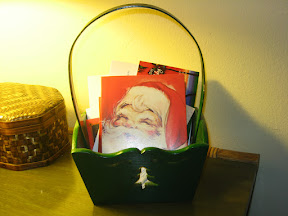
The cards we receive are placed in a green Christmas wooden basket on our coffee table in the living room. After Christmas is over, I go through and save the photos and Christmas letters. Most of the cards, unless unique or extra special, get their covers reused as gift tags for next year's Christmas, or passed on to non-profit organizations that recycle them.
This post is a part of the "Advent Calendar of Christmas Memories" meme created in 2007 by Thomas and Jasia. You, too, can write your own Christmas memories, either for your personal journal or blog. Visit Geneabloggers to participate and to read others' posts on these topics.
Labels:
Advent Memories 2007
| Share this : | Email This BlogThis! Share to X Share to Facebook |
Sunday, April 20, 2014
Sunday, April 04, 2010
Easter Greetings
Ole Lerfald, unknown location to Rena Lerfald, Glendive, Montana, postcard, undated, unstamped and unpostmarked. Lerfald-Westaby Postcard Collection, digitized and privately held by Miriam Robbins Midkiff, [ADDRESS FOR PRIVATE USE,] Spokane, Washington. Original collection privately held by Troy W. Midkiff, [ADDRESS FOR PRIVATE USE,] Vancouver, Washington. 2010.
| Share this : | Email This BlogThis! Share to X Share to Facebook |
Friday, April 15, 2011
No Scanfest in April
I apologize for the last-minute notice, but there will be no Scanfest in April.
Originally, I was going to bump it from the last Sunday in April (the 24th), which happens to be Easter Sunday, to the third Sunday, the 17th. However, I just discovered late last night that the summer camp reunion I planned to attend this weekend will be held on Sunday and not Saturday, as I previously thought.
I briefly considered having Scanfest on Saturday, the 16th, but realized I need a day to rest up and recover from a long week of work...the first week of school after Spring Break!
The next Scanfest will be held Sunday, May 22nd from 11:00 AM to 2:00 PM, PDT. This is one week earlier than normal, due to the Memorial Day weekend. See you then!
P.S. If you're just dying to talk with your chat buddies before May, check out Geneabloggers Radio Friday evenings and Dae Powell's chats.
Labels:
Scanfest
| Share this : | Email This BlogThis! Share to X Share to Facebook |
Saturday, March 01, 2008
March Is...
...Irish American Heritage Month.
...Women's History Month.
March 1: Korean Independence Movement Day (celebrated in both North and South Korea - independence from Japan)
March 8: International Women's Day
March 17: St. Patrick's Day
March 23: Easter Sunday
March 25: Greek Independence Day
Do any of the above feature in or affect your heritage, culture, or family history?
Carnival Due Dates and Other Events in March:
March 1: 43rd Edition of the Carnival of Genealogy - Technology
March 10: "Where Were You?" Carnival - Great Depression
March 14: 4th Edition of the Carnival of the Carnival of Irish Heritage & Culture - St. Patrick's Day Parade
March 15: 44th Edition of the Carnival of Genealogy - A Tribute to Women
By midday, March 16: Cabinet of Curiosities #5 - Steampunk Edition
March 21: 5th Edition of the Carnival of Central and Eastern European Genealogy - Traditional Dishes
March 29 - April 6: Spring Break Scan-a-Thon
March 30: Scanfest, 11 AM - 2 PM, Pacific Daylight Time
And One More Thing:
March 1 is National Pig Day!
...Women's History Month.
March 1: Korean Independence Movement Day (celebrated in both North and South Korea - independence from Japan)
March 8: International Women's Day
March 17: St. Patrick's Day
March 23: Easter Sunday
March 25: Greek Independence Day
Do any of the above feature in or affect your heritage, culture, or family history?
Carnival Due Dates and Other Events in March:
March 1: 43rd Edition of the Carnival of Genealogy - Technology
March 10: "Where Were You?" Carnival - Great Depression
March 14: 4th Edition of the Carnival of the Carnival of Irish Heritage & Culture - St. Patrick's Day Parade
March 15: 44th Edition of the Carnival of Genealogy - A Tribute to Women
By midday, March 16: Cabinet of Curiosities #5 - Steampunk Edition
March 21: 5th Edition of the Carnival of Central and Eastern European Genealogy - Traditional Dishes
March 29 - April 6: Spring Break Scan-a-Thon
March 30: Scanfest, 11 AM - 2 PM, Pacific Daylight Time
And One More Thing:
March 1 is National Pig Day!
Saturday, December 30, 2006
What's In A Name?
(I'm posting this as a response to the prompt on my other website, AnceStories2. I invite you to journal with me. It's a great way to leave a record behind for the generations to come!)
The name that was given to me at my birth was Miriam Joy Robbins. Now that I am married, it is Miriam Joy Midkiff, but professionally I go by Miriam Robbins Midkiff. My mom picked out my name from the Bible. Miriam was the sister of Moses, a prophetess, who danced when the Egyptians were destroyed in the Red Sea, and who grumbled with her brother, the high priest Aaron, against Moses' leadership. Her punishment was a temporary case of leprosy. My parents picked out Bible names for all of us children, either as first or middle names. They served as missionaries to Native Alaskan communities for many years, and so Bible names were a natural pick.
My great-grandmother, Lillian Fern (STRONG) HOEKSTRA, absolutely loved the name Mary. She gave it to herself as a nickname, and named her youngest daughter Mary. She also had a granddaughter named Mary. When I was nine months old, my parents went back to their hometowns in Western Michigan for several months, and during that time, we visited Great-grandma. She wanted my mother to change my name to Mary. Diplomatically, Mom told her grandmother that I was used to my name now, and that besides, Miriam was a variation of the name Mary, anyway.
Miriam is the Hebrew version of the Greek name Mary. The roots of both names come from the Hebrew word for "myrrh," the dried sap of a tree native to Somalia and eastern Ethiopia that is mentioned frequently in the Bible. For years, I did not like my first name, because it was a) hard to spell; b) hard to pronounce; and c) every name meaning book I read said Miriam meant "bitter." Then one day I came across an extended explanation of my name. While myrrh is indeed bitter, it is the base for healing ointments, incense, and perfumes. It was one of the three gifts the Wise Men brought to the infant Jesus. When the women went to Jesus' tomb on Easter Morning, they brought spices with them. It is likely that they had myrrh, as it was used to embalm bodies (and it covered up the smell of decay). Myrrh was worth more than its weight in gold in ancient times. The extant meaning, then, of Miriam is "bitterness turned into sweet fragrance," a definition much more acceptable to me!
"Joy," my middle name, is self-explanatory. My maiden name, Robbins, means "son of Robin." The name Robin is a nickname for Robert, which itself means "bright fame" or "red." Midkiff is still a puzzle. It is probably a U.S. southern dialect pronunciation of Metcalf(e), which means "meat calf."
My younger brother could not pronounce Miriam when he was a toddler, so he called me "Mimi" for a few years, which is actually a standard nickname for Miriam (along with "Mim"). My younger sister also called me "Mimi."
I prefer children to call me "Mrs. Midkiff," although I don't mind teenagers addressing me by my first name (I notice, however, that my teenage children's friends tend to either call me "Mrs. Midkiff," or simply avoid my name altogether when addressing me). Because I work at a middle school, the students there naturally call me "Mrs. Midkiff."
All my names (except for my middle name) are difficult to spell and pronounce. I could make long lists of the way they have been butchered in pronunciation and mis-spelled over the years! What is curious to me is that Midkiff, which is so easy to pronounce (yes, MID-kiff) is constantly pronounced "Metcalf" by strangers. It has also been mis-spelled as Midriff and Midkiss ("f" sounds like "s" over the phone, I figured out, so now when I have to give my name via telephone, I spell it out "M-I-D-K-I-double-F-as-in-Frank). Robbins is easy, too, but I constantly got "Robinson," "Roberts," and "Robertson." And Miriam is generally mis-pronounced as "MAIR-yum." The correct pronunciation is MEER-ee-um. Just two days ago, a clerk mis-read my name on my debit card and called me Mariah. Marion, Maryann, and Muriel are other mis-nomers. This explains why I named my children Melissa and Matthew. No odd names, no odd spellings!
The name that was given to me at my birth was Miriam Joy Robbins. Now that I am married, it is Miriam Joy Midkiff, but professionally I go by Miriam Robbins Midkiff. My mom picked out my name from the Bible. Miriam was the sister of Moses, a prophetess, who danced when the Egyptians were destroyed in the Red Sea, and who grumbled with her brother, the high priest Aaron, against Moses' leadership. Her punishment was a temporary case of leprosy. My parents picked out Bible names for all of us children, either as first or middle names. They served as missionaries to Native Alaskan communities for many years, and so Bible names were a natural pick.
My great-grandmother, Lillian Fern (STRONG) HOEKSTRA, absolutely loved the name Mary. She gave it to herself as a nickname, and named her youngest daughter Mary. She also had a granddaughter named Mary. When I was nine months old, my parents went back to their hometowns in Western Michigan for several months, and during that time, we visited Great-grandma. She wanted my mother to change my name to Mary. Diplomatically, Mom told her grandmother that I was used to my name now, and that besides, Miriam was a variation of the name Mary, anyway.
Miriam is the Hebrew version of the Greek name Mary. The roots of both names come from the Hebrew word for "myrrh," the dried sap of a tree native to Somalia and eastern Ethiopia that is mentioned frequently in the Bible. For years, I did not like my first name, because it was a) hard to spell; b) hard to pronounce; and c) every name meaning book I read said Miriam meant "bitter." Then one day I came across an extended explanation of my name. While myrrh is indeed bitter, it is the base for healing ointments, incense, and perfumes. It was one of the three gifts the Wise Men brought to the infant Jesus. When the women went to Jesus' tomb on Easter Morning, they brought spices with them. It is likely that they had myrrh, as it was used to embalm bodies (and it covered up the smell of decay). Myrrh was worth more than its weight in gold in ancient times. The extant meaning, then, of Miriam is "bitterness turned into sweet fragrance," a definition much more acceptable to me!
"Joy," my middle name, is self-explanatory. My maiden name, Robbins, means "son of Robin." The name Robin is a nickname for Robert, which itself means "bright fame" or "red." Midkiff is still a puzzle. It is probably a U.S. southern dialect pronunciation of Metcalf(e), which means "meat calf."
My younger brother could not pronounce Miriam when he was a toddler, so he called me "Mimi" for a few years, which is actually a standard nickname for Miriam (along with "Mim"). My younger sister also called me "Mimi."
I prefer children to call me "Mrs. Midkiff," although I don't mind teenagers addressing me by my first name (I notice, however, that my teenage children's friends tend to either call me "Mrs. Midkiff," or simply avoid my name altogether when addressing me). Because I work at a middle school, the students there naturally call me "Mrs. Midkiff."
All my names (except for my middle name) are difficult to spell and pronounce. I could make long lists of the way they have been butchered in pronunciation and mis-spelled over the years! What is curious to me is that Midkiff, which is so easy to pronounce (yes, MID-kiff) is constantly pronounced "Metcalf" by strangers. It has also been mis-spelled as Midriff and Midkiss ("f" sounds like "s" over the phone, I figured out, so now when I have to give my name via telephone, I spell it out "M-I-D-K-I-double-F-as-in-Frank). Robbins is easy, too, but I constantly got "Robinson," "Roberts," and "Robertson." And Miriam is generally mis-pronounced as "MAIR-yum." The correct pronunciation is MEER-ee-um. Just two days ago, a clerk mis-read my name on my debit card and called me Mariah. Marion, Maryann, and Muriel are other mis-nomers. This explains why I named my children Melissa and Matthew. No odd names, no odd spellings!
Labels:
AnceStories2,
Michigan,
Midkiff,
Robbins,
Strong
| Share this : | Email This BlogThis! Share to X Share to Facebook |
Sunday, March 17, 2013
Scanfest is Coming (Early)!
What is Scanfest? It's a time when geneabloggers, family historians, and family archivists meet online here at this blog to chat while they scan their precious family document and photos. Why? Because, quite honestly, scanning is time-consuming and boring!
Scanfest is a great time to "meet" other genealogists, ask questions about scanning and preservation, and get the kick in the pants we all need on starting those massive scanning projects that just seem too overwhelming to begin.
To get started, you need to know the basics about scanning:
1. Don't use commercial glass cleaners (i.e. Windex) or paper towels to clean your scanner's glass plate. Use a soft, clean cloth, preferably microfiber. If you must use a liquid, use water sprayed directly onto the cloth and make sure to let the plate dry thoroughly before placing photos or documents on it.
2. Wear cotton gloves (available at many art and/or photography supply shops) when handling photos and old documents.
3. Don't slide the photos around on the glass plate. Place them exactly where you want them. Photos should NEVER be scanned by a scanner that feeds the document through the machine, but ALWAYS on a flat-bed scanner.
4. Set your scanner to scan at no smaller than 300 dpi (dots per inch). Many experts recommend 600 dpi for photographs.
5. Photographs should ALWAYS be scanned and saved as .tif files. Use "Save As" to reformat the .tif file to a .jpg file for restoration and touchups, emailing, or uploading to an online photo album. ALWAYS retain the original scan as a .tif file.
6. Documents can be scanned as .pdf files or .tif files.
7. When you are done scanning your photos, don't put them back in those nasty "magnetic" photo albums. Place them in archival safe albums or boxes found at websites such as Archival Products or Archival Suppliers. Do NOT store any newsprint (articles, obituaries, etc.) with the photos. The acid from the newspaper will eventually destroy the photograph.
Now about the chatting part of Scanfest:
We will be using Blyve, a live blogging platform that you access right here at AnceStories. On Sunday at 11 AM, PDT, come right here to AnceStories and you'll see the Blyve live blog/forum in the top post. It's not really a "chat room," per se, it's more like a live forum and anyone visiting this site can read and see what is happening in the forum.
You will not need to download any software.
We look forward to having you participate with us!
Labels:
Scanfest
| Share this : | Email This BlogThis! Share to X Share to Facebook |
Thursday, March 21, 2013
Half a Million Wiltshire Records Now Available Online
MOONRAKERS, QUAKERS AND CHOCOLATE MAKERS – HALF A MILLION HISTORIC WILTSHIRE RECORDS AVAILABLE ONLINE
Ancestry.co.uk, the UK’s favourite family history website, has today launched online Wiltshire Church Records, 1538 – 1897 and Wiltshire Quaker Birth & Death records 1542 - 1897 a combined collection of more than half a million historic Anglican and Quaker marriage, birth and death records – offering unique insight into the history of many non-conformists in Wiltshire.
Spanning over 350 years, the records include more than 500,000 marriages from all 327 Wiltshire parishes, as well as more than 3,300 Wiltshire Quaker births and deaths.
Well-known as the home of ancient Neolithic site Stonehenge and for its wool-producing history, the county of Wiltshire was home to many members of the prominent Quaker family the Frys. Included in the collection are birth records for Cornelius and William Storrs Fry - brothers of chocolate dynasty founder Joseph Fry, whose chocolate company Fry, Vaughan & Co was famed for creating the first ever chocolate Easter egg in the UK.
The records are available to search by criteria including name, age and residence and in some cases detail addresses, occupations and parents’ names. Miriam Silverman, Senior Content Manager at Ancestry.co.uk said “These records are a fantastic resource for anyone interested in finding out more about their ancestors in Wiltshire – non-conformist or otherwise. The collection is also a significant addition to the Wiltshire records we currently have on Ancestry.co.uk, including almost 27,000 Wiltshire Extracted Parish Records.”
For more information, visit www.ancestry.co.uk. (Anyone with an Ancestry.com World Explorer membership can access and search all of Ancestry.com’s global sites including Ancestry.co.uk.)
| Share this : | Email This BlogThis! Share to X Share to Facebook |
Friday, December 04, 2009
Advent Calendar of Christmas Memories No. 4: Christmas Cards
(Originally written in December 2007)
Christmas Cards
Did your family send them? Did your family display the ones they received? Do you still send Christmas cards?
During the last four weeks, I've been going through the letters my mom wrote her parents in Western Michigan from Alaska during the years 1966 - 1978, and have just started 1977. There are many December letters tucked inside Christmas cards during those years, although I don't specifically remember Mom sitting down with a stack of them to sign and mail off. It may be that she purchased just a few to mail to family and friends, or perhaps she was able to buy them by the box. I do know from what she wrote in those letters that it was hard to buy holiday cards of any kind in Southeast Alaska. My mother's greeting to her parents on Easter or Mother's or Father's Day, for instance, usually consisted of the weekly letter with best wishes for the family member(s) and an explanation that no store on the island sold greeting cards.
Once we moved to Eastern Washington in 1979, I do remember our family sending off greeting cards. Sometimes Dad would get a neighbor to take a nice group photo of our family with his camera and get some Christmas photo cards printed up. We would dress up for these photos, most of the time. Mom would tuck newsy notes or letters in with both the greeting cards and the photo cards.
I think cards were taped along the beams of our house in Alaska, which had a cathedral ceiling, but I'm not sure if I'm remembering that correctly. In our home in Eastern Washington, the cards were always--and still are--taped around the doorway and pass-through between the dining area and kitchen.
After my husband and I married, I started sending out Christmas cards to friends and family members, and after our children were born, I added photos and a Christmas letter. I haven't done a Christmas letter every year, but I did most years. They're fun to go back and read, because I always hit the highlights of the past 12 months. The past few years, with postage so expensive and with most people in my e-mail address book having color printers, I've just e-mailed my Christmas letter and scanned photos of our family, while mailing "hard copies" to family and friends without Internet access. This year has been so busy that I am probably going to forgo the cards altogether and just mail and e-mail the Christmas letters. I figure at the rate I'm going, people are going to be lucky to even hear from us!
The cards we receive are placed in a green Christmas wooden basket on our coffee table in the living room. After Christmas is over, I go through and save the photos and Christmas letters. Most of the cards, unless unique or extra special, get their covers reused as gift tags for next year's Christmas, or passed on to non-profit organizations that recycle them.
This post is a part of the "Advent Calendar of Christmas Memories" meme created in 2007 by Thomas and Jasia. You, too, can write your own Christmas memories, either for your personal journal or blog. Visit Geneabloggers to participate and to read others' posts on these topics.
Labels:
Advent Memories 2007
| Share this : | Email This BlogThis! Share to X Share to Facebook |
Saturday, September 22, 2007
The Biography of Martin O. HOLSTON
On May 29th, I posted an account of some Civil War veterans buried in Spokane, whose graves I had randomly picked to decorate during Memorial Day weekend.
Earlier this month I heard from Patrick Shade of Bridgewater, New Jersey, a great-great-grandson of Pvt. Martin O. HOLSTON of Illinois. We began a correspondence, and today he sent me a biography of his ancestor, which I have included below.
If you are related or connected to "Frank" Martin Olson HOLSTON or any of the other individuals mentioned in his biography, please contact me, and I will put you in touch with Patrick Shade.
Earlier this month I heard from Patrick Shade of Bridgewater, New Jersey, a great-great-grandson of Pvt. Martin O. HOLSTON of Illinois. We began a correspondence, and today he sent me a biography of his ancestor, which I have included below.
Martin O. Holston was a civil war veteran who served in the IL cavalry and infantry. There is little verifiable information about him until he enlisted in the Union Army. He served all of his time in the military as Martin Olson (Olsen). The best available information, at this time, indicates his parents were Jonathan Holston and Sophia Blanchard.
He enlisted on 4/18/1861 in Chicago, IL and was mustered into service on 7/8/1861 in Bellaire, OH by Capt Cram. He served first in Company C, Thielman’s Cavalry 16th Cavalry Regiment and later in Company C 16th Cavalry Regiment. He was mustered out 7/16/1864 in Chicago, IL. He re-enlisted 3/10/1865 in Joliet, IL for one year and served in Company G 4th U.S. Veteran Infantry Volunteers. He was finally mustered out 3/10/1866 in OH.
It should be noted that Martin O lists his age as 22 when he first enlisted on 4/18/1861 and again as 22 when he re-enlisted on 3/10/1865. His exact birth date can not be verified at this time but it appears to be between 1839 and 1843. All available records consistently indicate that he was born in Rochester, NY.
Martin O explains in his Civil War pension file that his father was a Jonathan Holston who died when he was two years old. After that, he adopted the surname of his step father (i.e., Olson or Olsen). Apparently, during his time in the service, he decided to re-adopt his original surname. Immediately after he was mustered out of the Union Army for the second time, he took the name Martin O Holston.
After the name change he quickly married his first wife, Elizabeth Forstmaier, on 3/14/1866 in Columbus, Franklin Co., OH. They had at least two children, Leonard Hayes and Lillian Elizabeth, who married and lived to adulthood. Martin O reports in his pension file that his wife Elizabeth died and was buried in Kansas City, MO.
Martin O married his second wife, Lana Dickens, on 5/19/1874 in Charleston, Coles Co., IL. They had at least three children. Two died as infants and one, Charles Marion, married and lived to adulthood. Lana died 5/31/1882 and was buried in Charleston.
The third wife of Martin O was Susan Easter, whom he married on 9/24/1883 in Charleston, Coles Co., IL. They had no children and were later divorced.
Martin O’s fourth wife was Eva Edna McGrath whom he married on 2/20/1886 in Marena, Hodgeman Co., KS. They had at least two children who married and lived to adulthood. Their first child, John A. Logan, was born on 12/15/1886 in Portland, OR and their second child, Jennie Augusta, was born on 1/29/1890 in Des Moines, IA. Eva died on 8/20/1921 and was buried in Warren Co., IA.
It was during this chapter in his life that he appears to first travel to the northwest. It’s not clear what drove him to go west but it was likely to seek employment. He was still in the Portland area by the end of 1888. By early 1890, he had relocated to IA.
Martin O drew a disability pension, on and off, for over 25 years. His pension file is voluminous. He worked as a laborer and even as a "pension attorney" for some time.
While working as a “pension attorney”, he apparently overstepped the legal bounds of his job and was convicted of forgery against the US government in October 1890. He was sentenced to 10 years at hard labor. He was extradited from Des Moines, IA and sent to the Oregon State Penitentiary on 1/31/1891. He served about 8-1/2 years and was released on 7/21/1899.
It was only during this period in his life when he used a first initial "F". The penitentiary records say the F is for Frank. Therefore, he was sometimes referred to as F.M.O. Holston.
After his release from prison, he relocated to Spokane, WA where he lived a modest life until his death on 10/29/1917. His death record indicates he had no living relatives although he had many.
If you are related or connected to "Frank" Martin Olson HOLSTON or any of the other individuals mentioned in his biography, please contact me, and I will put you in touch with Patrick Shade.
Labels:
Cemeteries,
Military
| Share this : | Email This BlogThis! Share to X Share to Facebook |
Tuesday, December 04, 2007
Advent Memories No. 4: Christmas Cards
I'm a little late jumping into Thomas and Jasia's Advent Calendar of Christmas Memories, but better late than never! And maybe I'll do some back-posting to get caught up; we'll see what time allows.
Did your family send them? Did your family display the ones they received? Do you still send Christmas cards?
During the last four weeks, I've been going through the letters my mom wrote her parents in Western Michigan from Alaska during the years 1966 - 1978, and have just started 1977. There are many December letters tucked inside Christmas cards during those years, although I don't specifically remember Mom sitting down with a stack of them to sign and mail off. It may be that she purchased just a few to mail to family and friends, or perhaps she was able to buy them by the box. I do know from what she wrote in those letters that it was hard to buy holiday cards of any kind in Southeast Alaska. My mother's greeting to her parents on Easter or Mother's or Father's Day, for instance, usually consisted of the weekly letter with best wishes for the family member(s) and an explanation that no store on the island sold greeting cards.
Once we moved to Eastern Washington in 1979, I do remember our family sending off greeting cards. Sometimes Dad would get a neighbor to take a nice group photo of our family with his camera and get some Christmas photo cards printed up. We would dress up for these photos, most of the time. Mom would tuck newsy notes or letters in with both the greeting cards and the photo cards.
I think cards were taped along the beams of our house in Alaska, which had a cathedral ceiling, but I'm not sure if I'm remembering that correctly. In our home in Eastern Washington, the cards were always--and still are--taped around the doorway and pass-through between the dining area and kitchen.
After my husband and I married, I started sending out Christmas cards to friends and family members, and after our children were born, I added photos and a Christmas letter. I haven't done a Christmas letter every year, but I did most years. They're fun to go back and read, because I always hit the highlights of the past 12 months. The past few years, with postage so expensive and with most people in my e-mail address book having color printers, I've just e-mailed my Christmas letter and scanned photos of our family, while mailing "hard copies" to family and friends without Internet access. This year has been so busy that I am probably going to forgo the cards altogether and just mail and e-mail the Christmas letters. I figure at the rate I'm going, people are going to be lucky to even hear from us!
The cards we receive are placed in a green Christmas wooden basket on our coffee table in the living room. After Christmas is over, I go through and save the photos and Christmas letters. Most of the cards, unless unique or extra special, get their covers reused as gift tags for next year's Christmas, or passed on to non-profit organizations that recycle them.
This post is a part of the "Advent Calendar of Christmas Memories" meme created by Thomas and Jasia. You, too, can write your own Christmas memories, either for your personal journal or blog. Click on their names for the list of topics. To see what others have written, go here.
Christmas Cards
Did your family send them? Did your family display the ones they received? Do you still send Christmas cards?
During the last four weeks, I've been going through the letters my mom wrote her parents in Western Michigan from Alaska during the years 1966 - 1978, and have just started 1977. There are many December letters tucked inside Christmas cards during those years, although I don't specifically remember Mom sitting down with a stack of them to sign and mail off. It may be that she purchased just a few to mail to family and friends, or perhaps she was able to buy them by the box. I do know from what she wrote in those letters that it was hard to buy holiday cards of any kind in Southeast Alaska. My mother's greeting to her parents on Easter or Mother's or Father's Day, for instance, usually consisted of the weekly letter with best wishes for the family member(s) and an explanation that no store on the island sold greeting cards.
Once we moved to Eastern Washington in 1979, I do remember our family sending off greeting cards. Sometimes Dad would get a neighbor to take a nice group photo of our family with his camera and get some Christmas photo cards printed up. We would dress up for these photos, most of the time. Mom would tuck newsy notes or letters in with both the greeting cards and the photo cards.
I think cards were taped along the beams of our house in Alaska, which had a cathedral ceiling, but I'm not sure if I'm remembering that correctly. In our home in Eastern Washington, the cards were always--and still are--taped around the doorway and pass-through between the dining area and kitchen.
After my husband and I married, I started sending out Christmas cards to friends and family members, and after our children were born, I added photos and a Christmas letter. I haven't done a Christmas letter every year, but I did most years. They're fun to go back and read, because I always hit the highlights of the past 12 months. The past few years, with postage so expensive and with most people in my e-mail address book having color printers, I've just e-mailed my Christmas letter and scanned photos of our family, while mailing "hard copies" to family and friends without Internet access. This year has been so busy that I am probably going to forgo the cards altogether and just mail and e-mail the Christmas letters. I figure at the rate I'm going, people are going to be lucky to even hear from us!
The cards we receive are placed in a green Christmas wooden basket on our coffee table in the living room. After Christmas is over, I go through and save the photos and Christmas letters. Most of the cards, unless unique or extra special, get their covers reused as gift tags for next year's Christmas, or passed on to non-profit organizations that recycle them.
This post is a part of the "Advent Calendar of Christmas Memories" meme created by Thomas and Jasia. You, too, can write your own Christmas memories, either for your personal journal or blog. Click on their names for the list of topics. To see what others have written, go here.
Labels:
Advent Memories 2007
| Share this : | Email This BlogThis! Share to X Share to Facebook |
Subscribe to:
Posts (Atom)