Showing posts with label Wohlfart(h). Show all posts

Monday, October 01, 2012

Mug Book Monday: Samuel Austin SNOOK (b. 1859)

"Mug books" are collections of biographical sketches usually found within county histories of the late nineteenth- and early twentieth-centuries, particularly in the United States. Each Monday, I'm highlighting ancestors or relatives who were featured in these mug books.


     "SAMUEL A. SNOOK, proprietor of a well-known hardware store in Johnstown, Cambria county, Pennsylvania, is a representative of one of the old pioneer families of this country, being of the eighth [sic - sixth or seventh] generation of the Snook family in America.
     "William Snook, the great-great-grandfather of Samuel S. [sic] Snook, was the great-grandson [sic - son or grandson] of the pioneer ancestor of the Snook family, who emigated to this country from Germany. He married and raised a family.
     "Matthias Snook, son of William Snook, married Christina Kleckman [sic - Maria Christina Kleckner], and had a number of children.
     "Levi Snook, son of Matthias and Christina (Kleckman [sic]) Snook, was a farmer in Center [sic - Centre] county, Pennsylvania, where his death occurred in 1877 [sic - 1889]. He was a strong supporter of the Union party. He married Sophia Kleckmer [sic - Margaretha Wolfart(h)], and raised a family of children: 1. Matilda, married John Frazin. 2. Rueben [sic] W., of whom later 3. Jacob W., married a Miss Stover. 4. Elizabeth, married George Walford. 5. Kate, married John Rute. 6. Matthias, unmarried, was killed during the Civil war. 7. Elias W., married Rinda Reid, 8. Amelia, married Charles Bierly. 9. Barbara, married Nathaniel Courier. 10. Levi W., married a Miss Berry.
     "Reuben W. Snook, eldest [sic - third] child of Levi and Sophia (Kleckmer) [sic - Margaretha Wolfart(h)], was born in Center [sic] county, 1833. He followed the occupation of farming in Clinton county, Pennsylvania, for about ten years, then removed to Bellefonte, Center [sic] county, Pennsylvania, residing there for about five years, and is at present (1906) living in retirement in Forsythe, Rosebud county, Montana. He is a member of the German Reformed church. He married Mary Walker, daughter of Daniel and Mary [sic - Hannah] (Erhardt) Walker. Daniel Walker was a farmer and mill owner, and one of the largest landholders in Myles [sic - Miles] township. He had children: Samuel, Jerry, Jonathan and two daughters. The children of Mr. and Mrs. Reuben W. Snook were 1. Samuel A., of whom later 2. Emma, married Amos Fehl. 3. Ellen, married Ira Brungard. 4. Rebecca, married George Westaby. 5. Sadie, married James Kenealy. 6. Annie, married a Mr. Armstrong. 7. William. 8. John. 9. Edward. 10. Howard. 11. Elizabeth. 12 Maggie. [Correction: some of these children were not Mary Walker Snook's, but were instead Reuben's through his second wife, Elizabeth Nearhood. There are also children missing from this list.]
     "Samuel A. Snooks [sic], first son and eldest child of Reuben W. and Mary (Walker) Snook, was born in Myles [sic] township, Center [sic] county, Pennyslvania, May 23, 1859. He was educated in the public schools of Bellefonte, where he was apt and studious. He then served a three years' apprenticeship to the wire drawing trade, and then held a positon of clerk in the Cambria County Bank of Johnstown; was with Bantly Fronheiser for three years, and then in the hardware business with John Dibert until 1889, when the flood of May 31, of that year, destroyed the building. Mr. Snook established a hardware store at No. 514 Main street, in 1899, and has conducted this very successfully up to the present time (1906). He is highly respected and esteemed by a large circle of friends and business acquaintances. He is a member and trustee of the United Brethern church, and a stanch supporter of the Republican party. He is a member of Johnstown Council, No. 401, Royal Arcanum.
     "He married, April 10, 1889, Annia G. Shaffer, daughter of Samuel and Mary (Kantner) Shaffer, who had six children: Sarah, John E., Mary, Catherine, of Allentown, Annie and Margarett. Samuel Shaffer was a salesman. The children of Samuel A. and Annia G. (Shaffer) Snook are: Earl, born February 9, 1890. Clyde, October 11, 1892. Mary E., November 27, 1894. Robert W., October 3, 1898. John S., February 5, 1901."

---

Samuel Austin SNOOK was the brother of my children's 3rd-great-grandmother, Rebecca Catherine (SNOOK) WESTABY. There is a great deal of genealogy in this biography, some of it correct, some of it definitely not so. While transcribing this biography, not only did the genealogical errors make me cringe, but so did the obvious and numerous spelling and punctuation errors. Of great interest to me, however, is the note that Samuel's business was destroyed by the Johnstown Flood of 1889. This was one of the worst disasters in history of the United States in which 2,209 people were killed from the South Fork Dam on the Little Conemaugh River bursting, causing 20 million tons of Lake Conemaugh to cascade down the river. It damaged or destroyed five towns, killed 99 complete families, and caused $17 million dollars (the equivalent of over $407 million dollars today) of damage. To date, only the Galveston Hurricane of 1901 and the attacks of 9/11 in 2001 produced more casualties. Several movies and numerous books, including one written by Pulitzer Prize-winning author David McCullough, have featured this disaster.

This biographical sketch was taken from Volume III of the History of Cambria County, Pennsylvania with Genealogical Memoirs, by Henry Wilson Storey, published by The Lewis Publishing Company of New York and Chicago, 1907. Samuel's sketch was found on pages 626 and 627. This county history, transcribed and with images, can be found at the Cambria County, Pennsylvania GenWeb site.

Saturday, December 15, 2007

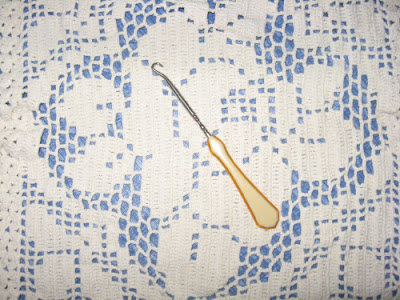
The Buttonhook of Rebecca Catherine (SNOOK) WESTABY

[Laura and Carrie] dressed carefully in their woolen winter dresses and nervously combed their hair and braided it. They tied on their Sunday hair-ribbons. With the steel buttonhook they buttoned their shoes.

"Hurry up, girls!" Ma called. "It's past eight o'clock."

At that moment, Carrie nervously jerked one of her shoe-buttons off. It fell and rolled and vanished down a crack of the floor.

"Oh, it's gone!" Carrie gasped. She was desperate. She could not go where strangers would see that gap in the row of black buttons that buttoned up her shoe.

"We must take a button off one of Mary's shoes," Laura said.

But Ma had heard the button fall, downstairs. She found it and sewed it on again, and buttoned the shoe for Carrie.

At last they were ready. "You look very nice," Ma said, smiling. [1]

When I was a girl, my favorite books were the Little House books by Laura Ingalls Wilder. Living on a small farm in rural Alaska with no electricity or running water, I could relate very well to her experiences. One of the things I also enjoyed doing was perusing a reproduction of an early twentieth-century Sears, Roebucks, and Co. mail-order catalog, that had pages and pages of button-up shoes. Now outside of museums, I have never seen button-up shoes, but my husband and I were blessed a few years ago to receive a button hook that had belonged to his great-great-grandmother, Rebecca Catherine (SNOOK) WESTABY, a woman who was alive when he, his brother, and several cousins were born. Unfortunately, to my knowledge no one ever took a five-generation photo for posterity. There were some four-generation photos taken when my father-in-law was a boy, however:


The woman on the far left in this photo is Rebecca at about age 79. Her son and daughter-in-law, granddaughter, and great-grandchildren also appear here.


First, a little history about Rebecca: she was born on 21 August 1865, probably in the Nittany Valley of Centre County, Pennsylvania to Reuben Wohlford SNOOK and Mary Ann WALKER. She was the middle of about half a dozen children, and her mother died when she was five years old. Reuben remarried to Elizabeth NEARHOOD and they had nine more children.

According to my father-in-law, the family came out west to California by covered wagon, and Rebecca walked behind the wagons much of the way. I have not found evidence that they ever made it to California. Perhaps they did, or perhaps they changed their mind along the trail. At any rate, they ended up in Forsyth, Custer (now Rosebud) County, Montana at least by the late 1880s. There Rebecca met and married George Rice WESTABY, II, always called "Rice," around 1888. They had seven children: Clarice Orvilla, a little girl born in 1889 who died in infancy; my husband's great-grandfather, George Rice, III; Guy Steven; Izma Ann (the only surviving daughter); Charles Wilson, Reuben Wohlford; and Lynn Walker WESTABY. What I like about Rebecca and Rice is that they named their children with family names. Many were named for relatives, and WILSON, Wohlford (from WOHLFART[H]), and WALKER were all ancestral surnames.

By 1920, Rebecca and Rice were separated, the older children all living on their own or with their spouses, while Reuben and Lynn lived with Rebecca and Rice in their homes, respectively. I've never heard what the cause of separation was, nor have looked for a divorce record for the couple. The family story passed down was that Rice married twice more before his death in 1927. Records from Rosebud County have not been filmed by the Family History Library; they are also archived in various locations, and both time and money must be invested to obtain the records I need to flesh out this family a little more. I do know that Rebecca's father and step-mother, as well as some of her siblings, are buried in the Forsyth Cemetery. Rice died in Forsyth as well, but his body was sent back to Illinois to be buried with Westaby family members in Thompson Cemetery, Jo Daviess County.

Rebecca, meanwhile, moved on. It is said that she lived in Sheridan, Wyoming for a while, but the next time I find her is in the 1930 U.S. Federal Census in Salem, Marion County, Oregon, working in a cannery. She would have been 64 years old at this time. Why she came to Salem is somewhat vague to me; her youngest son Lynn may have lived there, but he died while swimming in either Tillamook Bay or the Columbia River in 1923 (again, oral history unverified). He had an artificial leg, which may have accounted for his inability to survive whatever caused his drowning. According to family history, his body was never recovered. At any rate, Rebecca lived alone during her senior years. Her children were scattered from New Jersey to Montana and Idaho to the Yakima Valley of Washington State. According to her obituary, she made quilts all the way up until four years before her death, caused by a stroke and fall in her bathroom.


Now about that buttonhook: there is a wonderful website for The Buttonhook Society where I found information about this handy tool. It seems that buttonhooks were used for more than buttoning shoes, as buttons on gloves, the back of shirtwaists, boots, and many other articles of clothing were popular during the 1880s - 1910s. In fact, buttonhooks were still produced in the 1920s and 1930s. How were they used? The tip of the hook would be threaded through the buttonhole from the outside of the shoe or clothing. Then the button would be grasped with the hook and carefully pulled through the buttonhole. Obviously, pulling too hard on the hook could result in the button flying off, as the example from The Long Winter, above, tells us. Rebecca's buttonhook has no manufacturer's mark, and the handle is a resinous material that appears to be an early plastic, indicating that this is a newer model. So I doubt this hook has much monetary value, but its worth as a family memento is priceless!

[1] Laura Ingalls Wilder, The Long Winter (1940; reprint, New York: Harper & Row Publishers, Inc., 1968), 76.

This post was written for the 2nd Cabinet of Curiosities Carnival hosted by Tim Abbot of Walking the Berkshires. What unusual or unique items from the past do you possess?